by Rev. Mark Creech
RevMarkCreech.org
The contrasting responses of Riley Gaines and Franklin Graham to a recent controversy involving former President Donald Trump offer more than a passing moment of disagreement. They provide a revealing window into a deeper struggle among Christian conservatives in America.
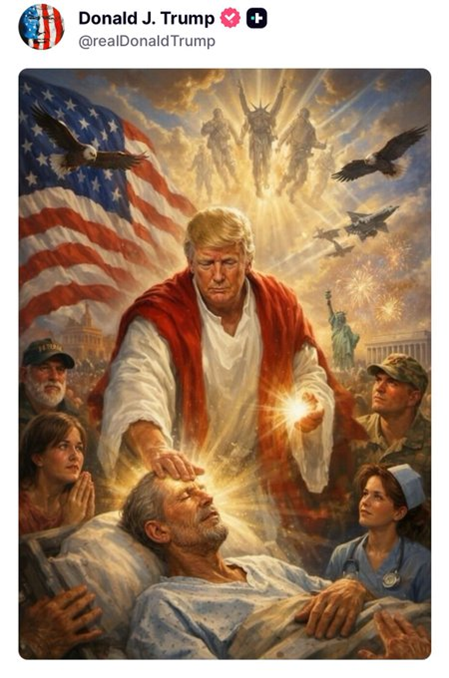
Gaines, a vocal supporter of Trump, did something that has become increasingly rare for Christian conservatives: she criticized him. Responding to a social media post that many found irreverent, she raised concerns rooted explicitly in her faith. Her objection wasn’t political; it was theological. It had to do with reverence, humility, and recognition of Christ’s proper place. Yet, in the same breath, she reaffirmed her support for the president and his political agenda.
Franklin Graham, by contrast, took a markedly different approach. Rather than engaging the substance of the concern, he largely dismissed the controversy as overblown. In his view, it was another example of people making too much out of too little. His response reflected a posture that has become familiar: defend, deflect, and move on. In doing so, the issue itself seemed less important than resisting what he and others perceive as disproportionate outrage or politically motivated criticism.
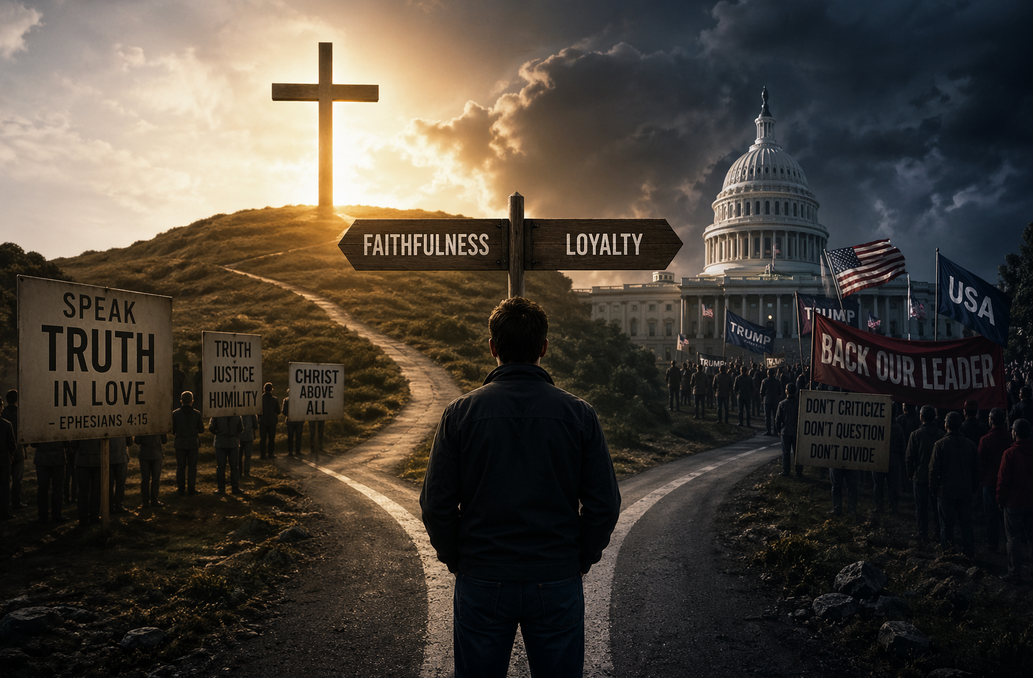
These two reactions, critique within support and protective minimization, are not just differences in tone or temperament. They represent two instincts within Christian conservative engagement with politics. They raise a difficult question that cannot be avoided:
What does faithfulness to Christ require when a leader you support is in the wrong?
That is not merely a political question. It is a biblical one.
The difference between Gaines and Graham, then, is not merely stylistic. It reflects two competing instincts within this movement: one that leans toward moral clarity even when it is uncomfortable, and another that prioritizes loyalty and the preservation of broader political aims.
To be fair, that second instinct does not arise in a vacuum. Many of Trump’s supporters, including Graham, are deeply aware of what they see as persistent, often unfair criticism from the press and political opponents. They believe the president is rarely given credit for his genuine accomplishments and that controversies are frequently amplified beyond their proper proportions. In that context, the impulse to push back and to say, in effect, “this is much ado about nothing,” can feel less like excuse-making and more like a necessary correction.
There is much truth in that concern. Public figures, including presidents, are often judged through partisan lenses, and media coverage is rarely even-handed toward a conservative president. Acknowledging this reality is part of an honest assessment.
But even so, the existence of unfair criticism does not remove the responsibility for fair and honest self-examination. If anything, it heightens it. Because the credibility of Christian testimony depends not on whether others are fair, but on whether believers are.
That leads to a larger issue.
It is a serious and complicated question, because Christian conservatives do not all answer in the same way. Nonetheless, if the aim is to respond in a way consistent with core Christian convictions, several principles ought to guide the conversation.
At the heart of the Christian faith are commitments to biblical authority, personal morality, truthfulness, repentance, and the lordship of Christ over all of life. This includes politics. Taken seriously, these commitments create a certain tension with any political figure, not just one.
So, what might a faithful response look like?
First, truth and integrity must matter, even in the leaders we support. Scripture does not carve out exceptions for political allies. It consistently condemns deceit, slander, and corrupt speech. If Christians excuse or minimize such behavior because it comes from someone who advances policies they favor, they risk undermining their own witness. A commitment to truth that only applies selectively is not a faithful commitment to truth.
Second, character is not irrelevant. While there is ongoing debate about how much personal morality should weigh in evaluating political leaders, historic Christian teaching places a high value on virtues like humility, self-control, faithfulness, and justice. When those qualities are absent, or when conduct appears to contradict them, it is not unreasonable to say so.
Third, there is a real danger of political idolatry. One of the recurring concerns within Christian conservative circles is the temptation to tie the credibility of the faith too closely to the fortunes of a particular leader or movement. Political figures are not saviors. There is only one Messiah. When loyalty begins to silence our obedience to God and clear moral judgment, something deeper has gone awry.
Fourth, faithfulness includes a willingness to speak truth to power. The biblical witness is filled with examples of prophets confronting kings. They did not do so out of disloyalty to the king, but out of their love for the truth. Silence in the face of wrongdoing has never been the standard of righteousness.
Fifth, Christians must grapple honestly with the tension between moral concerns and policy priorities. Many support political leaders because of deeply held convictions about issues like abortion, religious liberty, or the courts. Those concerns are real, urgent, and heavy in consequence. But the question they raise is this: At what point does overlooking harmful behavior begin to erode the very moral witness one is trying to preserve? There is no easy formula here, but there is a need for honest, consistent reflection.
Finally, repentance and grace must be applied consistently. Christianity teaches both accountability and forgiveness. But grace is not indifference, and forgiveness should not diminish the importance of accountability. A faithful response holds wrongdoing and the possibility of redemption in proper tension, without collapsing one into the other.
In the end, the credibility of the Christian witness does not rise or fall on the success of any political leader. It rises or falls on whether believers are seen to believe what they say they believe – consistently, publicly, and without favoritism.
A response “true to the faith” will not always be politically convenient. Oh no, it may, at times, look like Riley Gaines – supportive, yet willing to say, “This is wrong.” It may even go further than that. It may risk the wrath of political leaders and their most devoted supporters.
But it cannot look like silence.
And it cannot look like excuse-making.
That’s not faithfulness to Christ.
At the same time, Christians should not imagine that even perfect consistency will win the world’s approval. There should be no illusions, it won’t! Jesus warned that His followers would be misunderstood, opposed, and hated, not so much because of their failures, but because of their association with Him. The goal, then, is not to secure the world’s applause, but to be faithful to the One who loved us and shed His own blood to redeem us. His faithfulness to us, unlike our own to Him, has never failed.
Our faithfulness is never flawless. The Christian message has never been that believers have it all together. It is that they don’t! It is that they are sinners saved by grace, often struggling, sometimes stumbling, sometimes even grossly sinning, and yet called again and again by the Master to repentance and renewal. The task is not perfection, but the never-ending pursuit for integrity: a sincere, ongoing effort to bring every part of life, including political engagement, under the lordship of Christ.
So, we strive. We strive not simply to appear righteous, but because we belong to the One who is. Even when we fall short, we do not abandon the effort, because fidelity to Christ, however imperfect, is still the calling.
When loyalty and conviction collide, what Christian conservatives choose in that moment will reveal far more than any statement of their beliefs ever could.