by Dr. Mark Creech
Director of Government Relations
Return America
The North Carolina General Assembly’s Short Session is now fully underway. Bills from the previous 2025 Session that remained eligible because they passed one chamber are now being heard in the second chamber, while dozens of new measures are also being filed. Below is a report on what happened in the Senate Education/Higher Education Committee when a critical bill addressing the negative impact of social media on minors was taken up, passed, and sent to the Senate Judiciary Committee for another hearing. The additional bills listed are measures Return America will continue to monitor as the session moves forward. We should be especially concerned about any effort to privatize spirituous liquor in North Carolina. Such a move would be a serious mistake, undermining sound alcohol policy that minimizes harms and preserves public health and safety.
A Needed Step to Protect Children from the Harms of Social Media
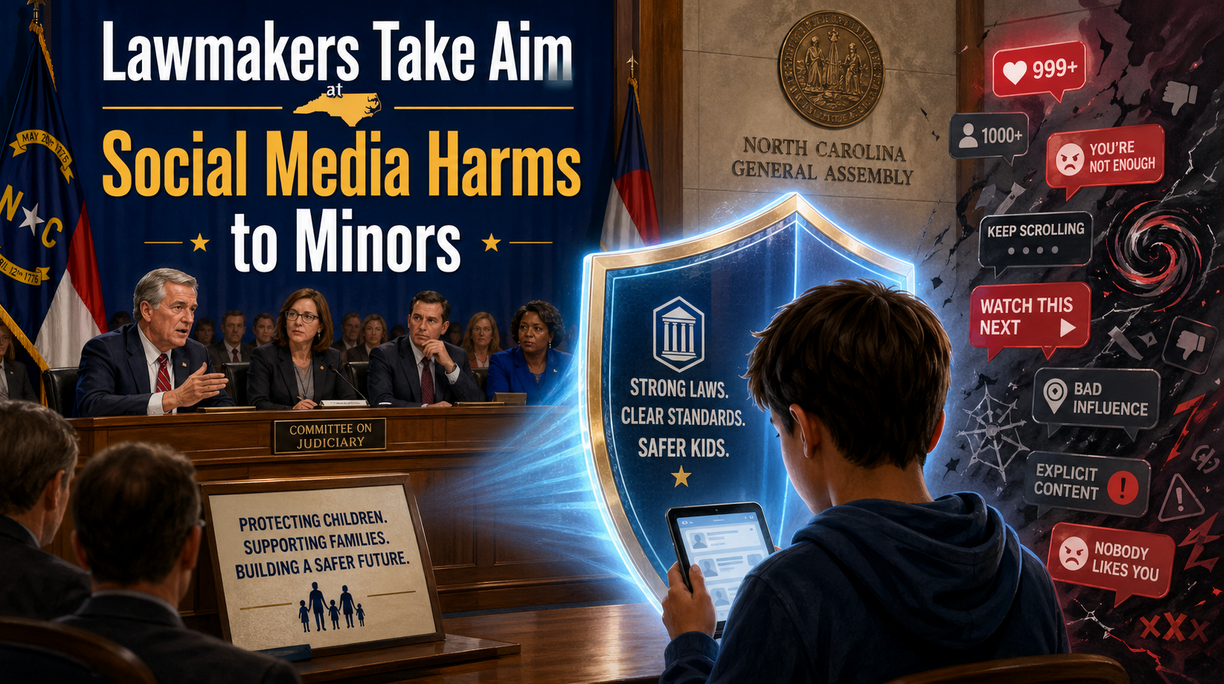
On Wednesday, April 29, the Senate Education/Higher Education Committee took up House Bill 301 – Social Media Protections for Minors, a measure designed to help parents and protect children from the growing dangers associated with social media use.
Return America was present for the committee hearing.
House Bill 301 is a serious and much-needed effort to address one of the most pressing concerns facing families today: children and teenagers’ exposure to online predators, addictive platforms, harmful content, and mental health risks tied to social media. The bill would prohibit children under 14 from accessing social media platforms and downloading social media apps. It would also require parental consent for minors ages 14 through 16. In addition, the measure requires app providers to verify a user’s age and delete any data collected if the user is determined to be underage. The bill gives the Justice Department authority to enforce the law with civil penalties of up to $50,000 per violation and allows minors to bring civil actions for damages of up to $10,000.
One of the most notable developments during the hearing was Meta’s support, the parent company of Facebook and Instagram. Meta worked with lawmakers on the bill and expressed support for its approach, particularly the use of app-store-level age verification. Whitney Campbell Christensen, an attorney for Meta, testified that placing age verification at the app store level is the most effective way to prevent children from bypassing restrictions by moving to lesser-known apps or platforms. This cooperation from a major technology company is significant and demonstrates that the dangers posed to children online are not imaginary or exaggerated but widely recognized.
The committee’s discussion also addressed legal and constitutional questions, particularly potential First Amendment challenges. Similar laws in other states have faced litigation, but committee staff noted that Florida’s law has received preliminary approval in the 11th Circuit. The Supreme Court’s decision in Free Speech Coalition, Inc., et al. v. Ken Paxton, which affirmed age-verification requirements for pornography, was also cited as a positive sign for laws designed to protect minors online. While no law is immune to legal challenge, the state has both a right and a responsibility to act when children’s safety and well-being are at stake.
Some lawmakers raised practical questions about enforcement, including whether minors could bypass age verification by using an older sibling’s birthdate or other false information. The bill’s sponsor acknowledged that no system will be foolproof but rightly emphasized that the measure would still significantly reduce access and create stronger expectations for accountability. Public policy need not solve every problem perfectly to make a meaningful difference.
The committee also adopted an amendment from Senator Dana Jones (R-Forsyth) addressing artificial intelligence in K–12 education. The amendment establishes safeguards and training for AI use in schools, including age-appropriate AI literacy in computer science standards by the 2028–2029 school year, teacher and administrator training through the Friday Institute by June 30, 2028, a statewide district AI policy developed by DPI, and an evaluation framework for safe, curriculum-aligned AI tools. DPI has been consulted, and the timeline was deemed realistic. The amendment passed unanimously.
At the conclusion of the hearing, the committee voted to approve House Bill 301 as amended. The bill was subsequently referred to the Judiciary Committee.
House Bill 301 is a timely and prudent measure. It recognizes that children are uniquely vulnerable and that parents need meaningful support to protect them from the dangers of social media. In an age when technology companies have often moved faster than families, schools, and lawmakers can respond, this bill is a responsible effort to restore guardrails, strengthen parental authority, and place the safety of minors ahead of the profits and convenience of digital platforms.
*******
Key Measures Return America is Monitoring
SB 938 – Privatize Spirituous Liquor
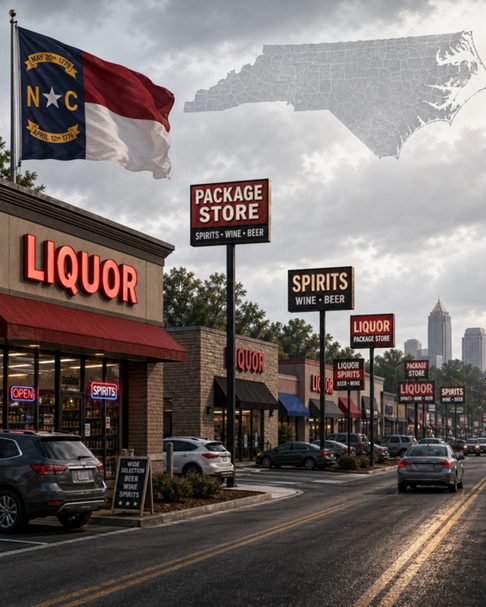
This bill would begin dismantling North Carolina’s current state and local ABC system and transition sales of spirituous liquor to privately owned package stores. It would require local ABC boards to cease operating ABC stores between July 1, 2028, and July 1, 2029; sell ABC store property, fixtures, and inventory to qualified bidders; and eventually end operations at the State ABC warehouse. It would replace ABC store elections with elections on off-premises spirituous liquor sales, create a new private package-store structure, authorize liquor wholesaler permits, and revise numerous ABC laws to reflect the shift from public control to private retail sales. The measure would also raise the liquor excise tax from 30% to 60% and direct portions of revenue to local governments, alcohol/substance abuse research or education, ABC Commission costs, and public education. Most of the act would take effect on July 1, 2027.
*Note on Privatization of Spirituous Liquor: Privatizing spirituous liquor in North Carolina would be an egregious error in responsible alcohol policy, the kind that minimizes harms and preserves public health and safety. North Carolina’s ABC system rightly emphasizes control over profit and limits outlet density, sales hours, advertising, and price-cutting pressures that drive liquor consumption and alcohol-related harms. The current system also preserves uniform pricing, local accountability, and significant recurring revenues for state and local governments, law enforcement, alcohol education, rehabilitation, and human services – funds that privatization would place at risk for uncertain short-term gains. Because alcohol is no ordinary commodity, public policy should restrain its promotion and availability, not turn spirituous liquor sales over to private retailers whose natural incentive is to sell more. Return America will diligently monitor this bill.
SB 937 – Marijuana and Vapor Products Reform
This legislation would make sweeping changes to North Carolina law governing marijuana, hemp-derived THC products, vaping, and enforcement. It would decriminalize possession of five grams or less of marijuana, tighten the legal definition of hemp to exclude many intoxicating or synthetic THC/cannabinoid products, and increase penalties for manufacturing, selling, or trafficking marijuana. The bill would also raise the purchase age for tobacco, vapor, and consumable products to 21, make certain vapor-product sales to minors a felony, require stronger age verification for online sales, increase the vapor-product excise tax from 5¢ to 10¢ per milliliter, increase the unauthorized-substance tax on marijuana, expand Alcohol Law Enforcement’s jurisdiction, and appropriate funds for ALE evidence storage, disposal, and staffing.
HB 1121 – Added Fee for Sexually Oriented Businesses
House Bill 1121 would impose a $10 fee for each customer entry at sexually oriented businesses in North Carolina that also hold an alcohol permit. The bill frames the fee as a way to address “adverse secondary impacts” associated with businesses that combine nudity and alcohol, and it states that the charge is not aimed at expressive content. Businesses would remit the fee quarterly to the Department of Revenue, maintain daily customer-count records without collecting customer names or personal information, and allow audits. The funds would go into the Sexual Assault and Rape Crisis Center Fund for use by the North Carolina Council for Women, which would be required to report annually on fees collected and disbursed. The bill would take effect on October 1, 2026.
HB 1091 – DWI Modernization Act of 2026
This measure would update North Carolina’s impaired-driving laws by changing how DWI-related cases are processed and enforced. It would require magistrates to provide written explanations when they find no probable cause in implied-consent cases; raise certain license restoration fees; streamline immediate civil license revocations; allow alcohol and oral-fluid drug screening results to be used in probable-cause determinations; impose stricter alcohol-related standards on transportation network company drivers; create a path for some repeat offenders to regain limited driving privileges by demonstrating sobriety; and make it a felony for an adult to help an underage person obtain alcohol if that underage person causes serious injury. Many of the bill’s key provisions would take effect on December 1, 2026.
Return America will continue to watch these measures closely and advocate for policies that protect families, strengthen communities, and uphold the public good.