

by Rev. Mark Creech
RevMarkCreech.org
When tragedy strikes, such as an assassination attempt, our first instinct is to look outward and ask, What kind of person would do such a thing? We may even be tempted to say that only the worst of sinners could ever stoop so low.
In Christ’s day, people often thought in similar terms. When a tower in Siloam collapsed, killing eighteen people, many assumed the victims must have been worse sinners than others. Surely, they reasoned, such a dreadful end must have been proof of greater guilt.
But Jesus refused to let them draw that conclusion. He said,
“Or those eighteen, upon whom the tower in Siloam fell, and slew them, think ye that they were sinners above all men that dwelt in Jerusalem? I tell you, Nay: but, except ye repent, ye shall all likewise perish” (Luke 13:4–5).
Here, Jesus turned the mirror back on everyone. He was saying, in effect: You think those people had to be worse sinners than you. No. The real issue is not merely the tragedy that overtook them, but the judgment that awaits all who refuse to repent.
In other words, Jesus would not allow His hearers to stand at a safe distance from calamity and analyze only the sins of others. He pressed the matter home to their hearts. They were not to look upon the fallen tower and say, What did they do to deserve that? They were to ask, Am I ready to meet God? Have I repented?
The fallen tower was not merely a story about eighteen dead men. It was a sermon for the living.
In much the same way, as we reflect on the most recent attempted assassination of Donald Trump, there is a natural tendency to focus entirely on the man who carried it out. Whatever his background, intelligence, education, or opportunities, in a single act he chose a path of violence, rebellion, and ruin. He acted against the sanctity of human life, lawful authority, and the peace of civil society.
It is a tragic and sobering reminder of what the human heart is capable of when it turns away from what is true and right.
Let me be absolutely clear: I am not comparing any political figure, including President Trump, to Jesus Christ. Christ is the Son of God and the Savior of the world.
“For there is one God, and one mediator between God and men, the man Christ Jesus” (1 Timothy 2:5).
No earthly leader belongs to that category.
Yet, while the individuals are not comparable, the principle is instructive.
In that awful moment, the would-be assassin rejected what was lawful, good, and just. He defied authority and violated the inherent dignity of every person. In doing so, he embraced a course that will carry consequences for the rest of his life.
But Jesus’ words in Luke 13 push us beyond the headlines and into our hearts.
The greater danger is not merely the visible act of one man’s rebellion, but the quieter, more common rejection that occurs every day: the rejection of God’s grace in Jesus Christ.
The Gospel is not merely a message to consider; it is God’s offer of abundant life now, forgiveness, reconciliation, and eternal life in Christ. To neglect it is not a neutral decision. To reject it is to despise God’s grace and mercy. It is to clench one’s fist before the universe’s exceedingly benevolent Sovereign and cast away the only hope of salvation. Scripture poses the terrifying question:
“How shall we escape, if we neglect so great salvation…” (Hebrews 2:3).
Again, Hebrews warns of the one who has “trodden under foot the Son of God” (Hebrews 10:29).
To reject Christ is not merely to decline religion. It is to trample underfoot the very mercy by which sinners may be saved. It is to treat what is holy as if it were nothing. Since all sin is ultimately against God, unbelief is not a harmless omission but rebellion against the One who created us for Himself.
When asked about the possibility of assassination, President John F. Kennedy once remarked,
“If anyone wants to do it, no amount of protection is enough. All a man needs is a willingness to trade his life for mine.”
That is the awful calculus of assassination: a man may be so blinded by hatred, pride, or delusion that he is willing to sacrifice his own life to attack another.
What makes this such a fitting warning is not only the violence of the act but also the ruinous exchange behind it. The person who commits such violence may imagine he is accomplishing something meaningful, perhaps even justified in his own mind. But instead of gain, he ultimately finds only loss.
So it is with the soul that rejects Christ.
“For what shall it profit a man, if he shall gain the whole world, and lose his own soul?” (Mark 8:36).
To turn away from Christ may feel like independence or freedom, but in truth it is exchanging eternal life for something temporal, passing, and empty.
And this is where Jesus’ warning in Luke 13 becomes deeply personal.
“Except ye repent…”
Those words are not directed only at the worst among us. They are directed at each of us. They strip away comparisons and silence excuses. They remind us that the line between righteousness and ruin does not run between “good people” and “bad people,” but through every human heart. For “all have sinned, and come short of the glory of God” (Romans 3:23).
However, the message of Scripture does not end with a warning. It offers a personal invitation.
“Let the wicked forsake his way, and the unrighteous man his thoughts: and let him return unto the Lord, and he will have mercy upon him…” (Isaiah 55:7).
That is the difference the Gospel makes.
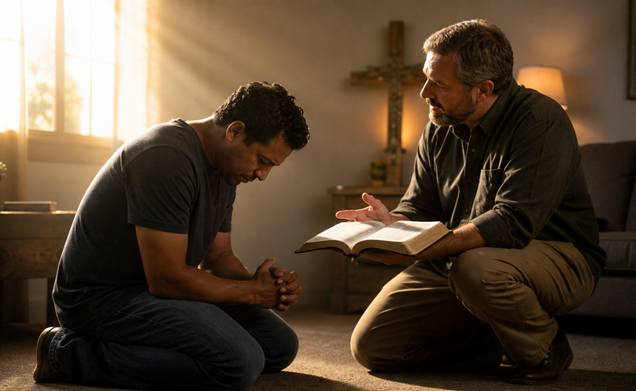
Some earthly decisions carry consequences that cannot be undone. A single act may forever alter the course of a life. A violent crime may warrant severe and lasting punishment under the law. Yet no one who turns to Christ in repentance and faith is beyond the reach of God’s loving kindness. The Bible says He will save to the uttermost (Hebrews 7:25).
So, when we look upon tragedy – whether it is a fallen tower or a shocking act of violence – the questions we should ask are not simply, What happened to that person? How could someone be so foolish, reckless, or wicked?
We should ask, What will I do with the truth God has shown me? What will I do with God’s offer of mercy in Christ? We should understand that nothing is worse in God’s judgment than turning away from Him – nothing! And there is no consequence more dreadful than the loss of one’s soul.
Nothing said here should diminish the horror of the attempted assassination. It is a grievous sin, a violent crime, and an assault on the God-given value of human life and on civil order. It deserves the full weight of lawful justice.
But Jesus teaches us that public tragedy ought also to become a private summons. The worst tragedy is not only losing one’s freedom, reputation, or even one’s life. The greatest tragedy is being lost for eternity.
Therefore, repent. Turn from sin. Turn to Christ. Trust the One who died for sinners and rose again. For there is no greater tragedy than rejecting the grace of God — and no greater hope than receiving it.