Hope Born in Uncertainty
Rev. Mark Creech
RevMarkCreech.org
Mother’s Day is a time to honor the women whose love, sacrifice, prayers, and quiet endurance shape the world in ways they may never fully see. Scripture says, “Her children arise up, and call her blessed; her husband also, and he praiseth her” (Proverbs 31:28). Yet sometimes a mother’s influence extends beyond her household and becomes part of a people’s memory.
North Carolina has such a mother in Eleanor Dare, and such a child in Virginia Dare.
Virginia Dare was born on August 18, 1587, on Roanoke Island, now part of North Carolina. She was the daughter of Ananias Dare and Eleanor White Dare and the granddaughter of John White, the governor of the Roanoke Colony. She is remembered as the first English child born in America. Just one week after her birth, she was baptized.
That is nearly all we know for certain. The rest is a mystery.
Virginia Dare was born into a fragile colony, far from home and surrounded by hardship, danger, and an uncertain future. Her mother, Eleanor, had crossed the Atlantic while pregnant. She gave birth not in comfort but in the wilderness of a new, precarious settlement. Soon afterward, John White returned to England for supplies. When he finally returned three years later, the colonists were gone. Virginia Dare, her parents, and the rest of the Roanoke settlers had vanished into what history now calls the Lost Colony.
It is a haunting story, but for Mother’s Day, it is also deeply moving.
The birth of Virginia Dare was an act of hope. In a place marked by uncertainty, Eleanor Dare brought forth a child. She could not know what would become of her daughter. She could not know whether the colony would flourish or fail. She could not know that Virginia’s name would still be remembered more than four centuries later in Dare County, in North Carolina history, and in literature, drama, and public memory.
But that is the nature of motherhood. No mother can see the whole road ahead. She does not know every sorrow her child may face, every danger the future may hold, or every purpose God may yet unfold. Motherhood is always an act of faith.
The Bible says, “Lo, children are an heritage of the LORD: and the fruit of the womb is his reward” (Psalm 127:3). That truth does not depend on ease, wealth, perfect circumstances, or worldly security. Children are not burdens to be avoided until everything in life is orderly or convenient. They are gifts to be received with reverence.
That message is desperately needed in our own day. The numbers tell part of the story. The CDC reported that U.S. births fell to 3,591,328 in 2023, down 2 percent from the previous year, as the fertility rate reached another historic low. Pew Research Center found that among adults under 50 without children, the share who say they are unlikely ever to have children rose from 37 percent in 2018 to 47 percent in 2023. Even more revealing, Pew found that 71 percent of Americans say having a job or career they enjoy is extremely or very important to a fulfilling life, while only 26 percent say the same about having children and 23 percent about being married.
These figures should be handled with compassion. Some women long for children and cannot have them. Some have suffered loss. Some have never married. Some are pouring themselves into service, ministry, caregiving, or the lives of children not their own. Scripture honors spiritual fruitfulness as well as natural motherhood.
Still, the cultural trend is clear and alarming. Much of modern culture has taught women to seek fulfillment in careers, self-expression, recognition, independence, and personal achievement. None of these things is inherently wrong. But when children are viewed as obstacles to fulfillment, we have forgotten something holy – something necessary for human flourishing.
Eleanor Dare reminds us that motherhood does not wait for perfect conditions. She bore life amid uncertainty. She gave birth in the wilderness. She could not control the future, but she participated in it. Her daughter’s life remains mostly hidden from us, but her birth became part of the story of North Carolina and America.
The apostle Paul wrote of Timothy’s faith, “the unfeigned faith that is in thee, which dwelt first in thy grandmother Lois, and thy mother Eunice” (2 Timothy 1:5). That is the quiet yet profound power of mothers. They shape lives before the world notices. They plant faith before history records the outcomes. They give themselves in love, trusting God with what they cannot see.
There is much we do not know about Virginia Dare. We do not know how long she lived. We do not know what trials her mother faced. We do not know the final chapter of the Lost Colony. But of one thing we may be certain: God was there.
This is the one full and unquestionable assurance any woman can have when bearing a child: God is there—with her and with her child.
God was there on Roanoke Island when Eleanor Dare brought her daughter into the world. He was there amid danger, isolation, fear, and mystery. The same God who sees the sparrow fall and numbers the hairs on our heads did not lose sight of that mother or that child. Scripture says, “Whither shall I go from thy spirit? or whither shall I flee from thy presence?” (Psalm 139:7). The answer is nowhere. No wilderness is too remote, no colony too forgotten, no mother too hidden, and no child too small for the presence of God.
That is a word of encouragement for every mother. You may not know what the future holds for your child. You may not be able to shield your child from every sorrow or guide them through every uncertainty. But you are not alone, and neither is your child. The God who was present in Bethlehem, on Roanoke Island, and at the Cross is still present. “God is our refuge and strength, a very present help in trouble” (Psalm 46:1).
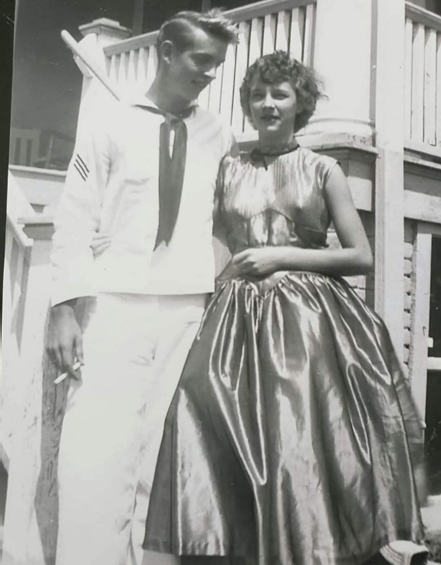
My parents were very young when their romance began. My father was only nineteen, and my mother was just fifteen. Both had come from troubled homes and longed for something better than what they had known. So they ran away to Dillon, South Carolina, where a minor could marry. They married there, and by God’s grace, they built that better life – one they shared for fifty-six years.
Two years after they married, while my father served in the United States Coast Guard, I was born. My mother, only seventeen at the time, later told me that my father was away at sea when she brought me home from the Naval Hospital in Cape May, New Jersey. She was alone in base housing, without her mother, without my father’s family, and without anyone nearby to guide or help her. She knew almost nothing about caring for a newborn.
She said she carried me into the house, sat in a chair, and began to sob, repeating through her tears, “What do I do? What do I do?” Everything before her seemed uncertain, intimidating, and frightening.
But God was with her, and God was with me.
That is the truth every mother needs to know. Motherhood often begins and continues amid circumstances no woman feels fully prepared to face. Yet uncertainty is not the same as abandonment. No room is too lonely, no burden too heavy, no mother too young, and no child too small for God’s care and presence.
On this Mother’s Day, Virginia Dare’s story reminds us that every birth is more than a biological event. It is a declaration of hope. It says the future is worth entering. It says life is worth receiving. It says God may be doing more through a mother and child than anyone can imagine.
Eleanor Dare did not know her daughter’s name would endure for centuries. My mother did not know what God would make of the sobbing young woman in Cape May or of the baby she held. No mother can know the whole story at the beginning. She can only know that the child she has been given is a tremendous gift.
And sometimes that is how God writes history: through a mother, a child, and hope born of uncertainty.
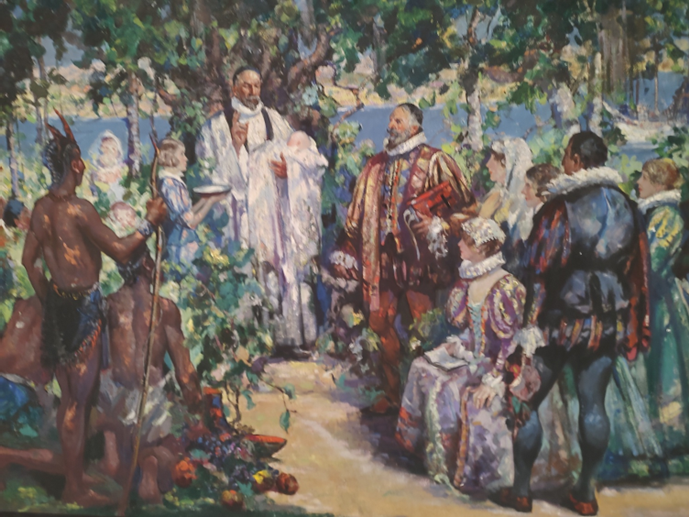
Picture above: The image at the top of this article is William Steene’s historical painting, The Baptism of Virginia Dare. Completed in 1929 and unveiled in Raleigh around early 1930, the painting now hangs on the outside wall of the chapel in the North Carolina Legislative Building.
It is a fitting location. There, between the chambers where laws are debated and public power is exercised, the image quietly reminds all who pass by that North Carolina’s story began not only with exploration and settlement but also with a mother, a child, and an act of faith.