
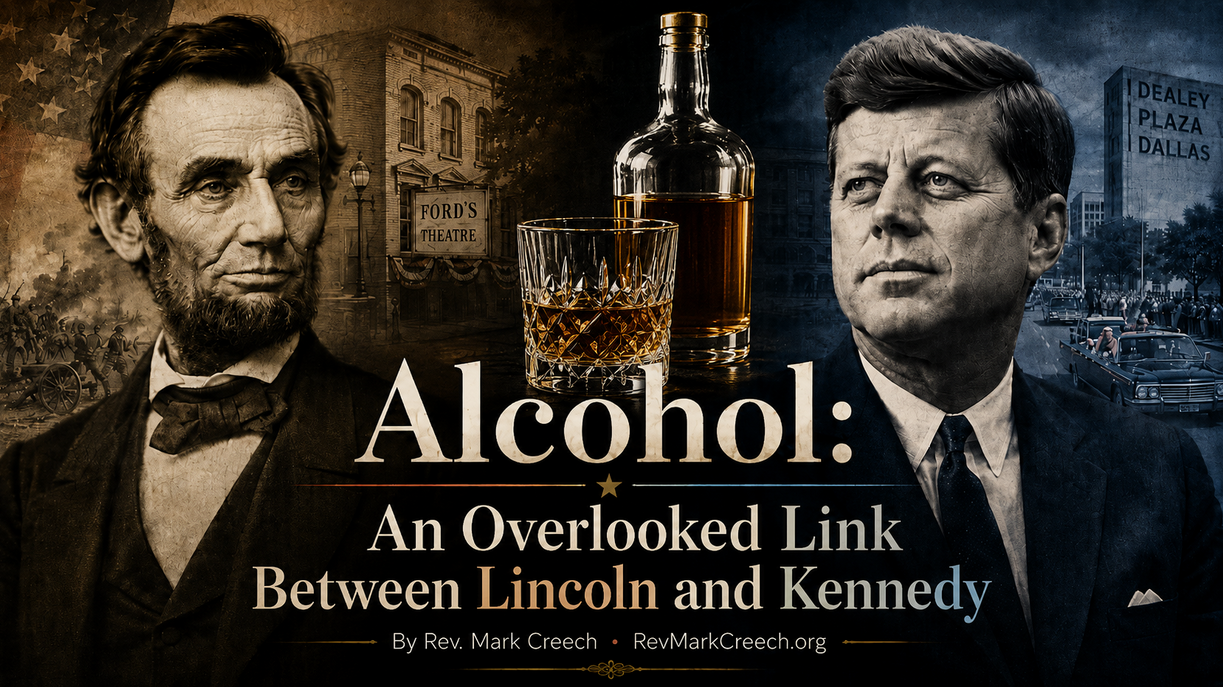
by Rev. Mark Creech
RevMarkCreech.org
Americans have long been fascinated by the striking similarities between the assassinations of Presidents Abraham Lincoln and John F. Kennedy.
Lincoln was elected to Congress in 1846; Kennedy in 1946. Lincoln was elected president in 1860; Kennedy in 1960. Both were assassinated on a Friday. Both were shot in the head while their wives were present. Both were succeeded by Southern Democrats named Johnson. Andrew Johnson was born in 1808; Lyndon B. Johnson in 1908. Lincoln was shot in a theater, and his assassin fled to a barn. Kennedy was shot from a warehouse, and his alleged assassin fled to a theater. Even the names of their assassins — John Wilkes Booth and Lee Harvey Oswald — continue to echo through American history like dark, haunting refrains.
Some of these parallels are exaggerated by popular folklore. Others are genuinely astonishing. Together, they have fueled decades of fascination, inspiring books, documentaries, and speculation.
But there is another connection between these two national tragedies that is seldom mentioned — an unsettling similarity that reveals something important about human weakness and cultural blindness.
Alcohol lingered in the shadows of both assassinations.
That statement should not be overstated. No serious historian argues that alcohol alone caused either president’s death. History’s great tragedies are rarely that simplistic. Yet alcohol’s role in both stories is difficult to ignore.
John Wilkes Booth, Lincoln’s assassin, lived in a culture saturated with taverns, nightlife, and drinking. Saloons served as gathering places for conspirators, sympathizers, and actors during the Civil War’s turbulent final days. Booth himself was known to drink, and shortly before entering Ford’s Theatre on April 14, 1865, he reportedly stopped at Taltavull’s Star Saloon next door, where he had whiskey and water. After the assassination, taverns and inns also became part of his escape route, including the Surratt Tavern in Maryland, where weapons and supplies had been hidden.
With Kennedy’s assassination, the matter is even more troubling. Members of the Secret Service detail assigned to protect the president reportedly spent the night before the Dallas motorcade drinking and socializing into the early morning hours. Later investigations and historical accounts confirmed that agents had been out at bars and nightclubs before the assassination. No official inquiry concluded that drunkenness caused Kennedy’s death, but many critics argued that fatigue, diminished alertness, and lax discipline may have contributed to a weakened security posture.
Again, alcohol was not “the cause.” But in both tragedies, it appeared as part of a broader climate of compromised vigilance and diminished restraint.
That should not surprise us.
Modern culture often frames the debate over alcohol narrowly, as though the Bible merely condemns drunkenness and treats alcoholic beverages as morally neutral. Yet Scripture’s warnings are far stronger and more searching than that.
The Bible frequently portrays intoxicating drink itself as deceptive, dangerous, and judgment-clouding.
“Wine is a mocker, strong drink is raging: and whosoever is deceived thereby is not wise” (Proverbs 20:1).
Notice carefully: the passage does not merely say that drunkenness is a mocker. Alcoholic wine in itself is personified as problematic.
Likewise, Proverbs warns:
“Look not thou upon the wine when it is red, when it giveth his colour in the cup, when it moveth itself aright” (Proverbs 23:31).
That warning goes far beyond a prohibition against excess. The admonition is not merely against intoxication, but against even being captivated by intoxicating wine in its alluring state. Why?
Because “at the last it biteth like a serpent, and stingeth like an adder” (v. 32).
Scripture also warns rulers and leaders, especially, against alcohol’s influence:
“It is not for kings, O Lemuel, it is not for kings to drink wine; nor for princes strong drink: lest they drink, and forget the law, and pervert the judgment” (Proverbs 31:4-5).
How striking that warning appears when considered alongside reports that Secret Service agents were drinking the night before Kennedy’s assassination. The issue was not merely whether someone became visibly drunk. The deeper issue was diminished vigilance and impaired judgment.
The Bible repeatedly links strong drink to violence, carelessness, poverty, immorality, injustice, and moral confusion. That is why generations of Christians once regarded abstinence not as legalism but as wisdom.
Interestingly, even as modern entertainment and advertising continue to glamorize alcohol, recent statistics suggest Americans may be growing more suspicious of it. Alcohol consumption in the United States has reportedly fallen to some of the lowest levels on record, especially among younger adults. Increasingly, many now associate drinking not with sophistication or freedom but with addiction, anxiety, broken relationships, impaired judgment, and declining health.
That development may be one of the few encouraging cultural trends of our time.
Perhaps experience is proving what Scripture warned about all along. A society cannot remain strong by dulling its moral sense or weakening its self-restraint. Nations, like individuals, require vigilance, sobriety, discipline, and clear judgment.
The strange parallels between Lincoln and Kennedy continue to fascinate Americans because they remind us how fragile a nation can be in moments of crisis. Yet perhaps the lesser-known shadow of alcohol surrounding both tragedies offers another lesson — one not merely about history, but about wisdom, self-control, and the kind of moral seriousness necessary for a people to remain truly free.