How House Bills 921 and 198 Would Normalize Casino Culture in the Name of Charity
Dr. Mark Creech
Director of Government Relations
Return America
Not long ago, North Carolina treated casino gambling as dangerous enough to prohibit. Even now, state law permits “game night” events only as a limited exception. Under current law, a tax-exempt organization may conduct or sponsor only four such events per year. The law also limits how often qualified facilities may host them. These restrictions exist for a reason: lawmakers understood that gambling, even when dressed up as entertainment or fundraising, carries social and moral risks.
House Bill 921 – ABC and Gaming Omnibus Bill and House Bill 198 – ABC Omnibus of 2026 would move North Carolina in the opposite direction. These bills would allow a nonprofit organization or charity to hold up to 24 “game night” events per year — a sixfold increase. They would also allow a qualified facility to host up to 24 game nights per calendar year. What was once treated as an occasional exception would now become a recurring feature of community life.
That is not a minor adjustment. It is a major act of normalization.
The bills also loosen restrictions on 50/50 raffles. They define a 50/50 raffle as one in which ticket-sale proceeds are split evenly between the winner or winners and the nonprofit organization or government entity after the drawing. More troubling, the usual raffle restrictions would not apply to 50/50 raffles conducted by nonprofits or government entities. Those ordinary restrictions include limits on the number of raffles, prize caps, certain proceeds-use requirements, bingo-related restrictions, and rules governing real-property raffles.
In other words, these bills do more than help nonprofits raise money. They substantially expand legal charitable gaming opportunities by raising the annual game-night cap and making 50/50 raffles by nonprofits and government entities far less constrained than ordinary raffles.
Supporters will call this harmless fundraising. They will say it is for churches, veterans’ groups, civic organizations, charities, and worthy community causes. But that is precisely what makes the proposal so dangerous. When gambling is linked to benevolence, it gains moral legitimacy. The public no longer sees gambling for what it is: predatory and socially destructive. Instead, it begins to associate gambling with generosity, civic virtue, fellowship, and helping the needy.
That is how a culture is shaped.
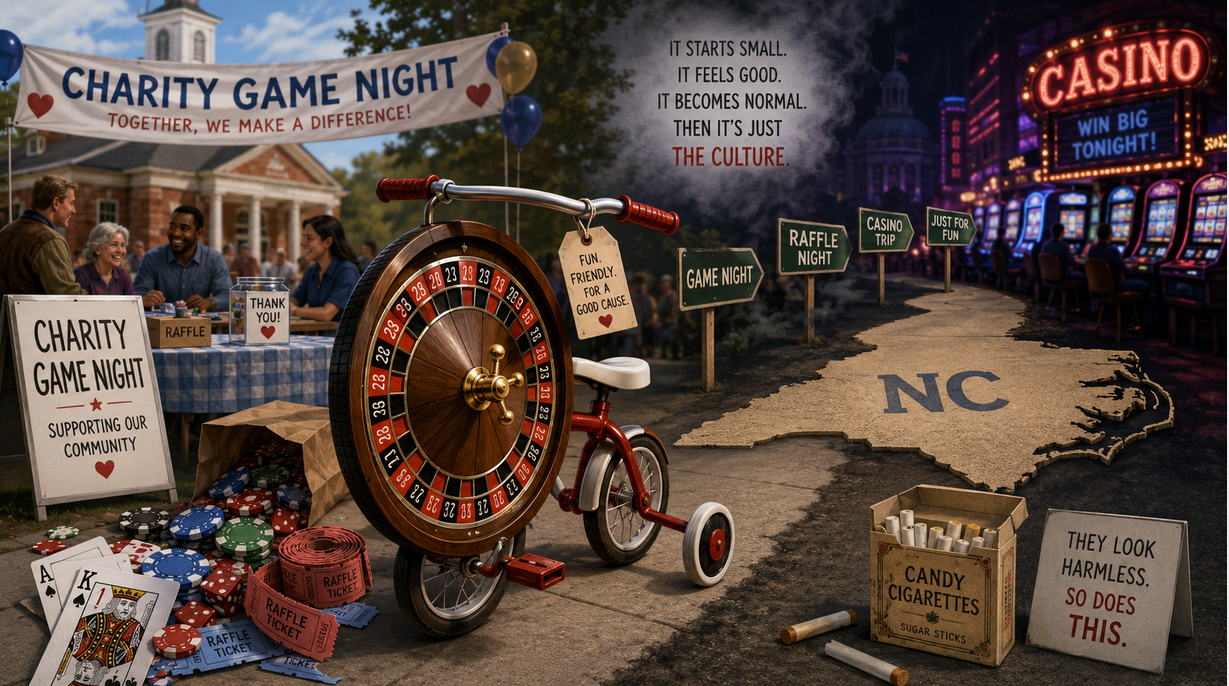
To put it plainly, this is gambling on training wheels.
Years ago, when casino-style “game night” legislation was first debated in North Carolina, the press quoted me as describing these events that way. I also compared them to handing out candy cigarettes to children. The point was not hard to understand then, and it is even more urgent now. Candy cigarettes didn’t make children smokers overnight. But they taught children to mimic smoking, to associate it with play, and to see a dangerous habit as harmless fun.
Casino nights do something similar with gambling.
They acclimate people to casino culture. They remove moral hesitation. They make games of chance seem playful, charitable, and socially respectable. They prepare the public to accept broader gambling expansion later.
That should concern us all.
This is exactly how gambling expansion works.
It doesn’t arrive all at once. It comes incrementally — one so-called “reasonable” exception at a time.
First came the state lottery, sold to the public as a way to support education. Then came repeated efforts to revive or legalize video gambling, often defended as a means to regulate illegal machines, help small businesses, fund education, support HBCUs, or generate revenue for public purposes. Then came casinos, promoted as economic development for rural counties, job creation, and tourism, and as a way to keep North Carolina dollars from crossing the border into Virginia. Then came sports betting, justified by tax revenue for youth sports, collegiate athletics, major events, tourism, gambling-addiction programs, and the General Fund. Now come casino nights for nonprofits, wrapped in the language of charity, community service, veterans’ groups, churches, and civic fundraising.
Every time, the argument is the same: this form of gambling is limited, regulated, harmless, and tied to a worthy cause. But the worthy cause does not cleanse the wager. It only makes the wager more acceptable. Each expansion moves the cultural line a little farther, teaches the public to view gambling as normal, and makes the next expansion easier to justify.
This is the genius of gambling expansion: it rarely presents itself as gambling expansion. It presents itself as help for children, schools, rural counties, small businesses, college athletics, tourism, veterans, nonprofits, and now charity itself. But beneath each noble label lies the same old bargain — the state authorizes more games of chance, more wagering, more losses, and greater public dependence on gambling revenue.
House Bill 921 is not merely about fundraising. It is gambling on training wheels — a carefully sanitized introduction to casino culture wrapped in the language of charity and community service.
North Carolina has already seen the consequences of this drift. Since legalized sports betting began, reports indicate alarming increases in calls about gambling addiction, treatment participation, requests to block gambling apps, and gambling-related distress. The social harms are no longer hypothetical. They are here, and families are already paying the price.
One would think lawmakers would exercise caution in light of these developments. Instead, some appear ready to push gambling deeper into the mainstream by attaching it to charitable causes.
That matters because law is never morally neutral. Law teaches. Government shapes public perception. When the state authorizes casino nights for nonprofits and charitable organizations, it sends a powerful message: gambling is socially acceptable; gambling is harmless recreation; gambling is compatible with good citizenship and community service.
Perhaps most troubling, young people absorb this lesson.
Many children and young adults will encounter gambling for the first time not in some sleazy casino environment, but at well-respected community events connected to organizations they trust. Gambling becomes positively associated with fellowship, fun, civic engagement, and worthy causes. The stigma disappears. The moral caution and the danger fade.
With bills of this nature, what previous generations warned against, this generation now markets as wholesome entertainment.
Don’t be deceived, these are not innocent little parlor games. The legislation involves classic casino-style gambling specifically designed to stimulate risk-taking behavior and repeated wagering. Blackjack, roulette, poker, and craps are not equivalent to bake sales or barbecue fundraisers. They are psychologically engineered games of chance built around the thrill of uncertainty and the pursuit of quick reward.
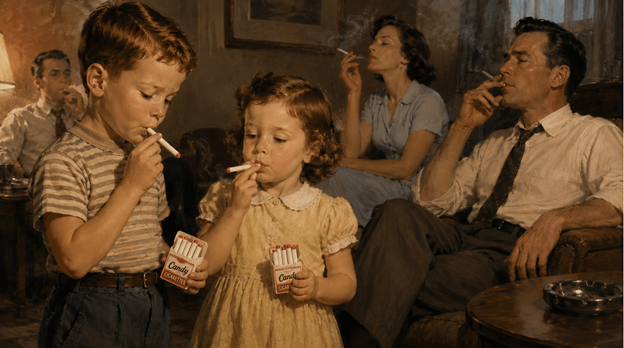
Casino nights are to gambling culture what candy cigarettes once were to smoking culture: an introductory form of social conditioning. They may seem harmless to those who look only at the surface, but the deeper effect is to standardize what ought to remain morally suspect.
There is another danger few are discussing: once nonprofits become financially dependent on gambling revenue, they inevitably become defenders of gambling expansion. Organizations that once opposed gambling start lobbying for larger prize limits, more gaming nights, broader permissions, and fewer restrictions as their budgets become tied to gambling proceeds.
History repeatedly demonstrates this pattern.
Eventually, gambling ceases to be an occasional fundraiser and becomes an institutional dependency.
Who ultimately pays for the normalization of gaming activities?
The poor bear the greatest burden. Gambling revenue disproportionately comes from financially vulnerable households, addicted gamblers, and people desperate for relief from economic hardship. The industry’s profits thrive not on moderation, but on repeated participation and habitual behavior.
There is something profoundly troubling about the state encouraging activities that make its own citizens losers by exploiting their weaknesses.
Churches and Christian ministries, in particular, should resist these proposals. The Church should never seek to finance righteousness through practices that profit from covetousness, addiction, and false hope. Christian ministry loses its moral authority when it adopts the methods of the casino floor to fund the work of the Kingdom of God.
Gambling in any form causes social disruption and moral harm. It is morally flawed because it is predicated on taking from one’s neighbor without providing something of equal value in return. For one person to win, others must lose something of value to them and be left empty-handed. That is hardly charity. Neither is it love for one’s neighbor.
Supporters will insist that opponents are overreacting. “It’s just harmless fun,” they say. Yet cultural decay often advances under the guise of harmlessness. The Bible says the devil comes as an angel of light. Gambling also comes dressed in light, but it is a devil whose sole purpose is to steal, kill, and destroy (John 10:10).
That is exactly what is happening.
North Carolina does not need further gambling normalization. It does not need to turn charitable organizations into gaming enterprises. It does not need to teach another generation that vice becomes virtuous as long as the proceeds benefit a good cause.
This is not progress.
It is gambling on training wheels.