by Dr. Mark Creech
Director of Government Relations
Return America
There are many troubles afflicting America today, but few are as tolerated, excused, celebrated, and politically protected as the destructive use of alcohol.
Alcohol is not a minor social concern. It is not merely a private choice without public consequences. It is a factor in broken homes, ruined careers, violent crimes, traffic fatalities, child neglect, domestic abuse, poverty, liver disease, mental illness, and death. Federal health authorities estimate that excessive drinking takes about 178,000 lives in the United States each year. That is not a statistic; it is a national calamity. It amounts to hundreds of deaths every day.
Alcohol is also involved in millions of emergency department visits, contributes to injuries and violence, and imposes enormous costs on families, communities, employers, law enforcement, and taxpayers. We do not often speak of it this way, but the truth remains: alcohol is the most devastating and normalized recreational drug in American life.
If you want to know the extent to which alcohol use and abuse have affected our nation, just consider this — there is hardly a family anywhere — not even one — that has not had a relative with an alcohol abuse issue or, in some way, been its victim. That is amazing.
Yet pulpits no longer talk about alcohol. Christians do not see it as an important and urgent issue. And you can be certain that it is very low on most lawmakers’ radar.
There was a time when the issue of alcohol was considered a moral, family, public safety, and public health matter. Today, however, the conversation is usually reduced to business opportunity, convenience, tourism, hospitality, and tax revenue. The people who have to live with the consequences — the families, the children, the churches, the law enforcement officers, the emergency rooms, the employers, and the communities — are too often left out of the discussion.
When Control Gives Way to Commerce
My experience has shown that the North Carolina House Alcoholic Beverage Committee, which vets alcohol-related bills, has become more of a committee that essentially handles the commerce of alcohol, often rubber-stamping business interests. Originally, however, the committee’s purpose was as much about public health and safety as it was about alcohol. The “C” once stood for control, not consumption.
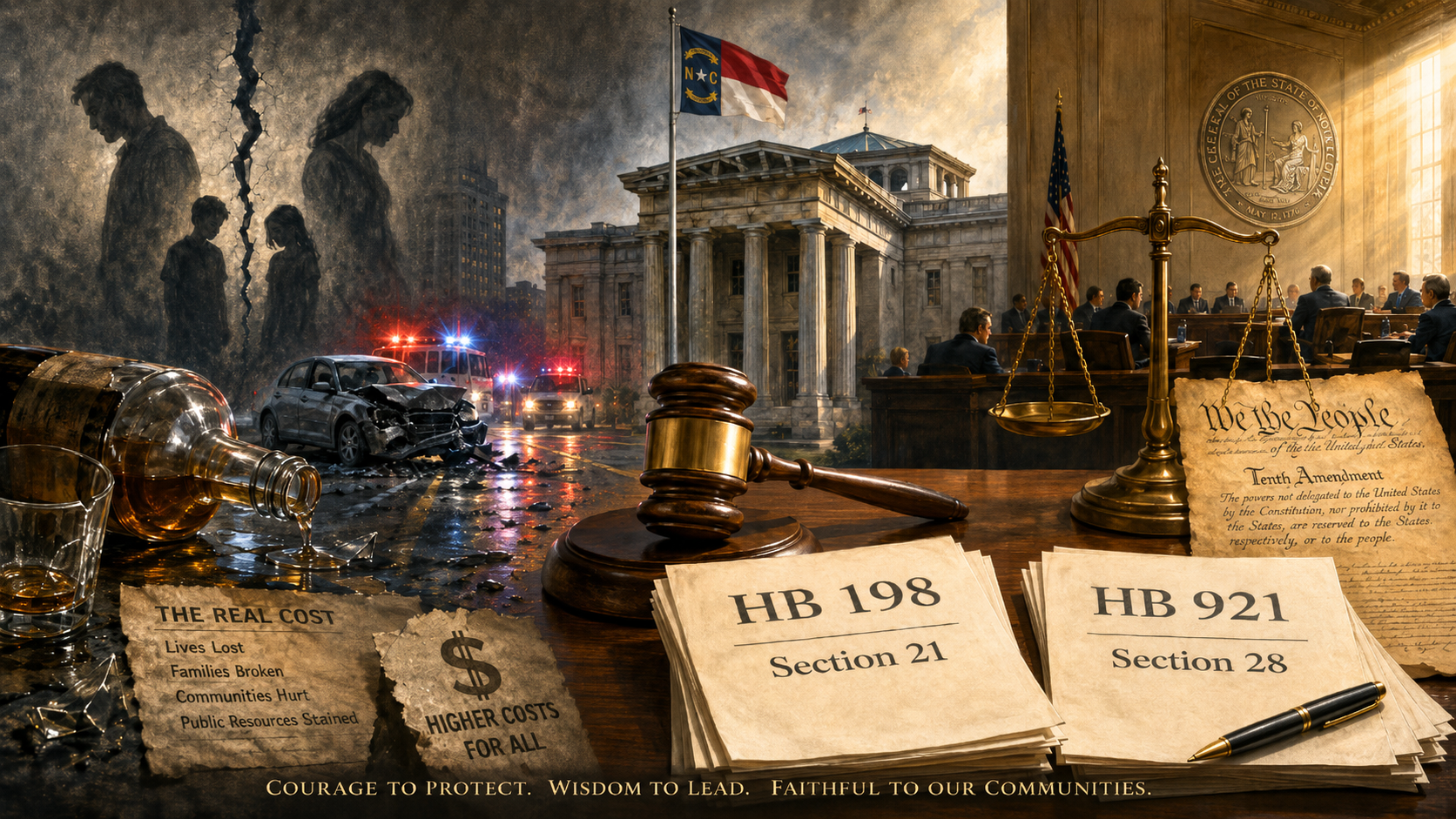
That brings us to two major alcohol-related bills now before the North Carolina General Assembly: HB 921 – ABC & Gaming Omnibus Bill and HB 198 – ABC Omnibus of 2026.
Two ABC Bills, One Troubling Direction
HB 921 is the more dangerous of the two. It is a sweeping ABC and gambling omnibus bill, and it contains provisions that would significantly expand alcohol availability and alcohol commerce in this state. Among the most troubling provisions are those dealing with premixed spirituous liquor cocktails and an expansion of casino-style game nights for nonprofits. HB 921 does not appear to retain the earlier language expressly authorizing Sunday ABC store openings, which was in its original version.
HB 198 – ABC Omnibus of 2026, the Senate version, passed the Senate this week. It would be preferable if both bills failed. North Carolina does not need another alcohol expansion bill. We do not need to make drinking easier, more convenient, more available, or more normalized. We need lawmakers with the courage to ask whether our state is already paying too high a price for alcohol, especially now, given that HB 921 and HB 198 are the most far-reaching pieces of legislation to loosen alcohol control in North Carolina history.
Nevertheless, it appears to be a foregone conclusion that one of these bills will pass and become law. At this point, the only bill moving is HB 198. To be fair, the Senate has considered some of our arguments and omitted several of the most concerning provisions.
HB 198 does not include the provision to open ABC stores on Sundays, which was originally part of Edition 1 of HB 921. It also omits the broader provision on spirituous liquor cocktails that would allow liquor to be sold outside North Carolina ABC stores. It further omits the gambling provision that would have allowed an expansion of casino nights for nonprofits.
Those omissions matter. They are good, demonstrating that Return America’s advocacy has made a difference.
What the Senate Omitted
Still, HB 198 is not a bill we can support without serious reservations. Even the ABC Commission has expressed concerns about several provisions that remain in these bills. When the very body charged with administering and enforcing the ABC laws raises concerns, lawmakers ought to listen carefully. Alcohol policy should never be written primarily by those who profit from alcohol sales.
If one of these bills is going to pass, we would hope it would be HB 198 rather than HB 921. HB 921 is truly a dangerous bill. It leaves too many provisions intact that would further commercialize and normalize alcohol and gambling. HB 198 is better only because some of the worst provisions have been removed. But better does not necessarily mean good.
The Tourism ABC Establishment Provision
Moreover, a constitutional issue remains that should not be ignored. It appears in both HB 198 and HB 921.
In HB 198, it appears as Section 21, which expands the Tourism ABC Establishment provision. In HB 921, the same troubling expansion appears as Section 28.
This issue is not new to me. I remember appearing before the House ABC Committee in the early 2000s to argue against one of these special ABC carveouts. I opposed it then because I believed it was unconstitutional, and I have good reason to believe it remains unconstitutional today.
Since that time, the General Assembly has enacted numerous local alcohol exceptions and special provisions. Many of them were never challenged in court, even though they should have been. As a result, a questionable practice has continued year after year, not because it was right, not because it was constitutional, and not because it honored the people’s right to vote on alcohol sales in their own communities, but because no one had the courage or the will to stop it.
That is the heart of the matter.
The Local-Option Principle
When alcohol expands within a community, North Carolina has historically required residents to decide the question through the local-option process. That principle matters. It protects local citizens’ right to determine whether alcohol sales should be allowed and, if so, in what form (ABC stores, malt beverages, unfortified wine, fortified wine, and mixed beverages). It recognizes that alcohol is not an ordinary product and that its sale carries consequences for the entire community. Furthermore, it recognizes that no one knows better than local residents how alcohol sales are affecting the community.
Special local alcohol carveouts undermine that principle. They allow selected places to receive alcohol privileges without the ordinary vote of the people. They create exceptions for one area, one development, one type of property, or a favored set of circumstances that cannot be applied statewide. That may be convenient for certain business interests, but it is dangerous for constitutional government.
Article II, Section 24 of the North Carolina Constitution prohibits local, private, or special acts regulating trade. Alcohol sales are unquestionably a regulated trade in our state.
This is not a theoretical concern. Similar local ABC enactments have already been successfully challenged in court.
Comparable Laws Have Already Failed in Court
In Reaves v. N.C. Alcoholic Beverage Control Commission, Frazier v. N.C. Alcoholic Beverage Control Commission, and Swain County v. N.C. Alcoholic Beverage Control Commission, comparable local ABC enactments were held unconstitutional. Those cases were litigated by former Speaker Pro Tem Paul Stam. All three challenges succeeded, and none of the rulings were appealed.
Although those cases were trial-court decisions and therefore not binding appellate precedent, they remain highly significant. They demonstrate that similar local alcohol carveouts tested in court have failed. They also show that the constitutional objection to Section 21or 28 is neither speculative nor novel. North Carolina courts have already recognized the danger of using special local legislation to regulate the alcohol trade.
A Carveout That Should Not Be Expanded
The provision may sound technical. It may sound harmless. It may sound like a tourism measure. But it is much more than that. It expands a pathway for alcohol permits in selected locations without following the ordinary local-option process. It continues the practice of creating special exceptions to the general law. It treats alcohol policy as a matter of legislative accommodation rather than constitutional restraint.
The appropriate response is not to expand the Tourism ABC Establishment provision. For that reason, Section 21 of HB 198 or Section 28 of HB 921 should be removed.
If alcohol sales are to be expanded in any community, it should be done through the ordinary local-option process and under general laws that apply uniformly, not through a special carveout for selected locations.
Knowing What Is Right
What makes this especially troubling is that most of the lawmakers I have talked to about this matter have told me, in one way or another, that they know I am right. They understand the constitutional problem. They understand the weakness of these special alcohol provisions. They know that this practice has gone on too long.
But knowing what is right is not the same thing as doing what is right.
The Bible says, “To him that knoweth to do good, and doeth it not, to him it is sin” (James 4:17). That is not only a spiritual truth; it is a public truth. Public officials are not called merely to recognize what is wrong. They are called to act. They are not called merely to privately agree with a concern. They are called to summon the courage to correct it.
There comes a time when lawmakers must stop saying, “Yes, you are right,” and start voting as if they believe it.
The Courage to Stop a Bad Practice
If a provision is unconstitutional, it should not be enacted. If it bypasses the people, it should not be excused. If it weakens local control, it should not be expanded. If it perpetuates a pattern that courts have already rejected in similar circumstances, the General Assembly should not wait for another lawsuit to force it to do what it already knows it ought to do.
Courage in public office is not shown by doing what is easy. It is shown by doing what is right when powerful interests want something else. It is shown by protecting the people’s constitutional rights, even when the issue seems small, technical, or politically inconvenient.
North Carolina’s ABC system was built on the premise that alcohol is distinct from other products. It is not milk. It is not bread. It is not ordinary commerce. It is a dangerous commodity that requires restraint, regulation, and accountability.
The “C” in ABC must again mean control.
HB 198 is better than HB 921 because some of the most objectionable provisions have been removed. At the least, the General Assembly should not expand a questionable Tourism ABC Establishment provision in either bill. It should honor the local-option process, respect the North Carolina Constitution, and show the courage to do what many lawmakers already know is right.
But when all is considered, neither of these bills should be passed. Even with the most egregious provisions of these two bills previously mentioned omitted, both still go entirely too far in making North Carolina citizens more vulnerable to alcohol-related harms.
Note: Return America appreciates the six brave Senators who voted against HB 198. They were: Senators W. Ted Alexander, Jim Burgin, Warren Daniel, Carl Ford, Steve Jarvis, and Norman W. Sanderson.