by Dr. Mark Creech
Director of Government Relations
Return America
Jyquante Spruill was only 14 years old when his family received the call every parent and grandparent dreads.
According to WRAL, Jyquante had passed out during gym class at Hope Middle School in Pitt County. Paramedics were en route.
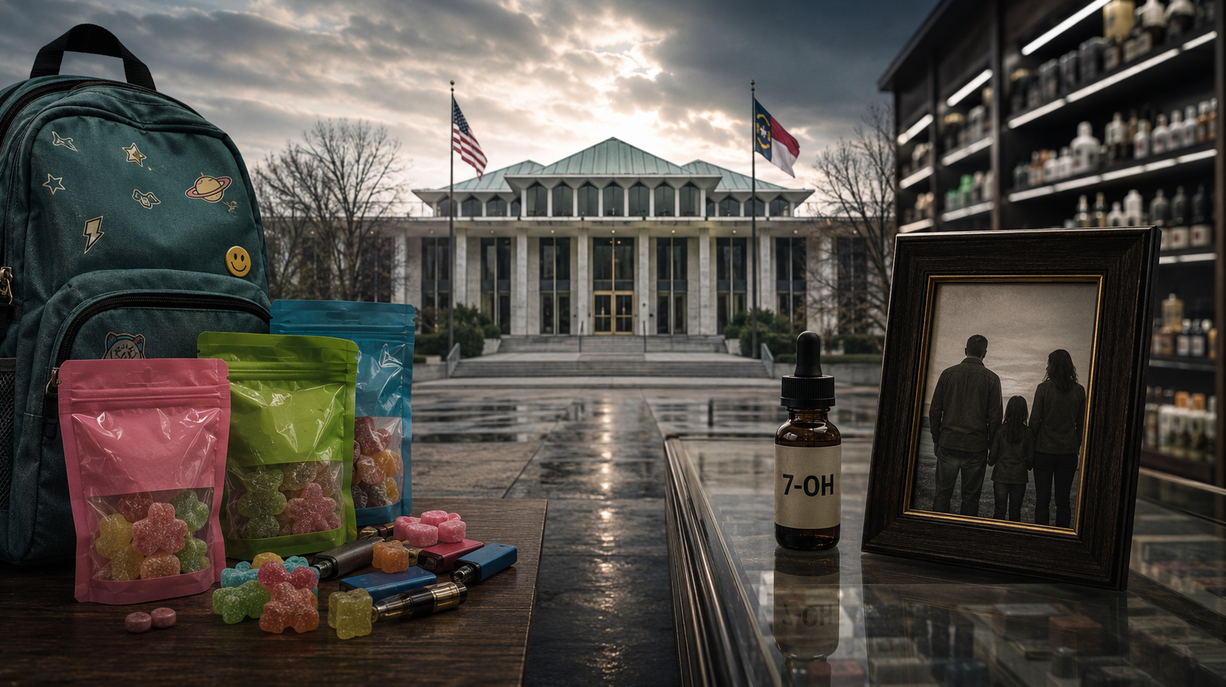
He was among several students affected after THC gummies were brought to school. His grandmother, Kesha Spruill, was at work when she learned what had happened. Frightened and shaken, she left work immediately to get to him.
Jyquante received medical attention and was later released. His family was spared the worst outcome.
But his story reveals a growing danger in North Carolina. Intoxicating products made and packaged to look and taste like ordinary candy are reaching children who may have little understanding of what they are consuming.
Then there is the story of Carrson Kase Wilson.
WRAL recently reported that Carrson was the 28-year-old son of Jimmy and Leah Wright, founders of Wake Monarch Academy, a recovery-focused high school in Raleigh. He had struggled with substance abuse but had been doing well in recovery when, according to his parents, he began using a powerful substance called 7-OH.
The substance is related to Kratom but can be far more potent than the natural plant. Carrson reportedly purchased it at a local vape shop and began using it for back pain.
Within months, he was asking his parents for help. He described the withdrawal as pain unlike anything he had ever felt.
Carrson died on April 27, 2026.
His parents remember him as “a bright light gone way too soon.” They believe 7-OH played a serious role in the addiction and suffering that preceded his death. Now they are pleading with lawmakers to prevent other families from experiencing a similar tragedy.
These are two distinct stories, yet both raise the same urgent question:
How many more young people must be poisoned, addicted, hospitalized, or lost before North Carolina takes action?
The Law Has Not Kept Pace
Intoxicating hemp products are now widely available at gas stations, convenience stores, vape shops, and online.
They are sold as gummies, candies, drinks, and vaping products. Some are brightly colored and packaged to naturally appeal to young people.
Kratom products are also readily available. Natural kratom and highly concentrated substances such as 7-OH are often discussed as if they are the same, even though their strength and risks may be very different.
These products have entered the marketplace faster than lawmakers have been able to respond.
House Bill 328 – Regulate Hemp-Derived Consumables is an effort to begin to correct that failure.
The Senate approved the bill’s conference report on July 2 by a vote of 37 – 6. The measure now awaits action in the House when lawmakers return to Raleigh on July 27.
The House should approve the bill.
What the Bill Would Do
HB 328 would prohibit the sale or delivery of hemp-derived consumable products to anyone under 21 and would also prohibit possession of such products by anyone under 21.
The same age restriction would apply to kratom.
The bill would prohibit synthetic kratom products, including chemically altered substances such as synthetic 7-OH. It would also remove many intoxicating hemp products and chemically converted cannabinoids from retail shelves.
Businesses that violate the law could face criminal charges and substantial civil penalties. Repeat offenders would face increasingly severe consequences, and businesses could be held liable for unlawful sales by their employees.
In plain language, HB 328 would accomplish three important things:
It would make it harder for young people to obtain these products.
It would prohibit some of the most dangerous substances currently sold openly.
And it would impose meaningful penalties on sellers who prioritize profit over public safety.
That is not everything North Carolina needs to do, but it is something important that can be done now.
A Ban Would Be Better
Let’s be candid: it would be far better if lawmakers simply banned these intoxicating products outright.
These substances do not become safe simply because the purchaser has reached 21. Whatever benefits their advocates may claim, the risks of impairment, dependency, accidental poisoning, and abuse do not vanish on a person’s twenty-first birthday. These products impair judgment, invite dependency, endanger families, and impose costs on schools, hospitals, law enforcement, employers, and communities. Their harm does not end at age 21.
The strongest public policy response would be prohibition.
Some will object that prohibition never works because it does not completely eliminate the prohibited conduct. But that is an impossible standard, applied selectively.
Laws against theft do not eliminate theft. Laws against drunk driving do not prevent every impaired driver from getting behind the wheel. Laws against illegal drugs do not stop every sale or use.
Yet no reasonable person concludes that such laws lack merit.
Prohibition works by reducing availability, raising the cost of illegal conduct, discouraging casual use, limiting commercial promotion, empowering law enforcement, and making clear that society will not approve of a dangerous product.
It may not stop every determined user, but it can significantly curb use, reduce exposure, protect public health, and save lives.
That is what good law is designed to do – not to create a perfect world, but to restrain harm.
Imperfect but Necessary
HB 328 is not a perfect law, but it is necessary.
Merely setting the legal age at 21 is far from sufficient.
Stores should be required to verify valid identification. Online sellers should be required to use reliable age-verification systems. Deliveries should require proof that an adult received the package.
North Carolina also needs strong standards for product testing, truthful labeling, potency, child-resistant packaging, retailer licensing, and enforcement.
Some of these safeguards were considered in earlier proposals but are omitted from the final conference report.
That is disappointing.
Lawmakers have been unable to agree on every aspect of a comprehensive system. Some favor strict regulation. Others, including this writer, believe these intoxicating, dangerously concentrated products should be entirely banned. Still others worry about the effects on lawful hemp businesses or on less concentrated natural kratom products.
But disagreement over the perfect solution cannot become an excuse for inaction. When a problem is urgent, lawmakers sometimes must accept an imperfect measure rather than leave a serious danger unaddressed.
The question is not whether HB 328 solves every problem.
It does not.
The question is whether it would protect North Carolinians – especially young people – from products already causing serious harm.
It would.
Supporting this bill does not require pretending it does everything needed. Nor does it require abandoning the stronger case for a complete ban. It simply recognizes that when lawmakers cannot yet agree on everything that should be done, they still have a duty to do what they can -now.
Another Family Should Not Have to Get the Call
Jyquante Spruill’s grandmother received a frightening call and rushed to his side.
She was able to bring her grandson home.
Jimmy and Leah Wright could not bring Carrson home.
No law can prevent every tragedy. Age restrictions have not completely eliminated underage drinking, smoking, vaping, or drug use.
Nevertheless, such laws still matter.
When members of the North Carolina House return on July 27, they should adopt the conference report on HB 328 and clear the way for the bill to be presented to the Governor.
They should do it for parents who should not have to wonder whether a brightly colored package sold at a gas station contains a powerful intoxicant.
They should do it for teachers, school officials, paramedics, and emergency-room workers who have seen young people sickened by these products.
They should do it for families struggling to rescue loved ones from addiction.
They should do it in memory of Carrson Kase Wilson.
They should do it before another parent or grandparent receives the call that changes everything.