
by Rev. Mark Creech
RevMarkCreech.org
Recently, while scrolling through Facebook, I came across a video of a prominent pastor with a national following. Displayed on the platform beside him were various alcoholic beverages—beer, wine, and liquor. His message was familiar: the Bible does not condemn drinking; it condemns drunkenness.
Not long afterward, I saw another video featuring a well-known Christian personality. He explained that he had been raised in a Christian environment where drinking alcoholic beverages was strongly condemned. For many years, he accepted that position. Then he began spending time with a group of Christian men who were Reformed in their theology.
These men, he said, were serious Christians. They loved the Lord. They were devoted husbands and fathers. They gathered to discuss theology and Scripture while smoking cigars and drinking whiskey. Seeing their apparent spiritual maturity gradually changed his mind. What he had once considered inconsistent with Christian living, he now regarded as perfectly acceptable.
His conclusion seemed to be that because sincere, doctrinally sound Christians could drink without appearing intoxicated or irresponsible, moderate drinking must be morally unobjectionable.
Such reasoning has become increasingly common.
I know of few social issues among Christians that provoke a more emotional response than the subject of alcoholic beverages. Many believers have become entirely comfortable with drinking in moderation. To question that practice is often treated as legalism, judgmentalism, or an attempt to impose personal convictions upon another believer’s liberty.
Nevertheless, the fact that a practice has become common among Christians does not mean it has become wise. Nor does the sincerity, theological sophistication, or family devotion of those who participate in it settle the moral question.
Good Christians may possess blind spots. Sound doctrine in one area does not guarantee sound judgment in every other area. A man may understand the doctrines of grace and still underestimate the deceptive power of alcohol.
The question is not merely whether a Christian can consume an alcoholic beverage without immediately becoming drunk. The deeper question is whether Christians should normalize, celebrate, advertise, and socially commend a substance that has brought immeasurable sorrow into homes, churches, communities, and nations.
A Treasure from Another Era
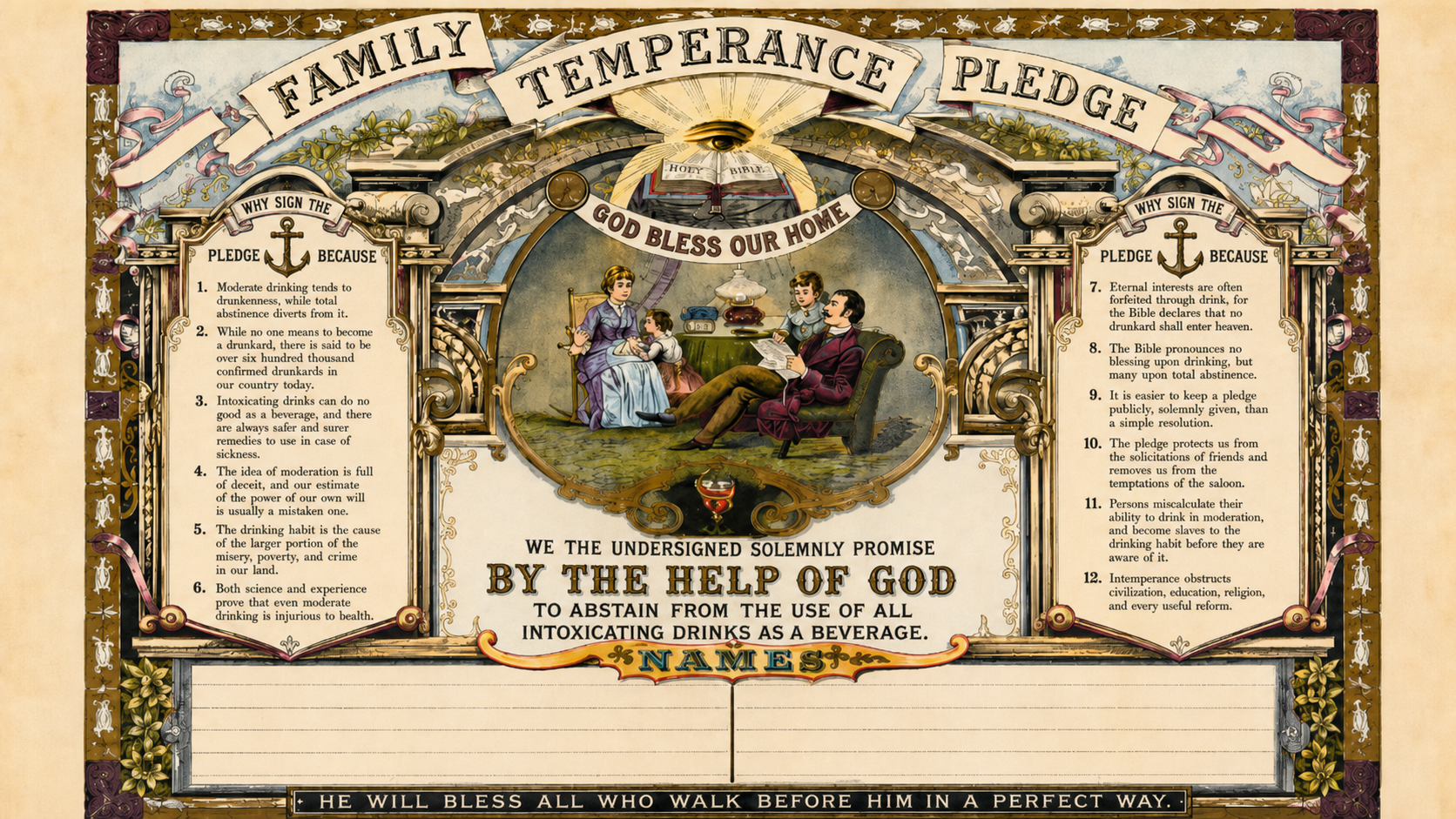
During the same week I encountered these videos, I came upon a woman selling what I consider to be an old treasure. It was a Family Temperance Pledge that had been kept inside an antique Bible.
I purchased it and hope to have it framed and displayed on my wall.
The beautifully illustrated pledge comes from an era when many Christians regarded abstinence from alcoholic beverages not as an embarrassing remnant of narrow religion, but as a noble act of faith, love, prudence, and social responsibility.
Across the top appear the words “Family Temperance Pledge.” Beneath an image of a family gathered in the home, the pledge declares:
“We, the undersigned, solemnly promise, by the help of God, to abstain from the use of all intoxicating drinks as a beverage.” [1]
It then presents twelve reasons for signing.
Some of its language reflects the period in which it was printed. Its reference to the number of confirmed drunkards in the country is obviously historical. Yet its moral reasoning remains remarkably relevant.
Indeed, the old pledge may speak more realistically about alcohol than many modern Christian discussions.
What the Bible Says About Alcohol
Before considering its twelve arguments, the biblical issue should be addressed.
Christian advocates of drinking frequently reduce the question to one sentence: “The Bible condemns drunkenness, but not drinking.”
That statement contains an element of truth, but it is far too simplistic to bear the weight commonly placed upon it.
In his book To Drink or Not to Drink, Christian philosopher and theologian Norman Geisler argued that Scripture makes important distinctions that are often overlooked in modern discussions of alcohol. [2]
Geisler maintained that the Bible consistently condemns the use of strong or undiluted intoxicating drink as a beverage. Wine in the biblical world, he argued, was commonly mixed with water and was therefore substantially less intoxicating than many modern alcoholic beverages. Drinking undiluted wine was viewed as excessive and, in the wider ancient culture, sometimes even as barbaric.
He pointed to passages such as Proverbs 20:1 and 23:29–32, Isaiah 5:11 and 24:9, and Leviticus 10:9 as warnings concerning strong drink, intoxication, impaired judgment, and the destructive influence of alcohol. [3]
Geisler also noted that total abstinence was required or commended in particular circumstances. Priests were forbidden to drink while performing their sacred duties. Kings were warned that alcohol could pervert judgment. Nazirites abstained entirely as an expression of consecration.
Both Testaments plainly condemn drunkenness. Ephesians 5:18 commands believers not to be drunk with wine. First Corinthians 6:9–11 warns that drunkards will not inherit the kingdom of God. Scripture repeatedly connects intoxication with moral carelessness, impaired judgment, shame, poverty, sexual sin, violence, and spiritual ruin.
Geisler acknowledged that the Bible refers to medicinal uses of alcohol, as in Paul’s instruction to Timothy to “use a little wine” for his stomach’s sake. But medicinal use is not the same as recreational use. Medicine taken for an ailment does not automatically become a model for social drinking.
He further argued that Christian conduct cannot be measured only by asking, “Is this explicitly forbidden?” Believers must also ask whether a practice is wise, edifying, enslaving, potentially harmful, or likely to cause another person to stumble. [4]
Romans 14:21 says:
“It is good neither to eat flesh, nor to drink wine, nor any thing whereby thy brother stumbleth, or is offended, or is made weak.”
First Corinthians 10:23 adds:
“All things are lawful for me, but all things are not expedient: all things are lawful for me, but all things edify not.”
Thus, even where Christians debate the precise boundaries of biblical permission, the discussion cannot end with a defense of personal liberty. Christian love willingly surrenders liberties when exercising them may endanger another person or diminish the believer’s testimony.
The believer’s question should not simply be, “How much may I drink without sinning?”
It should also be, “What course most honors Christ, protects my family, guards my influence, helps my weaker brother, and strengthens my witness for Christ?”
Twelve Reasons Worth Hearing Again
The old Family Temperance Pledge offers twelve answers.
1. “Moderate drinking tends to drunkenness, while total abstinence directly from it.”
Not every person who drinks becomes an alcoholic. But no person becomes an alcoholic without first taking the initial drink.
Drunkenness is rarely chosen as a destination. It is reached by a road that usually starts out moderately. Abstinence does not eliminate every danger in life, but it completely removes the danger of becoming intoxicated through beverage alcohol.
A person who never drinks never drives drunk, never becomes alcohol-dependent, and never awakens ashamed of what he said or did under alcohol’s influence.
2. “While no one means to become a drunkard, there is said to be over six hundred thousand confirmed drunkards in our country today.”
The pledge’s terminology and estimate belong to another era. Today, the clinical term is alcohol use disorder, or AUD. According to the latest federal estimate, approximately 28 million Americans ages twelve and older had alcohol use disorder in 2024. [5]
Most of them did not begin drinking with the intention of becoming dependent. They expected to remain in control. They assumed serious alcohol problems happened to other people – only those who were weaker, less disciplined, or less spiritually mature.
In a culture where alcohol is relentlessly advertised, socially celebrated, and increasingly normalized, even within Christian circles, the staggering number of Americans with alcohol use disorder demonstrates how routinely people underestimate alcohol’s enslaving power and dangerously overestimate their ability to control it.
3. “Intoxicating drinks can do no good as a beverage, and there are always safer and surer remedies to use in case of sickness.”
Whatever medicinal use alcohol may once have had, modern medicine provides safer and more precise treatments for nearly every condition for which alcohol was historically prescribed.
The pledge carefully specifies its use “as a beverage.” It does not deny that a substance may have medical or industrial purposes. It argues that recreational consumption is unnecessary.
No one requires whiskey, beer, or wine to maintain a healthy life. Alcohol is not essential to nutrition, fellowship, celebration, courage, relaxation, or joy.
4. “The idea of moderation is full of deceit, and our estimate of the power of our own will is usually a mistaken one.”
This may be the pledge’s most psychologically perceptive statement.
Moderation sounds safe because it assumes the drinker will always recognize the boundary and possess the will to stop before crossing it. But alcohol itself weakens the judgment needed to determine when enough is enough.
The more one drinks, the less reliable one’s self-assessment may become.
Human beings also tend to overestimate their own strength. Scripture warns, “Wherefore let him that thinketh he standeth take heed lest he fall” (I Corinthians 10:12).
The wise person does not merely ask whether he possesses the strength to resist temptation. He asks why he should unnecessarily place himself within temptation’s reach.
5. “The drinking habit is the cause of the larger portion of the misery, poverty, and crime in our land.”
The wording may sound sweeping, but no informed person can deny alcohol’s enormous contribution to domestic violence, broken homes, automobile injuries and deaths, workplace failures, assaults, sexual misconduct, poverty, neglect, disease, and crime. [6]
Alcohol does not cause every social problem. But it is far more than an aggravating factor. In countless cases, it becomes the catalyst that impairs judgment, loosens restraint, inflames conflict, and turns temptation, anger, or carelessness into tragedy.
Pastors, police officers, physicians, emergency-room workers, judges, social workers, and funeral directors have seen what alcohol can do. Its advertisements show friendship, romance, laughter, and success. They rarely show the smashed automobile, the frightened child, the battered spouse, the jail cell, the hospital bed, or the grave.
6. “Both science and experience prove that even moderate drinking is injurious to health.”
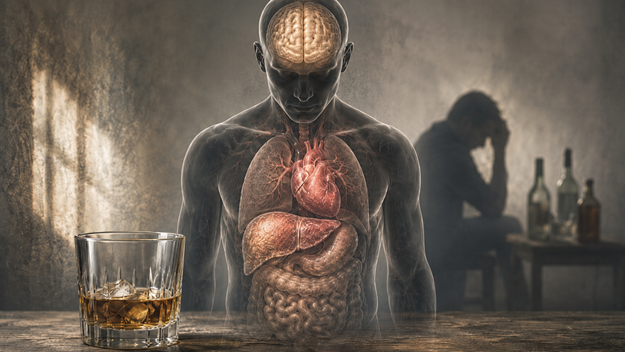
For many years, Americans were told that moderate drinking—especially a daily glass of wine—might protect the heart and contribute to longer life. That reassuring message is no longer supported with the confidence it once was. Researchers have increasingly questioned whether the apparent health benefits attributed to moderate drinking result from alcohol itself or from weaknesses in observational studies, including the misclassification of former drinkers as abstainers and differences in health, lifestyle, and socioeconomic circumstances between drinkers and nondrinkers. [7]
The evidence concerning cancer is especially sobering. Alcohol is a Group 1 carcinogen, the highest classification used for substances known to cause cancer in humans. [8] The U.S. Surgeon General has concluded that alcohol consumption causally increases the risk of at least seven cancers: cancers of the mouth, throat, voice box, esophagus, liver, colon and rectum, and female breast. Alcohol contributes to nearly 100,000 cancer cases and approximately 20,000 cancer deaths annually in the United States. [9]
Nor is the danger confined to heavy drinking. The World Health Organization states that there is no safe level of alcohol consumption in relation to cancer risk and that even small amounts increase the risk of certain alcohol-related cancers. [10] The danger comes from the ethanol itself, whether it is consumed in beer, wine, or liquor.
Alcohol is also a toxic, psychoactive, and dependence-producing substance. Once consumed, the body converts ethanol into acetaldehyde, a carcinogenic compound that can damage DNA and proteins. Alcohol can also produce oxidative stress, interfere with the absorption of protective nutrients, raise estrogen levels, and make tissues more vulnerable to other carcinogens. [11]
The old temperance pledge was therefore more scientifically perceptive than many modern defenders of “moderation.” One need not become visibly intoxicated before alcohol begins affecting the brain and body, and one need not be a heavy drinker before assuming some additional health risk.
From the standpoint of alcohol-related cancer prevention, the safest amount of beverage alcohol is none. Abstinence does not merely avoid drunkenness and addiction; it eliminates alcohol-related cancer risk and every other disease or injury that can arise only because alcohol was consumed.
7. “Eternal interests are often forfeited through drink, for the Bible declares that no drunkard shall enter heaven.”
Scripture’s warning is solemn.
Paul does not say that drunkenness is a harmless weakness. He includes it among sins that, when embraced as a settled way of life, reveal a heart unreconciled to God.
The church must never treat lightly what Scripture treats seriously.
At the same time, the Gospel offers hope. First Corinthians 6:9-11 warns that drunkards will not inherit God’s kingdom, but then declares, “And such were some of you.” Christ saves, cleanses, liberates, and transforms those enslaved by sin.
Alcohol may bind a person, but Jesus Christ can break the chains.
8. “The Bible pronounces no blessing upon drinking, but many upon total abstinence.”
Christians often search Scripture for permission to drink. A more revealing exercise might be to search for the spiritual benefits Scripture attaches to alcoholic beverages.
Alcohol is never listed among the fruits of the Spirit. No believer becomes more holy, discerning, prayerful, loving, self-controlled, or useful to God because he drinks.
By contrast, Scripture repeatedly praises sobriety, vigilance, wisdom, self-control, watchfulness, and willingness to deny oneself for the good of others.
Whatever arguments may be offered for drinking, they cannot reasonably be presented as necessary or even helpful for Christian maturity.
9. “It is easier to keep a pledge publicly, solemnly given, than a simple resolution.”
A private intention may be easily revised. A solemn pledge made before God and others strengthens accountability.
This does not mean that every Christian must sign a formal document. Nor should a pledge be treated as a substitute for grace or the power of the Holy Spirit.
Still, clearly stated convictions matter. A settled commitment removes the need to renegotiate one’s decision every time alcohol is offered.
The answer has already been given: “I do not drink.”
10. “The pledge protects us from the solicitations of friends and removes us from the temptations of the saloon.”
The old word “saloon” may sound dated, but the social pressure remains.
Today, the pressure may come at a restaurant, reception, sporting event, business gathering, neighborhood party, or even a church-related social occasion. Drinking is frequently treated as a mark of sophistication, relaxation, masculinity, adulthood, or freedom.
A firm conviction provides good protection.
It also raises a serious question: Why should Christians place pressure upon fellow believers to drink? Why should declining alcohol require an explanation, while consuming it does not?
No Christian should ever make another believer feel awkward for choosing sobriety.
11. “Persons miscalculate their ability to drink in moderation and become slaves to the drinking habit before they are aware of it.”
This point deserves to be read slowly.
Bondage often develops gradually. What begins as an occasional indulgence becomes a routine. The routine becomes an appetite. The appetite becomes a perceived need. Eventually, the person no longer drinks simply because he wants to; he drinks because he feels he must.
Scripture asks, “Know ye not, that to whom ye yield yourselves servants to obey, his servants ye are to whom ye obey; whether of sin unto death, or of obedience unto righteousness?” (Romans 6:16).
Paul declared, “I will not be brought under the power of any” (I Corinthians 6:12)
Christian liberty that leads to bondage has ceased to function as liberty.
12. “Intemperance obstructs civilization, education, religion, and every useful reform.”
Alcohol does not merely injure individuals. Its effects spread outward.
It drains family resources, disrupts education, burdens healthcare, complicates law enforcement, weakens industry, fractures communities, and hinders the church’s ministry.
Many of the great Christian leaders and preachers of earlier generations understood that evangelism and temperance were not competing concerns. They believed alcohol often stood directly in the path of spiritual awakening, family stability, economic progress, and social improvement. They also understood that alcohol can cloud the very faculties by which a person listens, reasons, remembers, exercises judgment, and responds to truth. [12] A mind impaired by drink may be less able to follow the Gospel clearly, feel the full weight of its claims, and act responsibly upon what has been heard.
This does not place anyone beyond the reach of God’s grace. The Holy Spirit is sovereign and can awaken the most impaired and hardened heart. But Christians should never celebrate a substance that dulls judgment, weakens self-control, and may hinder a person’s attentive hearing of the message that concerns his eternal soul.
They did not oppose alcohol because they hated pleasure. They opposed it because they had seen too much pain, and because they wanted nothing needlessly placed between a human soul and the clearest possible hearing of the Gospel.
Is Abstinence Legalism?
Whenever total abstinence is commended, someone always seems to raise the charge of legalism.
But legalism is not simply taking a strong moral position. Legalism is the attempt to earn salvation through works or to impose man-made requirements as conditions of justification before God.
Choosing abstinence because one wishes to guard his mind, protect his family, preserve his influence, avoid enslavement, and refrain from causing others to stumble is not legalism.
It is prudence.
A Christian may believe another believer is genuinely converted while still questioning the wisdom of that believer’s conduct. To say, “I believe this practice is dangerous and inconsistent with the highest demands of Christian love,” is not the same as saying, “You cannot be saved if you do it.”
Moreover, those who defend drinking must be careful not to practice a reverse legalism – treating abstainers as spiritually immature, culturally backward, fearful, or unable to appreciate Christian liberty.
No believer should be mocked for declining a substance that has destroyed millions of lives.

What Are We Teaching the Next Generation?
The most troubling feature of the videos I saw was not merely that Christians were drinking. It was that alcohol was being deliberately displayed, defended, and normalized as part of Christian fellowship.
A pastor standing beside an assortment of alcoholic beverages communicates more than a theological distinction between drinking and drunkenness. Christian men smoking cigars and sipping whiskey while discussing doctrine create an image that others may imitate without possessing the same restraint they claim to possess.
Our influence travels farther than our intentions.
The mature Christian must think not only about what he believes he can handle, but also about what his example may encourage someone else to attempt. [13]
A man may say, “I can drink without becoming drunk.”
But can he guarantee that his son can? His daughter? A recovering alcoholic in his church? A young believer who admires him? A person with a family history of addiction? Someone quietly struggling with despair?
The apostle Paul was willing to surrender a legitimate liberty rather than become a stumbling block.
That spirit is largely absent from modern defenses of alcohol. Much of the argument centers on rights: “The Bible does not forbid it. I am free to do it. No one should judge me.”
Christian love asks a different question:
“What am I willing to give up for the spiritual and physical good of another?”
By the Help of God
The Family Temperance Pledge is more than an interesting relic from the past. It is a witness from a generation that understood alcohol’s dangers and believed families should stand together against them.
Its central words are especially significant:
“We the undersigned solemnly promise, by the help of God, to abstain from the use of all intoxicating drinks as a beverage.”
Those words do not express confidence in human strength. They appeal to divine help.
The temperance movement had its excesses, as nearly every reform movement does. Some arguments made in its name were undoubtedly overstated. But its central insight was correct: beverage alcohol is dangerous, unnecessary, socially destructive, spiritually hazardous, and unworthy of Christian promotion.
The old pledge concludes with the words:
“He will bless all who walk before Him in a perfect way.”
The Christian life is not about discovering how close one may walk to the edge without falling. It is about walking wisely, soberly, lovingly, and faithfully before God.
Perhaps the question is not merely, “May a Christian drink?”
Perhaps the better question is:
“What might God accomplish through a generation of Christian families willing to say, without embarrassment or apology, ‘By the help of God, we will abstain’?”
Sources:
- Family Temperance Pledge, undated illustrated broadside found inside an antique Bible; author’s personal collection.
- Norman L. Geisler, To Drink or Not to Drink: A Sober Look at the Problem (Quest Publications, 1984)
- Geisler, To Drink or Not to Drink: 5
- Geisler, To Drink or Not to Drink: 2.
- National Institute on Alcohol Abuse and Alcoholism, “Alcohol Use Disorder (AUD) in the United States: Age Groups and Demographic Characteristics,” updated August 2025, reporting data from the 2024 National Survey on Drug Use and Health. The precise estimate was 27.9 million people ages twelve and older, or 9.7 percent of that population.
- Centers for Disease Control and Prevention, “Facts About Excessive Drinking,” October 7, 2024. The CDC associates excessive alcohol consumption with motor-vehicle crashes and other injuries, homicide, suicide, sexual violence, intimate-partner violence, chronic disease, school and workplace problems, financial difficulties, and strained family relationships.
- Jinhui Zhao et al., “Association Between Daily Alcohol Intake and Risk of All-Cause Mortality: A Systematic Review and Meta-analyses,” JAMA Network Open 6, no. 3 (2023): e236185, https://doi.org/10.1001/jamanetworkopen.2023.6185.
- International Agency for Research on Cancer, “Alcohol and Cancer.” IARC classifies alcoholic beverages, ethanol in alcoholic beverages, and acetaldehyde associated with alcohol consumption as carcinogenic to humans, Group 1.
- Office of the U.S. Surgeon General, Alcohol and Cancer Risk: The U.S. Surgeon General’s Advisory (Washington, DC: U.S. Department of Health and Human Services, 2025).
- World Health Organization, “Alcohol and Cancer,” November 26, 2025. WHO states that there is no safe level of alcohol consumption in relation to cancer risk and that even small amounts increase the risk of most alcohol-related cancers
- International Agency for Research on Cancer, “Alcohol and Cancer”; Office of the U.S. Surgeon General, Alcohol and Cancer Risk. These sources describe several mechanisms by which alcohol may cause cancer, including the carcinogenic activity of acetaldehyde, DNA damage, oxidative stress, hormonal changes, and interference with nutrient metabolism.
- National Institute on Alcohol Abuse and Alcoholism, “Alcohol and the Brain: An Overview.” NIAAA explains that alcohol interferes with the brain’s communication pathways and impairs functions involving memory, speech, balance, and judgment.
- Centers for Disease Control and Prevention, “About Underage Drinking,” January 14, 2025. The CDC reports that adolescents are more likely to drink when adults around them drink or engage in binge drinking.
Unless otherwise indicated, all Scripture quotations are from the King James Version.