by Dr. Mark Creech
Director of Government Relations
Return America
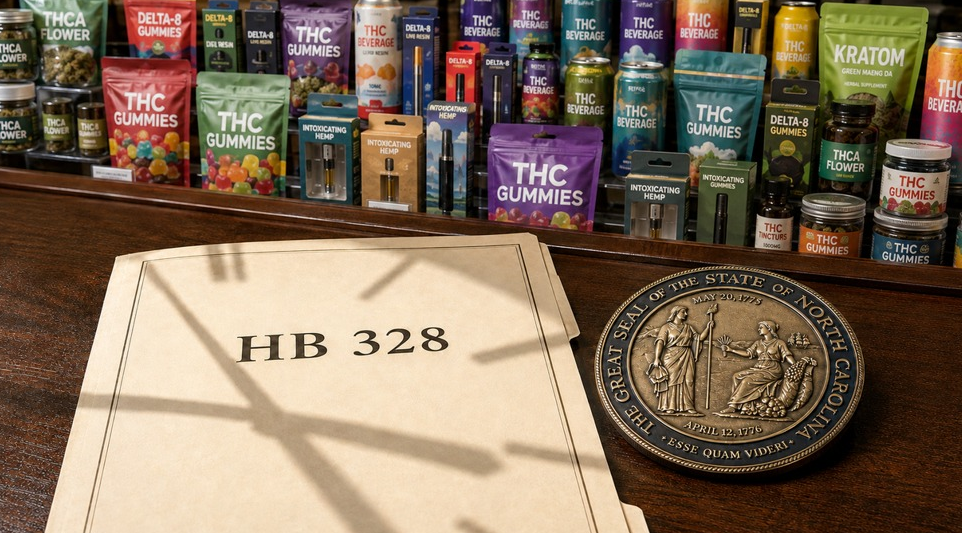
On Tuesday, the North Carolina House left House Bill 328, Regulate Hemp-Derived Consumables, in the Rules Committee and off the calendar. The Senate adopted the conference report 37-6 on July 2, but the House must approve the same agreement before it can be sent to Gov. Josh Stein.
The bill would remove the vast majority of intoxicating hemp products from lawful retail commerce by prohibiting ingestible or inhalable products containing more than 0.4 milligrams of total THC per container, as well as products containing synthetic or chemically converted cannabinoids. Of the hemp-derived consumable products that remain lawful, none could be sold, delivered, or possessed by anyone under 21. The bill would also ban synthetic kratom products and restrict natural kratom products to adults.
Hundreds of hemp-business owners, employees, consumers, and industry lobbyists crowded the Legislative Building. Their concerns deserve respect, but economic investment cannot be the sole criterion for public policy when the products can intoxicate, impair, addict, or poison.
House Speaker Destin Hall recognized the seriousness of the situation.
“Folks recognize that the current state of our law is not tenable,” Hall told reporters. “There are basically no rules. Things being sold that shouldn’t be. Things being sold to kids that shouldn’t be sold. The question is what to do about it.”
Hall plans to appoint a group of lawmakers to study the issue and develop proposals by the end of the year. Although lawmakers agree that action is needed, they remain divided on what that action should be.
That division should not be mistaken for indifference. Lawmakers faced a difficult decision under pressure, and many sought to protect young people without imposing unnecessary economic harm. Nevertheless, the conference report was as protective and comprehensive a response as North Carolina could reasonably expect for now.
Governor Stein also condemned the current “Wild West” market but objected that HB 328 lacks adequate regulation and meaningful age restrictions. He instead called for a “well-regulated THC market” where adults know the potency and ingredients of what they purchase.
The governor is correct that HB 328 does not establish a comprehensive system of testing, labeling, licensing, packaging, and inspection for products that would remain lawful. That is a legitimate concern, and additional standards may be necessary.
However, his broader characterization of the measure is incorrect.
HB 328 expressly makes it unlawful to sell or deliver hemp-derived consumable products to anyone under 21. It prohibits underage possession, establishes criminal consequences, imposes escalating civil penalties that can reach tens of thousands of dollars, and holds retailers responsible for employee violations. Age-verification requirements could be strengthened, particularly for online sales, but the bill unquestionably includes meaningful age restrictions.
The governor also said HB 328 “legalizes kratom,” which is misleading. Natural kratom is already generally lawful for adults in North Carolina. The bill would prohibit its sale to and possession by anyone under 21. More importantly, it would prohibit synthetic kratom products, including synthetic 7-hydroxymitragynine. Lawmakers may need to go further to address dangerous concentrated forms, but HB 328 makes current law more restrictive, not less restrictive.
The deeper disagreement is whether North Carolina should maintain a commercial market for hemp products that are recreationally intoxicating.
The governor has said yes. He wants this market regulated as part of an approach that could eventually include recreational marijuana. HB 328 takes a different approach.
It is important to understand that this market did not arise because North Carolina deliberately considered these intoxicating products and affirmatively approved them for recreational sale. It arose largely from an unintended opening in the 2018 federal Farm Bill. What was intended to legalize an agricultural crop became the doorway to a recreational intoxicant market. North Carolina has repeatedly declined to legalize recreational marijuana and should not allow a substantially similar market to become permanently established simply because it entered commerce through a federal loophole rather than through the deliberate approval of state lawmakers.
Nor is the fundamental problem resolved merely by regulating the market after it has become established. Testing can identify what is in an intoxicating gummy. Labeling can disclose its potency. Age verification can reduce direct sales to minors. None of these measures prevents an adult from sharing it with a teenager, a child from finding it, or an impaired user from endangering someone else.
Moreover, recreational intoxicants are not ordinary consumer goods. Their intended purpose is to impair, however temporarily, the clarity of judgment, perception, coordination, and self-control on which responsible conduct depends. Because the resulting harms rarely remain confined to the user, the state has no obligation to legitimize and protect a commercial market whose profitability depends on encouraging chemically induced impairment for pleasure.
We have become so saturated with drugs and so accustomed to chemical escape that many now speak of recreational intoxication as if it were a civil entitlement. It is not. Personal liberty does not obligate the state to legitimize, protect, and commercialize substances that promise pleasure through impairment. What earlier generations rightly recognized as a social scourge is increasingly repackaged as personal freedom, consumer choice, and economic opportunity.
No bill is perfect. The General Assembly could enact HB 328 and later strengthen age verification, set standards for products that remain lawful, address concentrated kratom more fully, and correct unforeseen problems.
But delay is not neutral. Every month these products remain on store shelves allows the market to grow, become more economically entrenched, and appear increasingly normal. That entrenchment strengthens those who want a legalized recreational market.
HB 328 remains eligible for consideration during the November post-election sessions. The choice is not merely between two regulatory systems. It is between dismantling a commercial market for recreationally intoxicating hemp products and allowing that market to become firmly established as the state debates how to regulate it.
North Carolina still has an opportunity to choose, but that opportunity will not remain equally available indefinitely.