
by Rev. Mark Creech
RevMarkCreech.org
There has been a kind of “last-days madness” in some Christian circles regarding the interpretation of Bible prophecy.
Gary DeMar used that phrase as the title of one of his books. I do not agree with all of DeMar’s eschatological conclusions, but I do think he identified a real problem: Christians have sometimes gone too far in trying to match every major news event to Bible prophecy.
A war erupts, and someone declares it a sign of the end. An earthquake strikes, and prophecy is invoked. A disease spreads, and once again we hear that Christ’s return must be near.
The problem is obvious. Wars, earthquakes, pestilences, persecution, and political upheaval are not unique to our generation. They have marked human history for centuries. If their mere existence proves the end is near, then almost every generation of Christians could have made the same claim.
That is why the Olivet Discourse, recorded in Matthew 24–25, Mark 13, and Luke 21, warrants careful reading.
In Luke’s account, Jesus Himself cautions against assuming that every crisis signals the end has arrived.
“When ye shall hear of wars and commotions, be not terrified: for these things must first come to pass; but the end is not by and by” (Luke 21:9).
Perhaps the problem is not that Christians have paid too much attention to prophecy. Perhaps we have sometimes paid attention to it in the wrong way.
The question is not whether our generation has wars, disease, disasters, and fear. Every generation has had them. The better question is whether we are now living in an age when these things can occur within the same general period, affect one another, and spread their consequences around the world.
I believe it is quite plausible that we are.
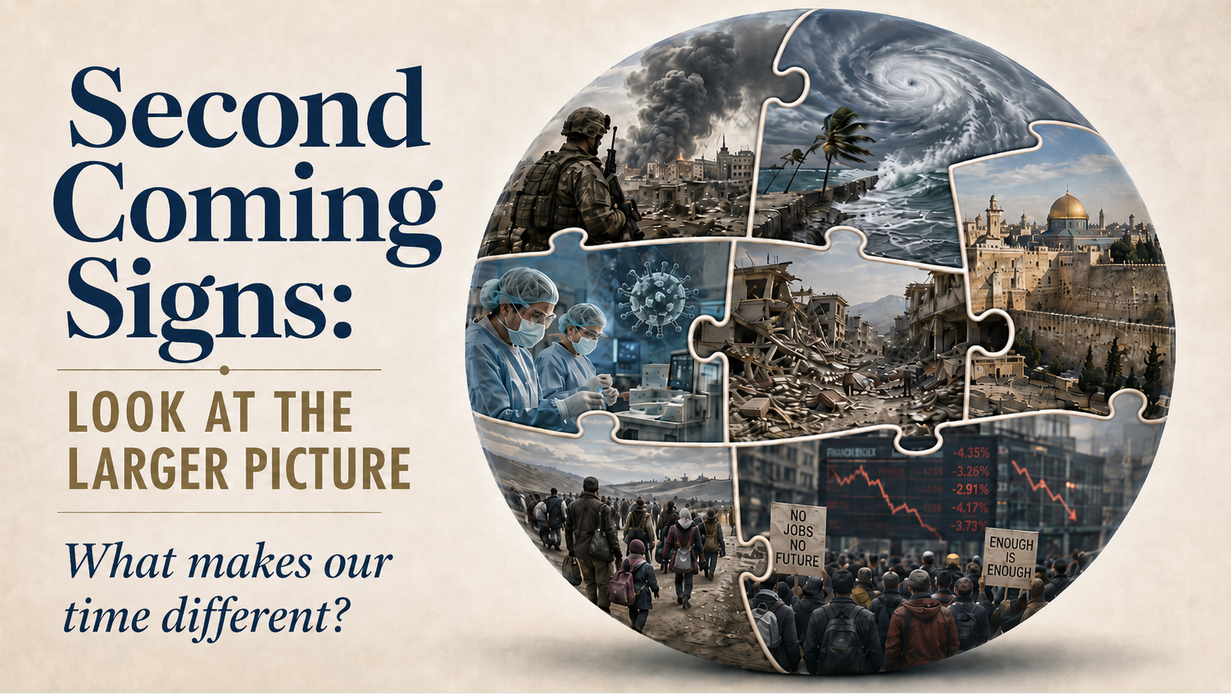
What makes our time different is not simply that trouble exists. It is that the world is now so interconnected that trouble in one place can quickly spread around the world.
A war in one region can affect fuel prices, food supplies, transportation, financial markets, and political relationships in countries far from the fighting. It can produce refugees, disrupt trade, and draw other nations into the conflict.
Disease provides another example. Epidemics are nothing new, but modern transportation enables illness to spread from one continent to another at remarkable speed. A local outbreak can become an international concern almost overnight.
That begins to sound more like the world Jesus described when He spoke of “distress of nations, with perplexity” (Luke 21:25).
Then there is the way the world now experiences fear.
Jesus said that men’s hearts would fail them “for fear, and for looking after those things which are coming on the earth” (Luke 21:26).
Fear itself is not new. But never before have so many people been able to watch the same crisis unfold almost instantly. Wars, terrorist attacks, earthquakes, disease outbreaks, political upheaval, and economic shocks can now be seen around the world within minutes.
Fear itself can spread globally in ways earlier generations could hardly have imagined.
Jesus also warned that His followers would face persecution, betrayal, and hatred for His name’s sake. Persecution has existed throughout Christian history, so its presence alone cannot identify the time of His return. Yet Jesus described hostility toward His followers extending among “all nations” (Matthew 24:9), making widespread persecution part of the larger prophetic picture.
Jesus also spoke of “signs in the sun, and in the moon, and in the stars” (Luke 21:25). Our age is witnessing extraordinary worldwide attention to unexplained phenomena in the skies, making those words especially thought-provoking. That does not mean these phenomena are the signs Jesus predicted, but they are difficult to ignore in discussions today.
And then there is Jerusalem.
Jerusalem holds an important place in the Olivet Discourse. Jesus spoke of its desolation, saying, “Jerusalem shall be trodden down of the Gentiles, until the times of the Gentiles be fulfilled” (Luke 21:24).
Whatever view one takes of the precise meaning of that verse, Jerusalem cannot be ignored. Even today, Jerusalem remains at the center of religious, political, and international attention, giving Jesus’ words continuing significance.
He described deception, conflict, calamity, persecution, distress among nations, fear, signs in the heavens, Jerusalem, and finally His return.
“And then shall they see the Son of man coming in a cloud with power and great glory” (Luke 21:27).
Jesus then said:
“When these things begin to come to pass, then look up, and lift up your heads; for your redemption draweth nigh” (verse 28).
Notice the words: “these things.”
Jesus isn’t pointing us to a single event, or even to two or three events occurring at the same time. He is describing a broader prophetic picture in which these conditions converge, eventually producing tremendous distress among the nations and culminating in His return.
We cannot say with certainty that we are living in the generation that will witness Christ’s return. Scripture gives us no license to set dates or make reckless predictions.
Still, neither should we ignore the possibility that we are living in an age when the conditions Jesus described can occur within the same general period, interact with one another, and produce worldwide consequences.
That should not lead to last-days madness. It should lead to watchfulness.