
by Rev. Mark Creech
RevMarkCreech.org
A haunting moment on the road to Calvary is easy to overlook.
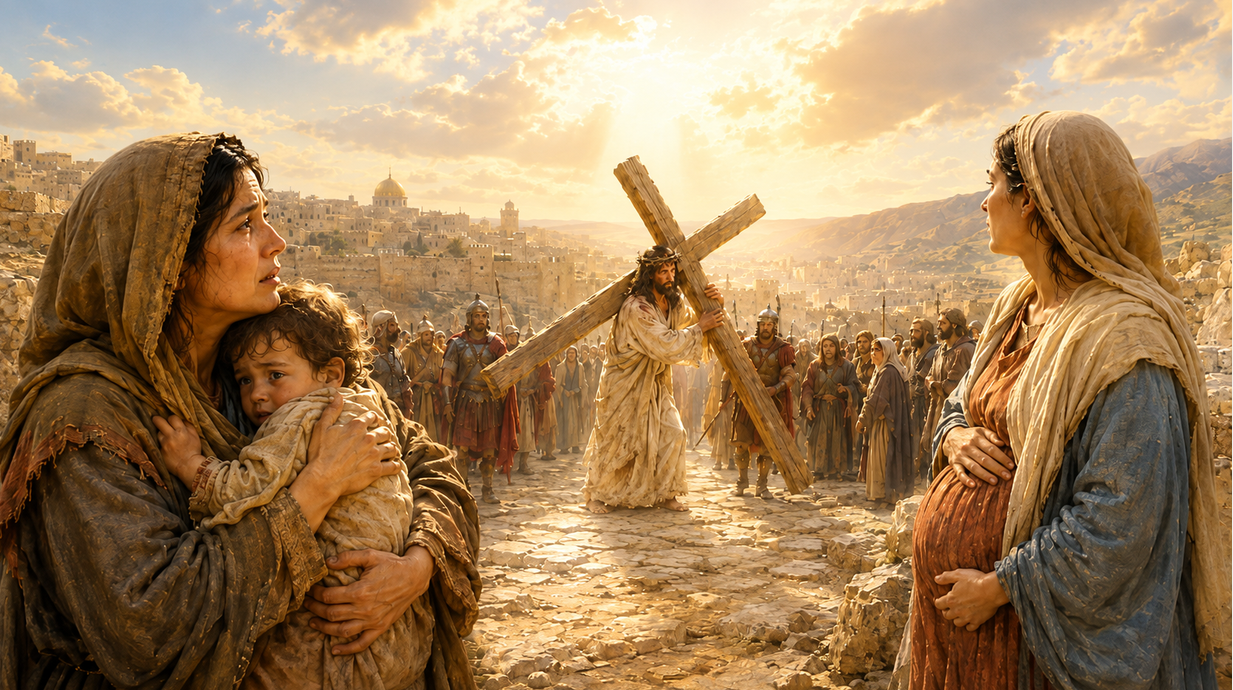
As Jesus made His way toward crucifixion, a great multitude followed Him. Among them were women who mourned and lamented what was happening to Him. Jesus turned and said:
“Daughters of Jerusalem, weep not for me, but weep for yourselves, and for your children” (Luke 23:28).
Then He spoke words that must have sounded almost unimaginable.
“For, behold, the days are coming, in the which they shall say, Blessed are the barren, and the wombs that never bare, and the paps which never gave suck” (v. 29).
Throughout Scripture, children are regarded as blessings. “Children are an heritage of the LORD,” declares Psalm 127. By contrast, in Jesus’ day, barrenness was ordinarily regarded as a profound sorrow.
Yet Jesus foresaw circumstances so awful that the normal order would be reversed. People would call the childless blessed – not because children had ceased to be precious, but because parents would be spared the anguish of watching their children suffer.
The immediate application of the prophecy was almost certainly the calamity that would befall Jerusalem. Less than forty years later, in A.D. 70, Roman armies surrounded the city. Siege, famine, violence, and death followed. Jesus knew what was coming and that mothers would witness horrors no mother should ever have to see.
However, Jerusalem’s destruction seems to be part of a broader biblical pattern of divine judgment that Revelation later invokes in its depiction of the final judgment. Jesus says people will cry to the mountains, “Fall on us,” and to the hills, “Cover us” (v. 30). Similar language appears in Revelation 6:16, where terrified humanity cries to the mountains and rocks to hide them “from the wrath of the Lamb.” Jerusalem’s destruction may therefore serve as an ominous foreshadowing of the greater worldwide catastrophe still to come.
That raises an unsettling question for our time.
Could there be a profound reversal in Jesus’ words for a civilization that has discarded millions of its unborn children?
Luke 23 is not a prophecy about modern abortion, and Scripture does not explicitly make that connection. We should never claim more for a biblical text than it claims for itself. Still, the possibility is hard to dismiss.
Our generation has found many reasons to justify the destruction of unborn life. One of them is, “Why bring a child into a world filled with so much suffering?” But even the most difficult state of affairs does not make a child’s life less worthy of protection.
Seen against our own time, what Jesus describes presents a shocking turnaround. He foresees conditions so frightful that people will call the childless blessed – not because children have ceased to be blessings, nor because abortion has become justified, but because parents will be spared the anguish of watching their children endure horrors that they are powerless to prevent.
It is almost as if God’s providence were exposing the terrible irony: a civilization that once destroyed its unwanted children may find itself living under conditions so dreadful that parents would give anything to spare their wanted children from the unthinkable events ahead.
The prospect of such an outcome is sobering enough to make one tremble. Humanity has presumed to decide when a child’s life is worth living. Yet the coming reckoning would reveal how little control humanity ever possessed. We are not sovereign over life, history, or judgment.
Only God is.
If abortion persists to the end, the world that has so casually asked whether an unborn child has a right to life may discover that the greater question is whether sinful humanity is prepared to face the wrath of a holy God who hates the shedding of innocent blood.
Yet Luke 23 does not leave us merely contemplating judgment.
Consider who spoke these terrifying words.
The Lord Jesus Christ was walking toward a cross. The One who had warned Jerusalem of the coming wrath was preparing to bear God’s wrath for sinners. Within hours, nails would pierce His hands and feet. Later, while hanging between two criminals, He would pray:
“Father, forgive them; for they know not what they do” (Luke 23:34)
That is the astonishing message of Calvary.
God takes sin more seriously than we can imagine, yet His mercy extends farther than we can imagine.
There is forgiveness for the woman who has had an abortion. There is forgiveness available to the man who encouraged or demanded an abortion. There is forgiveness for those who participated in taking an unborn life. There is forgiveness for every repentant sinner who comes to Jesus Christ.
The Savior who warned, “Weep for yourselves, and for your children,” continued walking toward Calvary.
He knew judgment was coming, and He went to the cross so that sinners might be saved from it.