by Dr. Mark Creech
Director of Government Relations
Return America
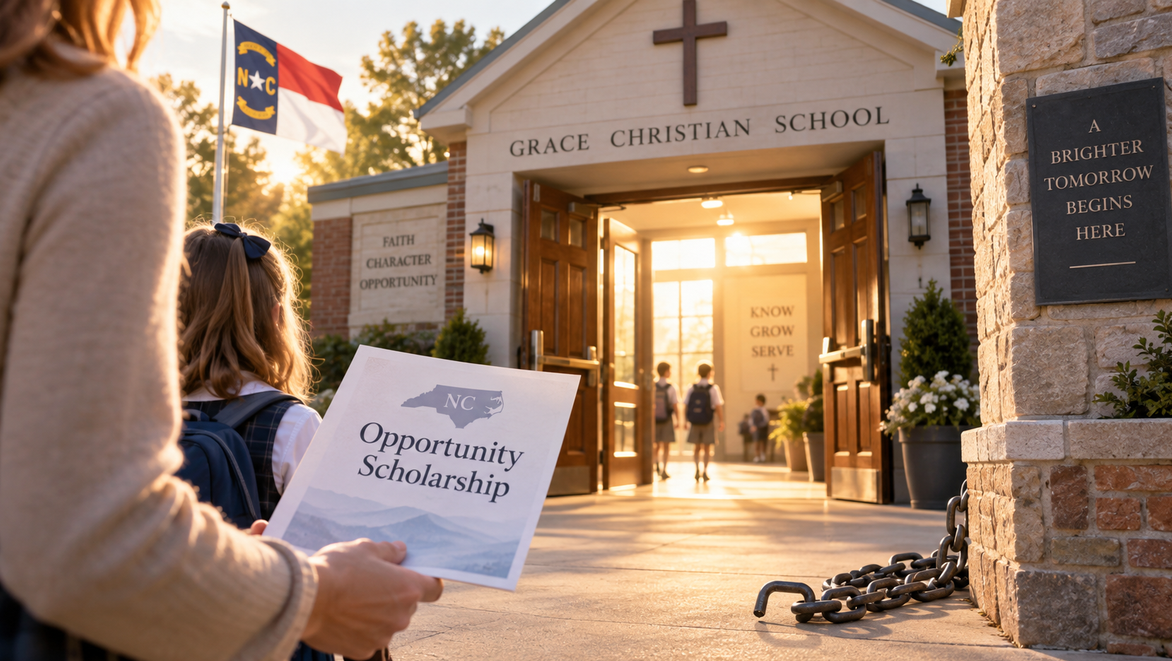
Some Christian school leaders are uneasy about North Carolina’s Opportunity Scholarship Program.
Their concern is easy to understand.
What happens if a future legislature requires schools that admit scholarship students to change their curriculum? What if the government eventually imposes requirements on sexuality, employment policies, admissions, or other matters that directly affect biblical convictions?
In other words, could accepting Opportunity Scholarship funds today ultimately place Christian schools under greater government control tomorrow?
These are not frivolous questions.
Christian institutions should never casually surrender their independence. A school that trades its Christian mission for financial security gains nothing of value.
Nevertheless, a possible future danger should not be mistaken for a present relinquishment of religious liberty.
In fact, this debate began almost as soon as North Carolina established the program.
In December 2013, Alliance Defending Freedom sent a letter to Christian schools about the newly enacted Opportunity Scholarship Program.
At the time, Equality North Carolina, the state’s leading LGBTQ advocacy organization, challenged the participation of schools that upheld traditional Christian beliefs about human sexuality. Rather than advising Christian schools to retreat, ADF urged them not to give up their rights protected by the Constitution.
The letter concluded that Christian schools should be able to participate in the program “without abandoning their faith” and stated that ADF was prepared to defend that right if necessary.
That argument remains important.
Christian educators should first understand that an Opportunity Scholarship is legally awarded to an eligible student. The state is not hiring a Christian school to operate a government educational program. Parents decide where their child will attend, and scholarship assistance follows that decision.
North Carolina law makes another significant distinction. It provides that Opportunity Scholarship funds awarded to students “shall not be considered funding from the State of North Carolina” for purposes of the statutory classification applicable to nonpublic schools.
This language does not guarantee that future lawmakers will never attempt objectionable regulations. But it clearly undermines the simplistic argument that accepting scholarship students automatically jeopardizes a Christian school’s commitment to a Christian worldview or that it turns the school into an arm of the state.
There is more.
North Carolina law governing private church schools contains an extraordinary statement:
“No human authority shall, in any case whatever, control or interfere with the rights of conscience or with religious liberty.”
The same body of law recognizes that private church schools may voluntarily participate in state-operated or state-sponsored programs.
The legal framework, then, is not based on government ownership or control. In fact, it does the opposite: state law already recognizes religious conscience and voluntary participation.
Of course, Opportunity Scholarships are not without conditions.
Participating schools must comply with testing, administrative, recordkeeping, and certain financial requirements. Christian schools should clearly understand these obligations, and most already do so.
Still, accountability should not be confused with control of the religious mission.
At present, North Carolina does not dictate to an Opportunity Scholarship school what it must preach in chapel or teach in the classroom.
The more serious concern is what might happen later.
Financial dependence can make future resistance challenging.
Suppose a school reaches the point where hundreds of students attend thanks to scholarship assistance. Teachers have been hired, buildings expanded, and programs enlarged. Then imagine a future legislature attaching a condition that strikes at the school’s biblical convictions.
Walking away from substantial revenue could be painful.
Yet former North Carolina House Speaker Pro Tem Paul “Skip” Stam, who crafted and championed the Opportunity Scholarship legislation, believes the program’s political and legislative safeguards are stronger than some critics may realize.
Stam told me that, in his professional legislative judgment, there is “zero chance” that harmful regulations will be enacted before 2031. He emphasized the program’s forward-funding structure, under which future appropriations are already set by law, and the political strength of more than 100,000 participating students and their families.
As Stam explained, any major reversal would require substantial political power in Raleigh and carry significant political consequences:
“Their parents are voters of all types and tend to be loud. Opponents would suffer politically if they made significant changes.”
Stam also suggested that schools concerned about future uncertainty could strengthen their financial independence by setting aside reserves from a portion of the tuition revenue they receive from Opportunity Scholarship students. Such planning could make it easier for a school to exit the program if future conditions threatened its Christian mission.
That does not eliminate all future risk. Laws can change, and no legislature can permanently bind another. However, Stam’s point is important: the program is no longer a small experiment serving a handful of families. It has become deeply established in North Carolina education, with a large constituency directly affected by any attempt to dismantle or radically alter it.
That is why every Christian school should set its red lines before dependency develops.
The families these scholarships benefit are of great importance.
Before such programs existed, a family that believed conscience required Christian education often faced a dual financial burden. They paid taxes that supported public education, then paid private-school tuition from what remained.
For wealthy families, that might have been possible. For a single mother, a pastor’s family, a mechanic, a schoolteacher, or a young couple with several children, Christian education would often be out of reach.
Today, Opportunity Scholarships have changed the equation.
The question, therefore, is not only what Christian schools might risk by participating.
It is also:
What opportunities for Christian education might be lost by refusing to participate?
Every scholarship is about much more than money.
It may represent a child whose parents desperately want an education aligned with their faith but could never otherwise afford it. It may also mean thousands of hours in a child’s formative years spent in an environment where prayer is welcomed, biblical morality is taught, and Jesus Christ is openly honored.
The potential downsides certainly warrant vigilance, but they should not overshadow what these scholarships are making possible for so many families today.
For some children, a Christian education profoundly shapes the course of their entire lives. For others, it could even mean the difference between heaven and hell.
Moreover, Scripture places tremendous responsibility on parents for their children’s upbringing and education.
Regarding the words of God, Moses commanded: “And thou shalt teach them diligently unto thy children” (Deuteronomy 6:7).
Paul instructed parents to raise their children “in the nurture and admonition of the Lord” (Ephesians 6:4).
Granted, the government has a legitimate interest in education. But our children do not belong to the government. School choice gives families additional ways to fulfill the responsibility God has entrusted to them.
Christian schools considering or currently receiving Opportunity Scholarships therefore need neither recklessness nor fear. They need wisdom.
A school accepting Opportunity Scholarships should decide in advance:
- We will receive scholarship students while remaining faithful to our Christian mission.
- We will not surrender biblical teaching.
- We will not allow the government to determine our theology or Christian polity.
- We will not abandon Christian standards simply to preserve revenue.
- If a future government ever requires us to choose between scholarship money and faithfulness to Christ, the money shall be forfeited.
These convictions should be established before financial dependence takes hold.
There is nothing wrong with Christian schools asking tough questions about government funding. In fact, they should.
They should know exactly where their biblical boundaries lie and be spiritually, legally, and financially prepared to walk away if the government ever demands compromise.
However, for thousands of North Carolina families, Opportunity Scholarships are opening doors that once seemed permanently shut.
Christians need not assume that because government helped a parent open the door, government already owns the room. It doesn’t.
And the opportunity to provide a Christian education, when it is so desperately needed, has never been greater in North Carolina.