by Dr. Mark Creech
Director of Government Relations
Return America
When North Carolinians vote this November, most people will naturally focus on the candidates. They will vote for members of Congress, state lawmakers, judges, county officials, school board members, and others.
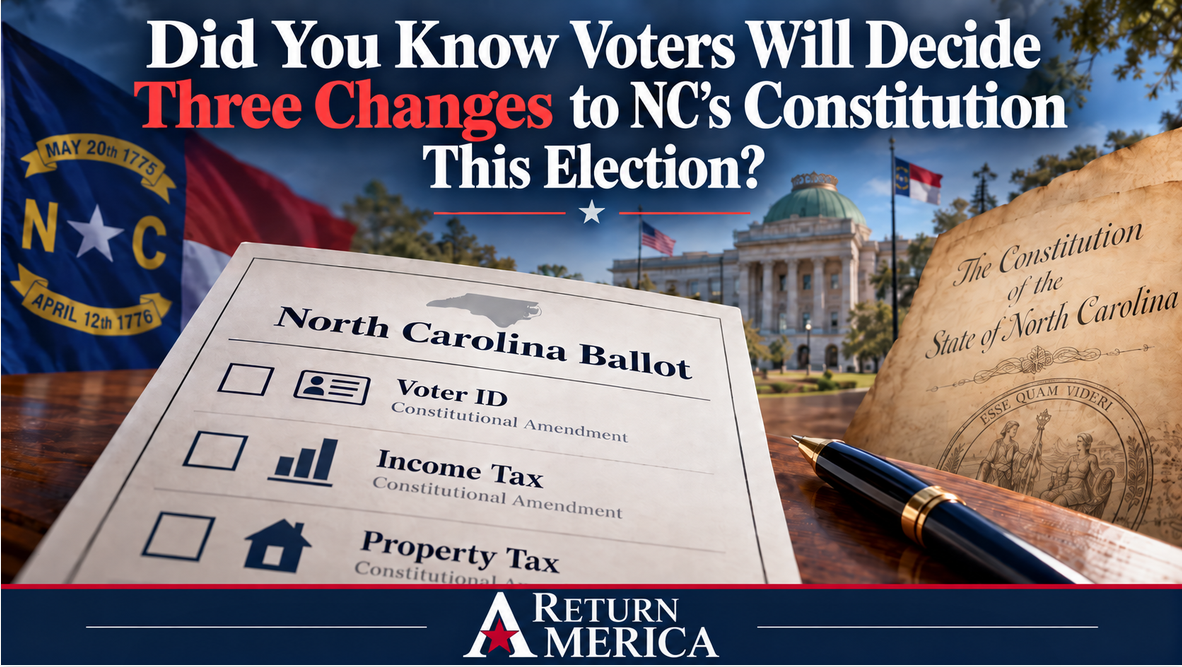
But three proposed changes to the North Carolina Constitution will also be on the ballot. These questions may not receive as much attention as the candidates, but they are very important nonetheless. The General Assembly can usually change a law later, but changing the State Constitution is considerably more difficult. That is why voters should understand exactly what they are being asked to decide this year.
Here are the three amendments in simple terms.
1. Photo ID for Every Type of Voting
The first proposed amendment addresses voter identification.
The ballot will say:
“Constitutional amendment to require all voters, not just those presenting to vote in person, to present photo identification before voting.”
North Carolina’s Constitution currently addresses photo identification for in-person voting. The proposed amendment would remove the words limiting that requirement to in-person voting. Instead, the Constitution would state simply that voters must present photo identification before voting.
Here is the easiest way to understand it: the constitutional requirement would apply to all voters, regardless of how they vote.
Something critical could easily be missed here. North Carolina law already requires a person voting by absentee ballot to submit a copy of photo identification or to use one of the exceptions provided by law. So this amendment would not create a voter-ID requirement for absentee voting from scratch. Instead, it would place that broader requirement directly in the State Constitution, where it would be much harder to change later because any future constitutional change would ultimately have to be approved by the voters.
That is the significant difference between placing the requirement in statute and placing it in the Constitution.
Therefore, the primary question before voters is simple:
Should North Carolina’s Constitution require photo identification for every method of voting?
2. Lowering the Maximum State Income-Tax Rate
The second proposed amendment deals with income taxes.
Currently, the North Carolina Constitution limits the income tax rate to 7 percent. The proposed amendment would lower that maximum to 3.5 percent.
The ballot will say:
“Constitutional amendment to keep the State income tax rate from being raised higher than three and one-half percent (3.5%).”
Here is one important point to understand: this amendment would not automatically set everyone’s income tax rate to 3.5 percent. Think of it as a ceiling.
The Constitution currently limits lawmakers from raising the income-tax rate above 7 percent. If voters approve this amendment, the ceiling would drop to 3.5 percent. Future lawmakers could keep tax rates below 3.5 percent, but they could not raise them above that level without another constitutional change. The amendment would apply to both personal and corporate income taxes for taxable years beginning on or after January 1, 2027.
Supporters of the amendment argue that a lower constitutional ceiling would protect taxpayers from large future income-tax increases. Critics counter that it could make it harder for future lawmakers to raise revenue if North Carolina faces serious financial needs.
The basic question is:
Should North Carolina’s Constitution prevent future lawmakers from setting an income-tax rate higher than 3.5 percent?
3. Putting Limits on Local Property-Tax Increases
The third proposed amendment deals with property taxes charged by local governments.
The ballot will say:
“Constitutional amendment requiring limits on property tax increases by local governments.”
This amendment needs a little more explanation because it does not tell voters what the actual limit would be. It does not say property-tax levies could rise only 2 percent, 3 percent, 5 percent, or any other particular number.
Instead, the amendment would require the General Assembly to pass statewide laws limiting how much local property-tax levies can increase. Those laws could also include exceptions.
Here is a simple way to picture it. Suppose a county collects $100 million in property taxes this year. The amendment would require state lawmakers to create rules limiting how much that total property-tax levy could increase in the future.
But voters are not deciding this November exactly what that limit should be. The General Assembly would decide those details later.
Supporters say such limits could help protect homeowners and other property owners from rapidly rising local property-tax collections. Critics say statewide limits could make it harder for counties and cities to fund schools, law enforcement, fire protection, roads, and other local services.
So the basic question is:
Should the State Constitution require state lawmakers to limit how much local property-tax levies can increase?
Three Constitutional Questions Christian Citizens Need to Understand
These amendments address three very different subjects: voting, state income taxes, and local property taxes. Yet all three share something important. If voters approve them, they will become part of the North Carolina Constitution.
Moreover, if approved, their effect could last for generations.
That makes these decisions different from voting on an ordinary law.
Christians should take their responsibility as citizens seriously. That means more than simply knowing the candidates’ names. It also means knowing what else is on the ballot and understanding the choices before us.
When you vote on November 3, do not stop after you finish voting for the candidates. Keep reading. Three constitutional questions will be waiting for you.
Know what they mean. Read them carefully. Make an informed decision about what should and should not be written into North Carolina’s Constitution.