by Dr. Mark Creech
Director of Government Relations
Return America
Suppose you put $100 on the Carolina Panthers to win Sunday’s football game. If they win, you collect your winnings. If they lose, you’re out $100. Everyone knows what that’s called. It’s gambling.
Suppose you visit another website and spend $60 to purchase what the company calls “contracts” that predict the Panthers will win. If they win, those contracts pay you $100, leaving you with a $40 profit. If they lose, your $60 is gone.
In the latter case, you’re not called a gambler; you’re called a trader. Instead of placing a bet, you’re buying a financial contract. Instead of gambling, you’re participating in a “prediction market.”
Confused? Don’t be. The basic idea is simple. In both cases, you’re betting money on a football game’s outcome.
These transactions differ legally and technically, but the resemblance is unmistakable. That resemblance is at the center of a controversy now at the door of the United States Supreme Court.
On October 8, the National Football League urged the Supreme Court to consider who should regulate sports-related prediction markets. According to the league, the first Sunday of the football season saw approximately $1.8 billion in NFL-related contracts traded. That’s a billion with a B!
Prediction-market companies argue that their contracts are financial products subject to federal oversight. State gambling regulators contend that contracts tied to sporting events resemble ordinary wagers and should fall under state gambling laws. Even the NFL has raised concerns about consumer protections and the integrity of professional sports.
North Carolina is Already Involved.
Earlier this year, the General Assembly approved legislation creating a separate tax system for sports-related prediction markets. Beginning January 1, 2027, qualifying operators will pay a 6 percent tax on net trading-fee revenue attributable to North Carolina.
Traditional sports wagering operators currently pay an 18 percent tax on gross wagering revenue, scheduled to increase to 23 percent in July 2027. These percentages aren’t directly comparable because they apply to different kinds of revenue. Nevertheless, the law shows how differently the two activities are treated. Why should risking money on the outcome of the same football game fall under such different rules?
Not Every Financial Risk Is Gambling
To be fair, not every financial contract involving an uncertain future event is gambling. Suppose a strawberry farmer purchases a contract that pays him if a late freeze destroys his crop. He’s protecting himself against financial loss, not merely hoping to profit from a prediction. That’s called hedging. Similarly, when you buy stock, you’re buying ownership in a real business, hoping to benefit from its success.
Gambling proponents sometimes argue that investing in the stock market is the same as gambling because both involve financial risk. But risk alone doesn’t make something gambling. Buying stock in a productive business is fundamentally different from betting on the Carolina Panthers. Certainly, some people speculate so recklessly in stocks that their behavior resembles gambling. Nonetheless, responsible investing is not the same as wagering money on whether a football team wins or loses.
The Power of a Respectable Name
The gambling industry has used more appealing terminology for years. Today, gambling is commonly called “gaming,” a term that sounds more like playing Monopoly than risking the family paycheck.
North Carolina didn’t simply establish a state lottery. It called it the “Education Lottery,” linking the noble cause of educating children to an enterprise that depends on people losing money. The name suggests that buying lottery tickets helps our schools. Yet what was sold to North Carolinians as a way to support education has become an enormous gambling enterprise whose growth increasingly outpaces the educational benefits it delivers.
According to a September 2026 State Auditor’s report, lottery sales skyrocketed 51 percent over two years, from $4.3 billion to $6.6 billion. Yet the percentage transferred to education fell from 23 percent to 16 percent, while annual transfers stayed near $1 billion. Even the State Auditor questioned whether the lottery’s original purpose was being fulfilled. The name still proudly proclaims “Education Lottery,” but the financial record tells a far less flattering story.
Then there are “digital instant games.” Sounds innocent enough, doesn’t it? These online games resemble casino slot machines and are available on smartphones. They generated approximately $2.6 billion in sales during fiscal year 2025, nearly 40 percent of all lottery sales. With about 87 percent returned in prizes, a smaller portion remains for education and expenses. What sounds like a harmless digital convenience is actually an expanding form of casino-style gambling.
So gambling becomes gaming. A lottery becomes an Education Lottery. Online slot-machine-style games become digital instants. Now, betting on football can become financial trading. The bettor becomes a trader, the wager becomes a contract, and the gambling platform becomes a prediction market.
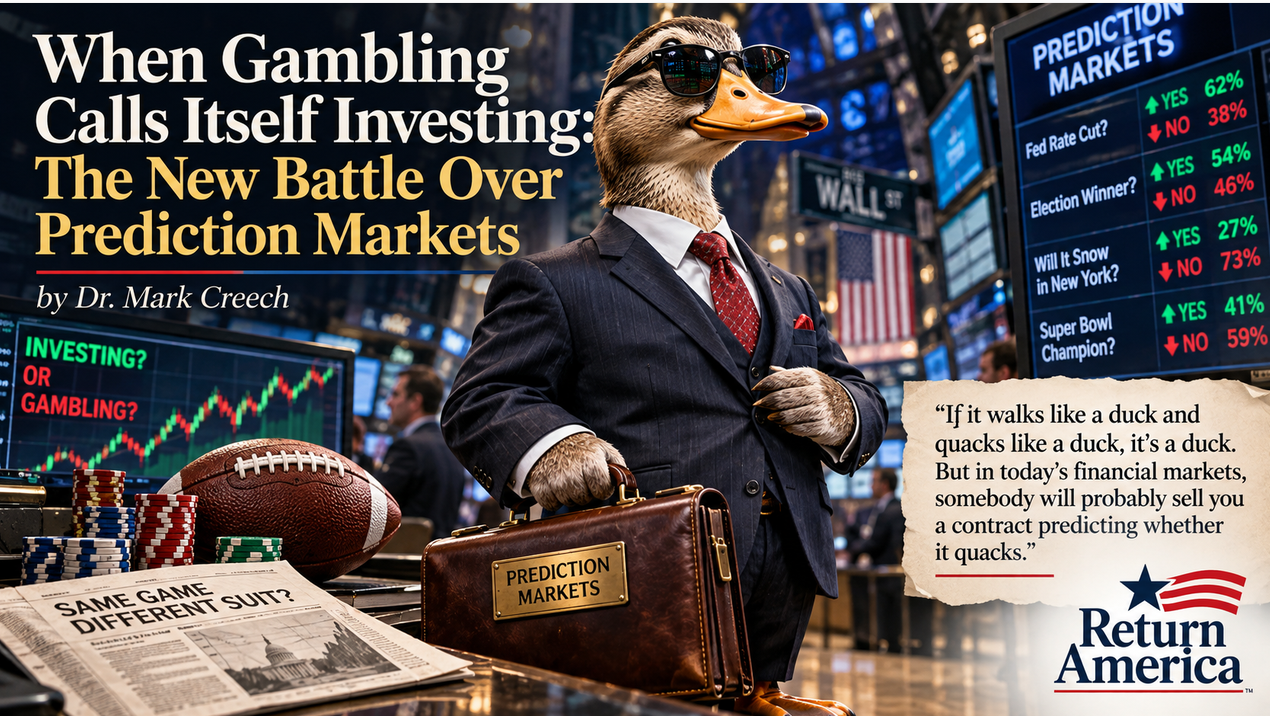
There’s an old saying: “If it walks like a duck and quacks like a duck, it’s a duck.” But in today’s financial markets, somebody will probably sell you a contract predicting whether it quacks.
Changing the words used to describe an activity can change how people perceive it, even when the underlying conduct remains essentially the same.
Looking Beyond the Label
The Bible warns against greed and the pursuit of quick and easy riches. First Timothy 6:9 cautions that those determined to become rich can fall into temptation and destructive desires. The Bible encourages honest work and responsible investing, not financial risk-taking.
The Bible repeatedly warns us against greed, wanting more and more, measuring our worth and status by what we possess, never being satisfied or content with what we have, and letting the love of money, which Scripture calls the root of all kinds of evil, govern our lives.
In 2 Corinthians 11:14, the Apostle Paul offers another sobering warning: “For Satan himself is transformed into an angel of light.” Paul was addressing spiritual deception, yet the principle illustrates a broader truth. Something dangerous can appear alluring, attractive, respectable, and even beneficial.
That is why the debate over prediction markets deserves more than arguments about regulation, financial terminology, and tax revenue. North Carolina already collects revenue from legalized sports gambling and will soon begin taxing prediction-market operators. Nevertheless, government revenue should never take precedence over consideration of the consequences for individuals, families, and society.
Whether a man calls himself a gambler or a trader, whether his transaction is called a wager or a financial contract, the essential question remains: What is he actually doing? Changing the vocabulary does not necessarily change the activity, nor does altering its appearance necessarily change its moral character.
After all, you can change the label on a bottle of poison and call it a wellness product, but that doesn’t make what’s inside any less poisonous.