
by Rev. Mark Creech
RevMarkCreech.org
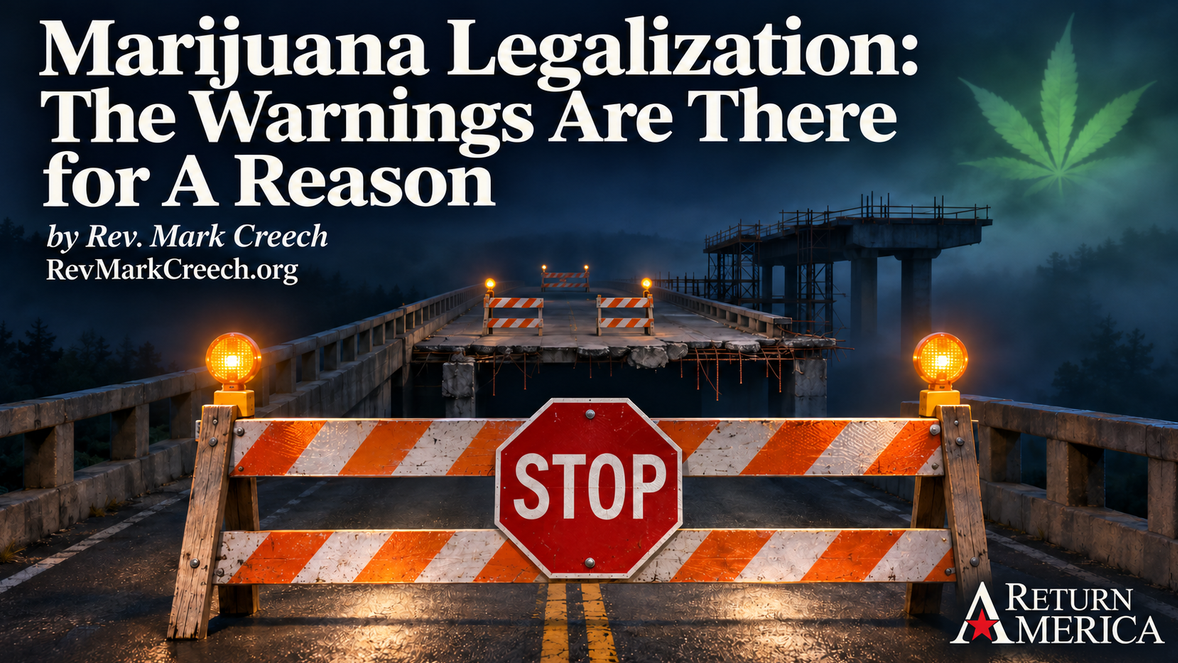
Recently, I watched a movie scene in which a car sped toward a bridge under construction. A wooden barricade stood across the roadway, bearing a reflective sign with a single urgent command: STOP.
The car smashed through it.
Then came another barricade. And another. And still another. Their reflective warnings flashed in the headlights as the car smashed through them, sending splintered wood flying in every direction. Then, suddenly, the roadway ended. The car plunged into the gap where the rest of the bridge should have been. The warnings had been unmistakable. Each barricade offered another opportunity to stop.
You know, I think a culture can be a lot like that. It can become so enamored with removing restraints that it begins measuring progress by how many barriers it tears down, without asking whether those barriers protect something worth preserving. North Carolina should consider that danger before legalizing marijuana.
The question is becoming more urgent. Rep. Robert Reives, the presumptive next House speaker, recently reaffirmed House Democrats’ longstanding interest in medical marijuana legislation, saying, “We’ve always been interested in doing that.” Governor Josh Stein supports going further by establishing a legal market for recreational marijuana. His cannabis advisory council has already recommended that approach in its interim report, with final recommendations due by December 31.
Before moving forward, lawmakers should examine the warning signs. Colorado and Washington voters approved recreational legalization in November 2012. Research published since then has documented serious reasons for caution:
- Impaired driving: A 2022 randomized trial in JAMA Psychiatry found that smoking marijuana impaired driving performance in a simulator, including among people accustomed to using the drug.
- Psychiatric effects: A 2020 review of experimental studies in The Lancet Psychiatry found that THC can trigger temporary psychiatric symptoms, including hallucinations and delusions, in healthy individuals.
- Psychotic disorders: A 2019 multicenter study associated daily high-potency cannabis use with nearly five times the odds of psychotic disorder compared with never using cannabis.
- Dependence: A 2020 systematic review estimated that approximately one-third of young people using cannabis weekly or daily developed dependence.
- Respiratory harm: A 2017 National Academies review found substantial evidence linking long-term cannabis smoking with worse respiratory symptoms and more frequent chronic bronchitis episodes.
- Vascular dysfunction: A 2025 JAMA Cardiology study found impaired blood vessel function among otherwise healthy regular marijuana smokers who did not smoke tobacco or vape.
- Severe vomiting: Prolonged, frequent cannabis use can cause cannabinoid hyperemesis syndrome – episodes of severe nausea, abdominal pain, and uncontrollable vomiting. Severe episodes are sometimes described as ‘scromiting,’ a combination of screaming and vomiting.”
Even the New York Times editorial board has reconsidered its earlier optimism about marijuana. In its February editorial, “It’s Time for America to Admit That It Has a Marijuana Problem,” the Times revisited assurances that legalization would bring few adverse consequences and might not increase marijuana use, acknowledging: “It is now clear that many of these predictions were wrong.” The board still supports legalization but now urges stronger safeguards against consequences it previously underestimated.
But stronger safeguards do not resolve the question North Carolina faces. Alcohol has long been taxed and regulated, yet its burdens on families, highways, and public health remain substantial. Such measures can reduce harm; they cannot make an intoxicating substance harmless. Before authorizing another commercial market for intoxication, lawmakers should ask whether the wiser course is to prevent additional burdens rather than to promise to manage the harms afterward.
Supporters appeal to personal freedom, medical benefits, criminal justice fairness, and tax revenue. Each argument deserves an answer.
Personal freedom matters, but impaired driving and accidental childhood exposure demonstrate that the consequences can extend beyond the consumer.
Calling marijuana “medical” does not exempt it from the standards we require of medicine. Patient testimonials cannot establish safe dosing, effectiveness, or long-term safety. The FDA has approved specific cannabis-derived or related drugs for certain conditions, but it has not approved marijuana itself. More specifically, the FDA has not approved smoked marijuana to treat any disease. North Carolina should demand rigorous evidence for the proposed products and uses. A legislative vote cannot substitute for scientific validation.
Fairness in criminal justice requires proportionate penalties and consistent enforcement; neither requires authorizing a commercial marijuana industry. Likewise, tax revenue must be weighed against the costs borne by families, health care systems, and the public. Revenue alone does not measure the public good.
North Carolina faces a choice about what it calls progress. Greater access, another commercial industry, and another source of tax revenue may satisfy political ambitions. But they do not address warnings about dependence, psychiatric illness, impaired driving, and burdens that extend beyond the user. Nor do they justify adding the harms of a commercial marijuana market to the heavy burdens we already bear from alcohol.
We don’t have to choose between tolerating an unregulated THC market and legalizing marijuana. Lawmakers can close loopholes that allow intoxicating products to evade meaningful controls, restrict dangerous products, enforce protections for children, and strengthen prevention and treatment. They can pursue proportionate penalties and fair enforcement without authorizing a commercial marijuana industry. The goal should be to reduce the harms already confronting our communities, rather than expand the market for intoxication.
Scripture counsels, “A prudent man foreseeth the evil, and hideth himself” (Proverbs 22:3). Prudence requires more than acknowledging the dangers a study or report identifies. It requires heeding warnings and changing course.
North Carolina should stop short of legalizing marijuana. A culture shows progress not by how many barriers it tears down. Sometimes it demonstrates wisdom by recognizing what the barriers protect and stop.
Destroying a barricade is no proof that the road ahead will be safer.