by Rev. Mark Creech, D.H.L
RevMarkCreech.org
John F. Kennedy has always been a figure I admired, not because he was without feet of clay, but because he embodied qualities that stirred something noble in the American spirit. His youth and vitality breathed fresh confidence into a country emerging from the long shadows of global conflict. His steady leadership during the Cuban Missile Crisis likely spared the world from catastrophe. His vision for the space program summoned the nation to reach beyond the possible. Above all, Kennedy possessed an incomparable gift for communication, the rare ability to give voice to ideals in ways that lifted the national spirit and called us upward.
Yet it was only recently, while rereading his famous 1960 address before the Greater Houston Ministerial Association during his presidential campaign, that I saw something in the late president I had never fully grasped. In that iconic moment, widely praised for its political genius, he articulated a view of the separation of church and state that struck me as far more rigid, far more secular, than I had ever understood. Admiration for a man’s strengths does not prevent honest reflection on his errors, especially when those errors helped shape the way our nation now thinks about faith in public life.
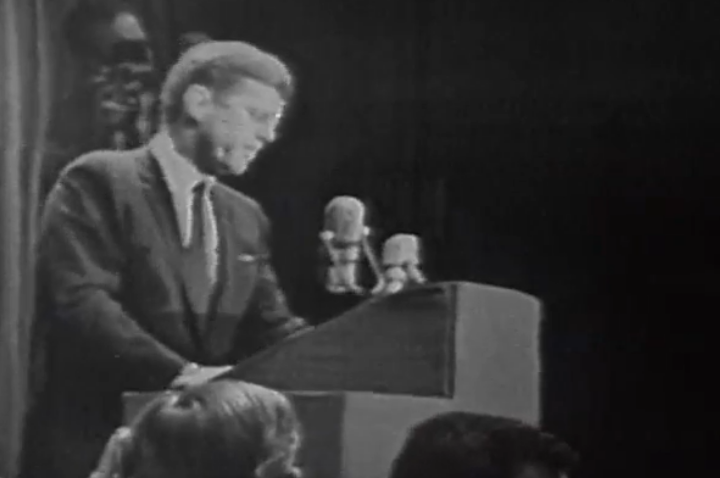
When Kennedy addressed the Protestant ministers in Houston, he faced the legitimate concern that Rome might guide a Catholic president. A simple reassurance that no bishop or pope would dictate his decisions would have sufficed. But Kennedy went further. He declared that he believed in an America where “the separation of church and state is absolute,” where pastors should avoid advising their congregations politically, and where no religious body should seek to influence public policy “directly or indirectly.”
Some argue that Kennedy was only trying to calm fears about papal control. But his own words clearly extend well beyond that. He was not merely rejecting ecclesiastical domination; he was advocating for a wholesale rejection of religious influence in the public square. While some today insist that Kennedy’s vision reflected the Founders’ intent, history does not support this claim. Early American leaders, though wary of government-imposed religion, consistently welcomed religion’s moral influence. Congress employed chaplains. Presidents issued calls to prayer and fasting. Jefferson himself attended worship services held in the halls of Congress. Kennedy’s “absolute” separation was not their model; it was a modern, secular reinterpretation that recasts the constructive role of faith as something constitutionally suspect.
By treating religious influence as inappropriate, Kennedy implied that the prophetic voices that fueled abolition, civil rights, temperance reform, and countless moral awakenings had no rightful place in shaping public policy. This was not simply a reassurance to Protestants. It was the embrace of a privatized faith, a view of religion that belongs in the home and the church, but not in the nation’s civic life.
Kennedy’s philosophy did not remain theoretical. When the Supreme Court handed down its egregious 1962 decision in Engel v. Vitale, striking down a voluntary, non-sectarian prayer in the public schools, the nation looked to the president for guidance. The prayer neither named Christ nor compelled participation. It was simply an acknowledgment of dependence on God, the kind of civic expression that had long accompanied American public life. Yet Kennedy did not question whether the Court had overreached. Instead, he suggested that Americans should “pray a good deal more at home” and attend church more faithfully. Some say he was merely showing respect for the Court, but presidents routinely comment on decisions that touch the nation’s moral fabric. Kennedy chose not to. His reaction was not neutral; it was aligned with the High Court’s wrongheaded interpretation of the First Amendment.
Others contend Kennedy was protecting minority rights. But there is a difference long recognized in American tradition between coercive religious exercises, which rightly fall outside government’s purview, and voluntary acknowledgments of God that enrich our civic identity. Kennedy erased that distinction. His response revealed what his Houston speech had already implied: religion belonged in private spaces, not public ones. That stance did not grow out of the Founders’ vision, but out of a secular reading of the First Amendment that ultimately – and unfortunately – became dominant in American understanding.
Kennedy rightly rejected the notion that a president should take orders from any religious authority. Still, in dismissing that danger, he embraced a doctrine that was equally unhealthy – a philosophy of public life that treated faith as something to be quarantined rather than something necessary for speaking to the conscience of a nation.
A better understanding of church and state is the one the Founders held: the state must not govern the church, the church must not govern the state; nevertheless, people of faith may speak, persuade, advocate, and shape public policy according to conscience. The wall of separation protects the church from state control; it was never intended to silence religious conviction or banish its influence from public policy.
Appreciating Kennedy’s remarkable strengths does not require the adoption of his philosophical missteps. He was a gifted leader and a masterful communicator, but even great men err, and when they do, the consequences often outlive them. The secular reading of the First Amendment that Kennedy embraced has permeated most of modern America’s public life. It need not continue. It should not continue. A free people can honor both the integrity of the state and the public witness of faith. Indeed, our nation is healthiest when it does both.
Kennedy lifted our aspirations, but the American experiment continues, and it calls us to recover a truer recognition of faith and freedom.
Picture: At a lectern in Houston, 1960, during his address to the Houston Ministerial Association. Photo courtesy of the John F. Kennedy Presidential Library and Museum.