
by Rev. Mark Creech, D.H.L.
RevMarkCreech.org
Christmas is so familiar that it is easy to miss how utterly unlike every other religious claim it truly is. The story is renowned throughout the world: a child in a manger, angels, shepherds, and songs of peace. Yet beneath these familiar scenes lies a declaration so radical that it reshapes how we understand God, humanity, and salvation itself.
Christianity does not begin with human beings reaching upward toward the divine. It starts with God coming down – entering history, taking on human flesh, and making Himself known in a way no philosophy, no moral system, and no religious speculation ever could. In the Incarnation of Christ, God does not merely speak; He demonstrates. He does not remain distant; He draws near. He does not reveal ideas about Himself; He reveals Himself.
The birth of Jesus Christ is not simply the opening chapter of His earthly life. It is foundational to the Christian faith. Everything we believe about who God is, how He rescues and redeems, and what He requires of us rests upon this astonishing truth: God has entered the human story.
To properly reflect on Christmas, then, is to move beyond sentiment and recover the wonder of it. The Incarnation reveals the heart of God, the nature of true greatness, and the sure hope of salvation anchored in time. The following seven timeless truths invite us to look again, carefully and reverently, at the mystery of how God robed Himself with humanity, and rediscover why this moment remains the most consequential event the world has ever known.
The Incarnation Is God’s Final and Full Self-Revelation
Human beings have always asked the same essential question: What is God like?
Creation shows us His power, conscience whispers of His moral law, and history records humanity’s countless attempts to imagine, define, and explain the divine. Yet Scripture is clear that none of these, on their own, can bring us to a true knowledge of God. The world does not know God through human wisdom alone. If God is to be known rightly, He must make Himself known (1 Cor. 1:21).
That is precisely what happens in the Incarnation.
An old illustration helps clarify this mystery. In the Rospigliosi Palace in Rome, Guido Reni’s celebrated fresco The Aurora is painted on a lofty ceiling. From the floor below, however, the painting is difficult to study. Straining upward, the viewer’s neck stiffens, the eyes grow weary, and the figures blur into indistinct shapes. To remedy this, a large mirror was placed near the floor, reflecting the artwork clearly so that its beauty could be examined more carefully and more easily.
In a far more profound sense, this is what God has done for us in Jesus Christ. In the Incarnation, God reveals Himself. We cannot, by searching, climb our way up to God. The more we attempt to comprehend Him through human intellect only, the more bewildered we become. In the birth of Christ, God does not send us a distant image of Himself; He becomes a human being. He comes to us Himself, stooping to our level so that finite minds might truly know what they need to know about the infinite.
Jesus Christ does not merely reflect God; He is God. In Him, God’s character is not described in abstractions but displayed in a real person’s life. His compassion toward the broken, His patience with the slow to believe, His severity toward hypocrisy, His tenderness toward the weak, and His willingness to suffer rather than condemn are not simply admirable virtues – they are a revelation of the very character of God Himself. Christ is the radiance of God’s glory, and the exact imprint of His nature (Heb. 1:3). To see Christ is to encounter God as He truly is.
Yet this self-revelation was not an improvisation, nor a response to human confusion. God did not reveal Himself in Christ because history demanded it, but because eternity had willed it. The Incarnation was not God’s last resort; it was His long-intended design, a purpose God set in motion before the world began.
The Incarnation Was Eternally Intended, Not Simply Born of Circumstance
It is easy to assume that the Incarnation came about because history reached a breaking point – that Christ entered the world only after human sin and suffering made divine intervention necessary. Read this way, Christmas can appear to be a response to circumstance, a gracious remedy applied once things had gone terribly wrong.
Scripture presents a far deeper and more comforting truth.
The coming of Christ was not God’s afterthought, nor was it simply born of historical circumstance. The Bible teaches that long before the world was ever made, God purposed to redeem a people through His Son. This does not mean that sin was insignificant or that evil was somehow excusable. The Fall was real, tragic, and devastating. Nor does it mean that God was the author of humanity’s great fall. Human rebellion mattered, and it mattered profoundly. Yet it did not take God by surprise, nor did it force His hand.
The New Testament speaks of Christ as foreknown before the foundation of the world and revealed in time for our sake (1 Pet. 1:20). This language reaches into eternity past – before Bethlehem and before the Garden of Eden – placing the Incarnation within the eternal counsel of God. History provided the setting, but eternity supplied the purpose. The Incarnation did not arise merely because circumstances demanded it, but because divine love had already determined it.
That God would set His love upon sinners before they ever existed, and resolve, even then, to come for them Himself, is a wonder beyond human reckoning.
This truth does not make redemption mechanical; it makes it exceedingly merciful. God did not decide to love after humanity fell. He loved first. The Incarnation, therefore, is not the story of God adjusting His plans, but of God fulfilling a purpose already rooted in His eternal love – a purpose that would not be undone even by something as dreadful as human sin.
Christmas marks the moment when what was purposed in eternity entered time. The child in the manger stands as a living testimony that God’s grace was not improvised and redemption was not merely a reaction to human failure. What unfolded in history was the outworking of a design established before the world began – a design eternally grounded in the very nature of God Himself. That eternal purpose did not remain distant or abstract – it united God and humanity in the person of Jesus Christ.
The concept stretches the limits of human understanding. Yet it is true.
The Incarnation Unites God and Man Without Confusing Either
When God’s eternal purpose entered time, it did not do so as an idea, a symbol, or a temporary appearance. The Incarnation is how God did more than draw near to the world; it is God’s full union with humanity in Jesus Christ.
This union is without parallel. In Christ, God does not cease to be God, and humanity is not absorbed into divinity. Jesus is not half God and half man, nor is He God merely appearing in human form. He is entirely God and fully man – two natures united in one Person. Scripture speaks of Him as the One in whom “the whole fullness of deity dwells bodily” (Col. 2:9), while at the same time affirming that He was made “like His brothers in every respect” (Heb. 2:17).
This distinction is not a matter of theological precision alone; it is essential to salvation itself. Only one who is truly God can reveal God perfectly, forgive sin authoritatively, and conquer death decisively. At the same time, only one who is truly human can obey God’s law perfectly in our stead, and pay the penalty for our sins – death – in our place. Scripture holds both truths together without hesitation: “Since therefore the children share in flesh and blood, He Himself likewise partook of the same” (Heb. 2:14). If Christ is less than God, He cannot save. If He is less than man, He cannot represent us.
The wonder of the Incarnation is that God did not save humanity from the outside. He wholly entered our condition – taking on real flesh, a real mind, real emotions, and real weakness, yet without sin (Heb. 4:15). He shared our nature so completely that He could stand where we stand, endure what we endure, and do for us what we could never do for ourselves.
Daniel Webster once expressed the proper posture toward this mystery. When asked whether he truly understood how Jesus could be both fully God and fully man at the same time, Webster replied that he did not. If he could fully comprehend Christ, he reasoned, Christ would be no greater than himself. It was precisely because Christ’s nature surpassed his understanding that Webster knew he needed Him. A Savior who can be fully explained would be no Savior at all.
In Jesus Christ, heaven and earth are not merely reconciled; they are joined. He is the one Mediator between God and men (1 Tim. 2:5), the living union of divine holiness and human weakness. Because this union is real and enduring, redemption is not a temporary solution but an eternally secure one for all who believe.
Since this is the means by which God came to us, the Incarnation redefines greatness as we generally know it.
The Incarnation Redefines the Nature of True Greatness
In the ancient world, the deification of rulers, heroes, or philosophers was almost always a movement upward. Powerful men were declared divine only after demonstrating dominance through conquest, political authority, military victory, or cultural influence. Egyptian pharaohs, Roman emperors, and mythic heroes like Hercules were exalted because they already stood above others. Deification functioned as political propaganda, reinforcing authority, legitimizing rule, and demanding submission.
In short, ancient deification was about the acquisition or consolidation of power.
Some have argued that Christian claims about Christ’s deity are not unique. Ancient practice often deified remarkable figures, and Christianity followed a familiar pattern, they argue. At a glance, the comparison may seem plausible. Yet the Incarnation does not fit that pattern at all.
The Incarnation of Christ moves in the opposite direction entirely.
Christianity does not proclaim that an extraordinary man was elevated to divine status. It proclaims that the eternal Son of God descended into human weakness. The movement is not man rising to godhood, but God stooping into humanity. This reversal stands at the very heart of the Christian faith and redefines greatness at its most fundamental level.
Philippians 2:6–8 captures this with devastating clarity. It tells us that Christ did not seek equality with God, which He already possessed. Instead, He emptied Himself, taking the form of a servant, and humbled Himself unto death, even the death of the Cross. Nothing like this exists in the religious imagination of the ancient world.
Where pagan deification glorified strength, the Incarnation sanctifies weakness. Where emperors claimed divinity to rule, Christ laid aside His glory to serve. Where myths celebrated ascent, the gospel proclaims descent. Where others demanded sacrifice, Christ became the sacrifice.
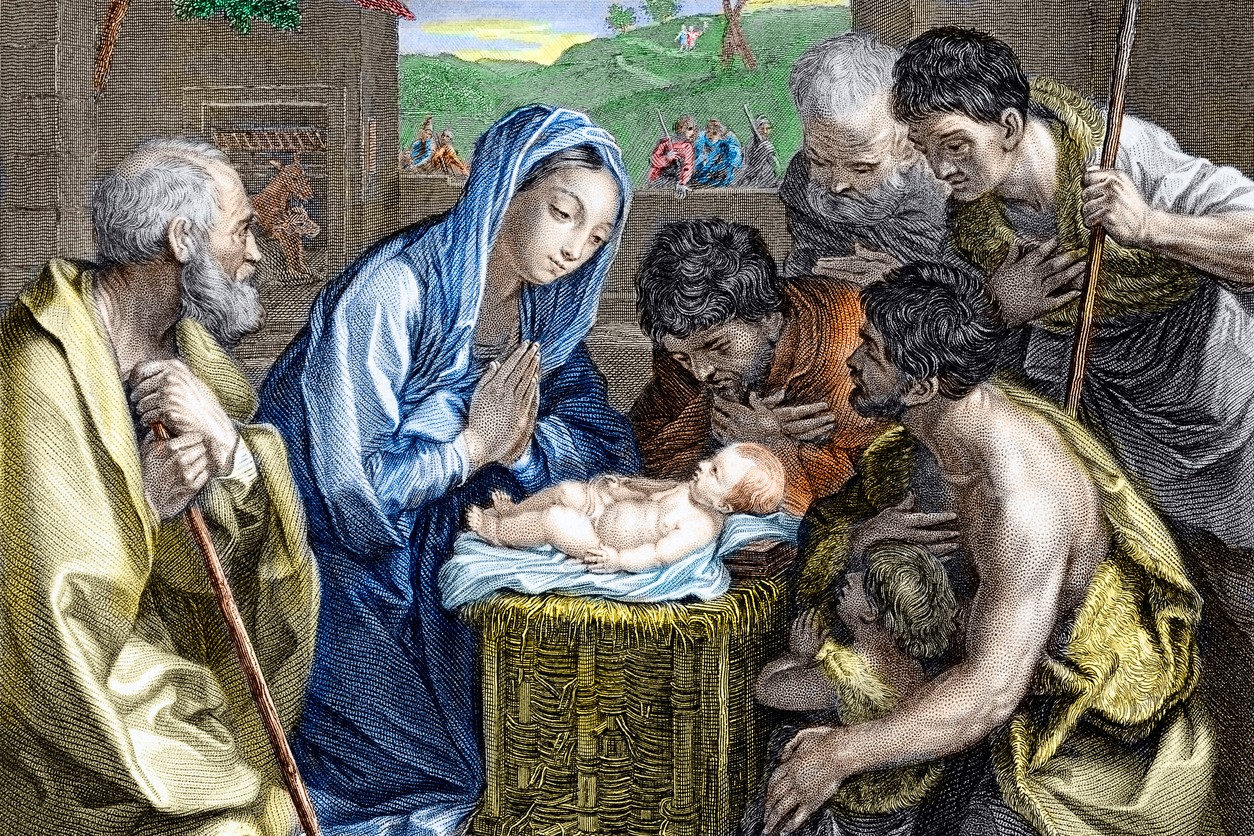
This redefinition of greatness is evident from the very beginning of Christ’s earthly life. God enters the world not in a palace but in a borrowed shelter, not surrounded by dignitaries but by animals and shepherds. There is no coronation, no throne, no display of earthly power, only a feeding trough. Even the angels who herald His birth do not summon the mighty of the world, but announce the good news to shepherds in the fields.
The early Christians did not invent Christ’s divinity to exalt a fallen hero. They proclaimed it because they were confronted with a risen Lord who bore wounds, washed feet, and forgave His enemies. In every other case, deification served man’s ambition. In Christ alone, divinity serves man’s salvation.
That is not a familiar religious impulse. It is a theological revolution. It prepares us to see that God’s power, like His greatness, is exercised not through force, but through redemptive self-giving love.
The Incarnation Demonstrates How God Displays His Power
Human power is typically expressed through force, control, and the ability to compel outcomes. Authority is demonstrated by imposing one’s will, silencing opposition, and overcoming resistance. From empires to modern institutions, power is measured by how much one can dominate.
The Incarnation reveals a radically different kind of power.
God does not enter the world wielding coercion. He does not overwhelm His enemies with spectacle or crush resistance through sheer might. Instead, He comes in weakness. He submits to the limits of human flesh, the vulnerability of infancy, and the constraints of ordinary life. From the beginning, the Incarnation declares that God’s power is not diminished by humility – it is displayed through it.
This pattern continues throughout Christ’s life. Jesus refuses to seize authority by force (Matt. 4:8–10; John 18:36). He resists the temptation to rule through domination. He silences storms, not armies (Mark 4:39); heals the sick, not political systems (Matt. 8:16–17); casts out demons, not rivals (Luke 4:40–41). Even when confronted with rejection, betrayal, and violence, He does not retaliate (Isa. 53:7; 1 Pet. 2:23). His power is exercised through truth, mercy, and sacrificial love (John 1:14; Matt. 12:20).
Nowhere is this more evident than at the Cross. What appears to be weakness is, in fact, a decisive act of divine power. Scripture declares that Christ was crucified in weakness, yet lives by the power of God (2 Cor. 13:4). The incarnation leads not to a throne of force, but to a rugged Cross of self-sacrifice – and it is there – in a very unexpected place – that sin is vanquished, death is undone, and redemption is forever secured.
However, make no mistake. Scripture is equally clear that the One who came in meekness will return in glory, exercising judgment and authority over all. The Incarnation shows not what God cannot do, but what astonishing ends He was willing to go to save us.
This reveals a truth that runs against every human instinct: God conquers not by crushing His enemies, but by bearing the weight and penalty of their own sin. He triumphs not by inflicting suffering, but by absorbing it. The power of God is not shown in the avoidance of suffering, but in the willingness to endure it as a display of His incredible grace – His unmerited favor.
The Incarnation, therefore, shows us that divine power is redemptive, not oppressive; sacrificial, not self-serving; patient, not coercive. God does not save the world by force. He saves it by emptying Himself.
This is precisely why the Incarnation matters, not only for what we believe about God, but for how we understand power, authority, and faithfulness itself. For the God who comes in weakness is the God who will be revealed in glory, and whose purposes are never thwarted, only patiently fulfilled.
The Incarnation Reveals God’s Faithfulness to His Promises
The Incarnation did not arrive as a religious improvisation – it came in the swaddling clothes of promise. From the earliest pages of Scripture, God spoke of a coming Redeemer, one who would be born of a virgin, descended from Abraham, rising
from the line of David, and arriving at the appointed time. Christmas is not the invention of a new story; it is the fulfillment of a very old one.
For centuries, Israel lived in expectation. The prophets spoke of a child who would be born in Bethlehem (Mic. 5:2), a king who would come humbly and bring peace (Zech. 9:9), and a servant who would suffer for the sins of others (Isa. 53). These promises were not vague religious hopes; they were rooted in real places, real people, and real events. When Christ was born, He entered not only the human condition but the long and unfolding story of God’s faithfulness.
Scripture also emphasizes timing. “When the fullness of time had come, God sent forth His Son, born of woman” (Gal. 4:4). The Incarnation occurred neither too early nor too late. It came at the precise moment God had determined. History did not rush God, and God did not abandon history. What He promised, He fulfilled in His own perfect timing.
The number and detail of these fulfilled prophecies make chance an increasingly unreasonable explanation. To help illustrate this, mathematician Peter Stoner once examined a small set of messianic promises. He asked how likely it would be for any one person, living from the time those prophecies were written to the present, to fulfill them all by accident. Limiting himself to just eight well-recognized prophecies dealing with matters such as Christ’s birthplace, manner of life, betrayal, and death, Stoner concluded that the odds were so enormous that chance fulfillment could reasonably be ruled out. And these eight represent only a small portion of what Scripture foretold. The point is not that faith rests on mathematics, but that the life of Christ fits the promises of Scripture far too well to be explained away.
This matters because Christian faith is not sustained by sentiment alone. It rests upon the conviction that God acts faithfully in real time, that His promises are not empty assurances, and that His redemptive purposes move steadily forward – even when fulfillment seems delayed or unlikely. The Incarnation assures us that what God has spoken, He will do.
Christmas, therefore, is not merely a moment of wonder; it is a marker of God’s trustworthiness. In the birth of Christ, God places His faithfulness on display before the world. The manager stands as a quiet testimony that divine promises are not forgotten, postponed indefinitely, or quietly abandoned. They are kept, patiently, precisely, and filled entirely in His appointed time.
The Incarnation Calls Us to a Life of Humble Obedience, Trust, and Worship
The Incarnation is not merely a truth to be contemplated or a religious doctrine to be affirmed; it is a reality that makes a claim on our lives. If the eternal Son of God has truly entered the human story – becoming human, bearing our weaknesses, suffering for our sins, and rising in victory from the grave – then indifference is no longer possible. The Incarnation demands, as well as deserves, a response.
Scripture makes it clear that the humility of Christ is not only the means of our salvation, but also the pattern of our discipleship. Christians are admonished, “Let this mind be in you, which was also in Christ Jesus:” (Phil. 2:5). The One who stooped to save us now calls us to follow Him in lives marked by humility, faith, and obedience. Christmas does not merely reveal what God has done; it shows what faithful trust looks like when it takes Christ seriously.
This obedience is not rooted in fear or coercion. It flows from confidence in who God has shown Himself to be. The Incarnation assures us that God is not distant, uncaring, or unreliable. He has entered our condition, kept His promises across centuries, and accomplished redemption at tremendous cost to Himself. Such a God is more than worthy of our trust. To rely upon Him is not naïve; it is most reasonable. To obey Him is not burdensome; it is truly fitting.
The incarnation also reshapes our understanding of what a life that is faithful to God looks like. Christ does not call His people to grasp for greatness, secure control, or demand recognition. He calls them to follow His ways earnestly – best expressed in lives that are quiet, often unseen, and often paying a high price for obedience. The way of Christ is the way of the Cross before the crown, and sacrificial service before glory.
Yet this call is not grim. The same Incarnation that humbles us also comforts us. God has not asked us to walk a path He Himself did not tread as one of us. In Jesus Christ, He has gone before us – into suffering, into obedience, and into death – and He has emerged victorious. The One who calls us to follow Him is the One who promises to be with us always, and also grants us victory over the world (Matt. 28:20; John 16:33; 1 John 5:4–5).
Christmas, then, is not merely an event to be remembered once a year. It is a truth that reshapes everything. If God has robed Himself in humanity to redeem us, then the proper response is not mere admiration, but surrender; not sentiment, but trust; not indifference, but worship.
The God who comes to us in Jesus Christ now calls each of us to respond, not simply with an acknowledgment of these truths, but with repentance, faith, and trust in Him.
For Christmas to have its ultimate meaning, we must be willing to put away our sin and receive Christ. The Incarnation of Christ is God uniting Himself with humanity so that we might know Him personally in Jesus Christ.
This, indeed, is the wonder of all wonders that Christmas proclaims.