
By Rev. Mark Creech, D.H.L.
RevMarkCreech.org
The Bible does not define backsliding with a single dictionary-style verse. Instead, it defines it through repeated descriptions, images, and spiritual outcomes – most clearly in the Old Testament, and then illustrated vividly in the New. When these strands are gathered together, a coherent and sobering picture emerges.
Biblically speaking, backsliding is a condition of the heart. It occurs when a person who genuinely belongs to God turns away from active obedience and close fellowship with the Lord. The result is not the loss of salvation, but an incremental spiritual decline – marked by diminished joy, a weakened testimony, and increased vulnerability to sin.
Solomon captures the essence of this condition in a single, penetrating sentence:
“The backslider in heart shall be filled with his own ways” (Proverbs 14:14).
This is where Scripture locates the problem – the heart, the seat of one’s affections and will. Backsliding begins there before it ever shows itself in conduct. The individual may still appear to be functioning within the life of faith, still profess belief, but inwardly self has replaced God as the governing authority. God’s will no longer rules the inner life. Backsliding starts not with open rebellion, but with quiet self-rule.
In his book Revival, Richard Owen Roberts writes with piercing clarity:
“God is infinitely patient and understanding of the weaknesses of His people, but backsliding is not merely a problem of human weakness. Backsliding is the sin of crowding God out by filling one’s life with self.”
The New Testament reinforces this truth, not by formal definition, but through lived example. Few illustrations are more arresting than that of Peter. On the night of our Lord’s betrayal, Scripture notes with painful simplicity:
“But Peter followed him afar off” (Matthew 26:58).
Distance from Christ came first. Then compromise. Then denial.
Peter’s collapse was not sudden; it was progressive. Backsliding is rarely dramatic at the outset. More often, it is subtle and gradual – marked by increasing distance from the Lord’s presence, growing comfort with spiritual compromise, and a slow dulling of Christian conviction.
Jesus’ words to the church at Laodicea (Revelation 3:14–22) describe corporate backsliding – not apostasy, not paganism, but spiritual decline within a body of believers:
“I know thy works, that thou art neither cold nor hot… because thou art lukewarm, and neither cold nor hot, I will spue thee out of my mouth” (Revelation 3:15–16).
Yet Scripture is equally clear about what backsliding is not. It does not mean that God has cast away His people. Throughout the Bible, backsliding is described as turning away, departing, or drawing back – never as being expelled from God’s covenant.
The Lord Himself declares:
“Return, ye backsliding children, saith the LORD; for I am married unto you” (Jeremiah 3:14).
The language of marriage is crucial. Israel’s backsliding deeply grieved God, but it did not dissolve her relationship with Him. The call was not to become His people again, but to return. Fellowship had been broken, not sonship. Nearness had been lost, not belonging.
Jesus’ parable of the prodigal son gives us one of Scripture’s clearest explanations of backsliding. In the parable (Luke 15:11–32), the prodigal does not cease to be a son when he leaves home. His rebellion interrupts fellowship with the father, but not the relationship. Even in the far country, he remains a son by status – though he lives like a servant instead of the royal child he truly is.
That is backsliding.
Understanding this distinction is essential. Without it, we either minimize backsliding or misunderstand grace. With it, we can speak honestly about spiritual decline while holding fast to the hope of restoration.
That brings me – perhaps unexpectedly – to a cultural illustration.
Years ago, the comedian Jeff Foxworthy became famous for a simple line: “If you do this or that, you might be a redneck.” He listed behaviors so familiar that people laughed – only to realize they were laughing at themselves.
In a similar spirit – not to mock, but to awaken – what follows are a few telltale signs that the spirit of backsliding may be taking root. This list is not meant to be exhaustive, but to serve as a primer for honest self-examination.
- If your Bible has more dust on it than your coffee table, you might be a backslider.
- If your church attendance now mostly depends on the weather, your mood, or kickoff time, you might be a backslider.
- If you used to ask, “What does God want?” but now ask, “What can I get away with?” you might be a backslider.
- If sin in your life bothers you less, but people who point it out bother you more, you might be a backslider.
- If conviction feels “judgmental” and repentance feels “extreme,” you might be a backslider.
- If spiritual hunger has been crowded out by constant phone scrolling and hours of television or streaming shows, you might be a backslider.
- If prayer has become something you intend to do more often than something you actually do, you might be a backslider.
- If profanity has become a normal part of your speech rather than something you consciously resist, you might be a backslider.
- If God has powerfully changed your life, but you rarely speak of it to others, you might be a backslider.
- If you now regularly entertain inappropriate thoughts or gaze at what you once shunned, you might be a backslider.
- If bitterness and hardness of heart feel justified, and forgiveness feels optional – or out of the question – you might be a backslider.
- If praise, thanksgiving, or obedience to God must wait for complete understanding of your difficult circumstances, you might be a backslider.
- If the values of this world sound increasingly reasonable, and Scripture seems increasingly “out of touch,” you might be a backslider.
- If substances you once approached with restraint have become something you now rely on to relax, escape, or take the edge off – rather than casting your burdens on God – you might be a backslider.
- If you pray earnestly when something goes wrong, but stop once things improve, you might be a backslider.
- If you’ve grown far more concerned about offending people than offending God, you might be a backslider.
- If you remember when you were once on fire for the Lord, but today only speak of it the same way people talk about high school glory days, you might be a backslider.
- If serving in the church once felt like a privilege, but you now consistently avoid volunteering, you might be a backslider.
- If criticism of fellow church members – or the preacher – flows more freely than your intercessions, you might be a backslider.
- And if you can read all of this without taking inventory of yourself, convinced it couldn’t apply to you, you are certainly a backslider.
The good news is this: Scripture does not merely diagnose backsliding; it invites return.
“Return, ye backsliding children, and I will heal your backslidings” (Jeremiah 3:22).
Backsliding is not the end of the story. It is a warning light on the dashboard of the soul – meant not to condemn, but to call us back. God does not withdraw His love from the backslider; He calls him back in earnest love. Restoration does not begin with despair, but with repentance. And repentance for the backslider does not restore salvation – it restores joy, nearness, and fellowship with the Lord.
The way back is not complicated. It is the same way we first came: humility, confession, and trust in a gracious Father who is still waiting for us to come home.
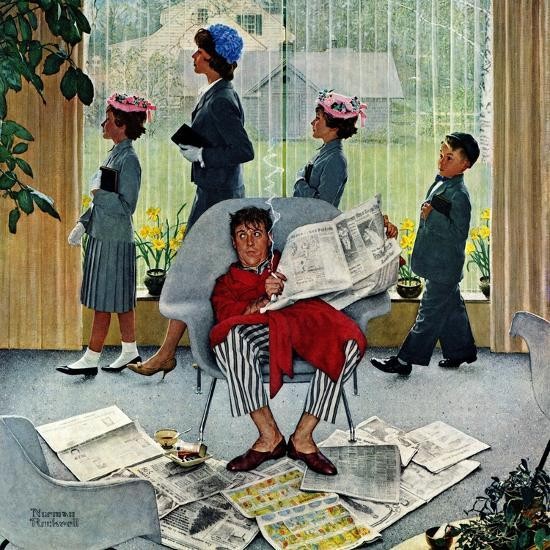
Picture: Norman Rockwell, Sunday Morning, 1959.
Originally published on the cover of The Saturday Evening Post.