
Dr. Mark Creech
Director of Government Relations
Return America
Last Friday afternoon, I decided to take advantage of the pleasant weather and spend some quiet time in downtown Raleigh. I walked over to the State Capitol carrying my Bible and a book. Finding a shaded place on the Capitol steps, I sat down to read, pray, and reflect.
For a while, it was peaceful.
Before long, however, a group of protestors marched through downtown. They appeared to be largely young people protesting the war in Iraq. One person shouted through a loud megaphone while others carried placards with anti-war slogans. Their chants echoed through the streets as they passed the Capitol.
That didn’t surprise me. Demonstrations in the capital city are nothing new.
What happened next did surprise me.
After the protestors moved on and traffic began flowing again, something I had never seen before came pedaling down the street. It was what can only be described as boisterous merriment on wheels. A large pedal-powered vehicle – commonly called a Pedal Pub – rolled past. About fourteen people sat around a bar, drinks in hand, laughing and cycling their way through downtown Raleigh.
I must admit the sight stirred a mixture of emotions in me – anger, frustration, and sadness. I could hardly believe what I was seeing. I did not know such things were operating here.
So I asked a Capitol police officer standing nearby if what I was seeing was indeed a bar on wheels.
“Yes,” she replied.
I briefly explained that years earlier, I had opposed legislation that allowed for this sort of thing – mobile drinking venues.
“Well,” she said with a shrug, “they’re just having a good time.”
“Maybe so,” I replied, “but does alcohol have to be everywhere for people to have a good time?”
The officer quietly slipped away.
Back in 2021, when legislation expanding alcohol policies in North Carolina was being debated—including provisions allowing alcohol sales and consumption on certain charter buses—I lobbied against the measure. My concern was simple: once alcohol becomes normalized in transportation environments, it inevitably encourages new forms of mobile drinking venues. By that time, lawmakers had already approved alcohol service in other transportation settings, including ferries and certain passenger rail excursions—developments that only a few years earlier would have struck many people as unusual and inappropriate. Each change was presented as limited and reasonable, but taken together, they revealed a broader pattern of expanding alcohol into ever more settings of public life, increasing the likelihood of additional alcohol-related problems for our state and nation.
My concerns were largely dismissed.
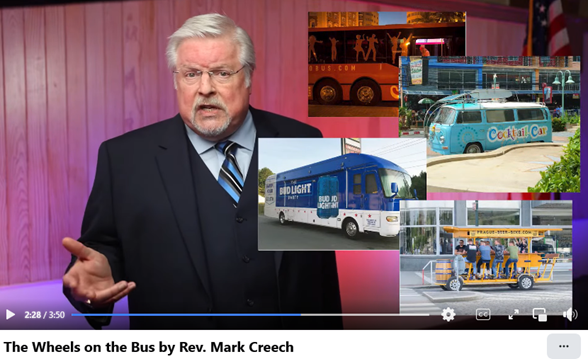
See the short video Rev. Creech did in 2021, urging the defeat of legislation for alcohol on buses.
Yet as I watched people with drinks in hand, hooting, singing, and pedaling down the street with the unmistakable revelry alcohol so often brings, I asked myself: Is this what families with children should have to see? What visitors to our capital city should encounter? What should citizens going about their daily business expect on the streets surrounding the North Carolina State Capitol?
On Monday, I did a little research and found that North Carolina’s open-container law generally prohibits alcohol in vehicles but contains an important exception: passengers may possess alcohol in vehicles designed to transport passengers for compensation, such as buses or limousines.
Entrepreneurs have learned to work creatively within this exception.
If a vehicle operates as a tour vehicle transporting paying passengers, it can qualify under the rule. In many cases, the operator does not sell alcohol; passengers simply bring their own beer or wine and pay for the ride. The result is a vehicle that, in practice, functions as a mobile drinking venue.
In other words, the law already contained an exception allowing alcohol in vehicles transporting passengers for compensation. That provision created a legal space for businesspersons to experiment with alcohol-centered mobile entertainment concepts.
Over time, some businesses began offering pedal-powered “trolley pubs,” where riders pay for a guided tour and bring their own beer or wine as they travel through downtown entertainment districts. These vehicles appear to operate under the same legal framework as other tour vehicles that transport passengers for hire.
While pedal-powered bars on wheels had been operating in Raleigh for several years under existing interpretations of North Carolina law, their growing visibility today reflects a broader trend toward normalizing alcohol in further settings of public life.
The debate I was involved in back in 2021 was part of a larger wave of alcohol policy changes that the North Carolina General Assembly had been considering for several years. Proposals at the time included allowing the sale of alcohol on certain charter buses, expanding distillery privileges, and promoting alcohol tourism in the state.
Supporters often framed these changes as ways to encourage economic development, tourism, and hospitality industries. But critics—including myself—warned that expanding alcohol consumption into new environments—especially transportation settings—would inevitably lead to more mobile drinking venues.
In recent years, the General Assembly has enacted a series of alcohol policy changes that steadily and widely expanded access. Brewery laws have been broadened, distillery privileges expanded, cocktails-to-go authorized, alcohol social districts permitted, delivery and service rules liberalized, and beer and wine sales approved for stadiums, arenas, and other athletic facilities on public university campuses. The state’s ABC laws have been repeatedly revised through omnibus legislation. Each change may seem modest on its own, but altogether they dangerously extend alcohol into too many settings of public life.
When alcohol laws move in this direction, new markets inevitably follow. Businesses innovate. And what once seemed unacceptable gradually becomes commonplace.
A Deeper Concern
For many people, a bar on wheels working its way down a city street in Raleigh may seem relatively harmless—just another quirky attraction for tourists. But beneath the amusement lies a deeper cultural shift that should concern anyone who believes in the principles of a self-governing society.
A free people must possess the capacity for self-restraint. Our system of ordered liberty depends upon citizens who can govern themselves before they attempt to govern others. When a culture progressively normalizes vice – when drinking becomes increasingly central to entertainment and commercialized ever more in various ways – it weakens the moral discipline upon which freedom itself depends.
The issue is not whether a few individuals can responsibly enjoy a drink, nor whether every passenger on one of these pedal pubs becomes intoxicated. The real issue is the steady expansion of a culture that treats alcohol as though it carries no inherent danger, and profit alone becomes the justification for ever-greater access. The result is a subtle yet profound transformation of a society that poses a serious threat to public health, safety, and morality.
It was astonishing—a bar on wheels, frivolity, drinks, and music rolling past the very building that represents the seat of our state government. The alcohol-fueled carousing that pedaled its way down Wilmington Street was more than a novelty attraction—it was a vivid reminder that when vice advances by inches in law, it eventually rolls through our streets in plain sight.
And once a society becomes accustomed to such things, it rarely asks how it arrived there or why it matters at all.
Image credit: Trolley Pub Raleigh. Screenshot taken from the Trolley Pub website (trolleypub.com), used for commentary and illustrative purposes.