(Part 3 of a 3-part series, No Time for the Light to Go Dim)
by Rev. Mark Creech
RevMarkCreech.org
Throughout Scripture, even in the earliest days of the Church, those who spoke God’s truth into public life were often given names meant to humiliate and discredit them.
The very name “Christian” was, in its origin, a term of reproach. In Antioch, where “the disciples were called Christians first” (Acts 11:26), the label was not bestowed as an honor, but as a way of marking them out – identifying them with Christ in a manner meant to ridicule and marginalize.
The pattern is hardly anything new.
The prophet Elijah was called “the troubler of Israel.”
The prophet Jeremiah was accused of weakening the nation.
The apostle Paul was labeled “a pestilent fellow,” a “mover of sedition” among the people.
In each case, the charge was not merely disagreement; it was an attempt to silence.
The message was clear: discredit the messenger, and you can dismiss the message.
In our own time, a similar pattern has emerged.
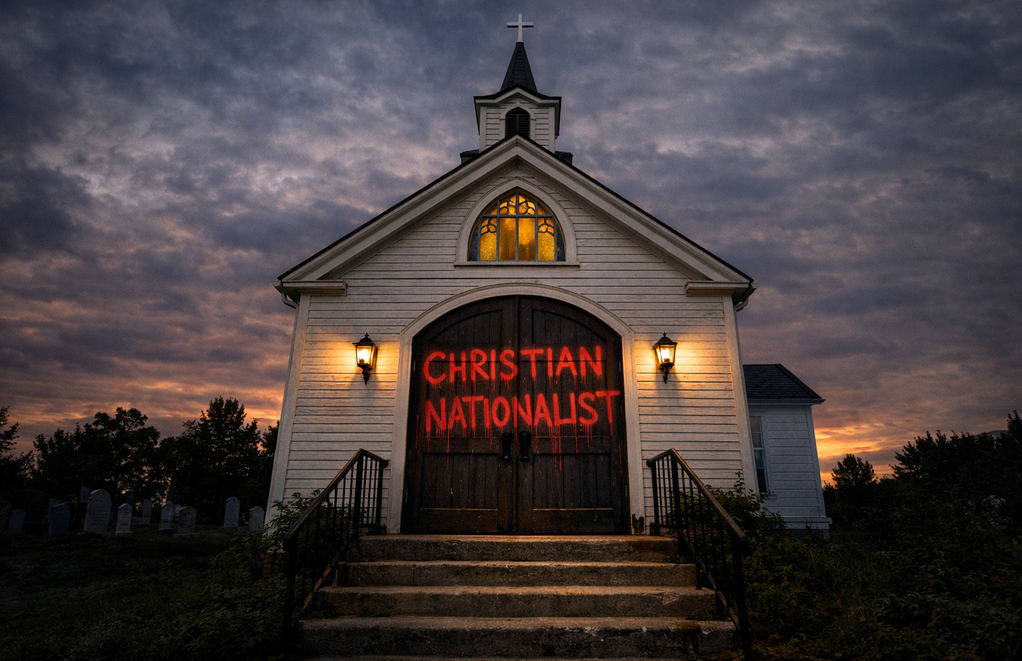
One of the most effective ways to silence a Christian voice in the public square today is to attach a label to it – one that sounds dangerous enough that no further argument is required. That label is “Christian nationalism.”
It is invoked in media, academia, and even within the Church itself. It is used broadly, often vaguely, and almost always with negative connotations. For many pastors and church leaders, the mere possibility of being associated with it is enough to produce hesitation, if not outright silence them.
Part of the label’s power lies in the word “nationalism” itself. It is not a neutral term in the modern mind. In the twentieth century, some of the most oppressive regimes in history wrapped themselves in the language of national identity. The party led by Adolf Hitler was known as the National Socialist German Workers’ Party. Though its ideology was far more complex and far more sinister than the word alone suggests, the association remains.
As a result, the term “nationalism” often evokes images of authoritarianism, coercion, and extremism. When the word is joined with “Christian,” the effect is immediate. Suspicion is cast before any explanation is given. The label does not arrive empty – it arrives loaded!
But before such a charge is accepted, it should be examined.
There are, to be sure, distortions of the Christian faith that wrongly merge the mission of the Church with the ambitions of the state. There are those who speak as though a nation could be equated with the Kingdom of God. The Church is not the state. Neither is the Gospel of Christ advanced by force.
But this is not what most faithful pastors and believers mean when they speak to the moral issues of the day.
To suggest that applying biblical truth to public life is inherently dangerous is to misunderstand, even misrepresent, the very nature of the Christian faith itself.
Jesus Christ is not Lord over a narrow corner of private devotion. He is Lord of all.
His authority extends not only to the heart, but to the home, to the church, and to the broader ordering of human life. Scripture speaks not only to personal salvation, but to truth and falsehood, to right and wrong, to justice and injustice, and to the created order itself.
When Christians affirm the sanctity of life, they are not engaging in political extremism; they are affirming that human beings are made in the image of God and, consequently, life is sacred at every stage.
When they uphold the biblical definition of marriage, they are not seeking control; they are bearing witness to God’s design, which cannot be defied without serious consequence.
When they speak about the importance of family, truth, or moral responsibility, they are not advancing a political agenda; they are applying timeless truth to present realities in ways consistent with God’s order and most conducive to human flourishing.
When they speak against the normalization of vice, whether in the form of alcohol abuse, gambling, substance abuse, or other practices that degrade human dignity, they are not imposing morality; they are seeking the good of their neighbors and the health of their communities.
If such convictions are now considered suspect, then the issue is not with the convictions themselves, but with a culture increasingly unwilling to tolerate them.
This, of course, is where the danger lies.
The label “Christian nationalism” is often used to turn faithfulness into suspicion, and genuine Christian conviction into extremism. It works to silence pastors and other church leaders by discrediting them before they ever speak.
In this way, the label becomes not merely descriptive, but profoundly strategic.
It functions as a preemptive muzzle.
When it succeeds, the consequences are significant.
Pastors who withhold what God has spoken and avoid applying Scripture to the moral issues shaping people’s lives do not become more faithful to the Gospel; they become less so. As Martin Luther, the great Reformer, warned:
“If I profess with the loudest voice and clearest exposition every portion of the truth of God except precisely that little point which the world and the devil are at that moment attacking, I am not confessing Christ… Where the battle rages, there the loyalty of the soldier is proved, and to be steady on all the battlefield besides is mere flight and disgrace if he flinches at that point.”
The Gospel does not exist in abstraction. It speaks into real lives, real communities, and real cultures. It calls sinners to repentance, but repentance from what? It calls for transformation, but according to what standard?
If the Church is unwilling to name the sins that are normalized in the culture, then its call to repentance becomes vague. If it refuses to address the lies that dominate public life, then its proclamation of truth becomes disconnected from reality.
Faithfulness requires more.
It requires the courage to speak – not carelessly, not harshly, not with partisan spirit, but clearly, biblically, and without apology where God Himself has spoken.
“For we can do nothing against the truth, but for the truth” (II Corinthians 13:8).
This is not a call for the Church to become political in the narrow sense. It is a call for the Church to be fully biblical. Yet it is also a call to speak to politics whenever public policy blatantly disregards the moral law of God, defies His created order, or gives legal protection to what He has clearly condemned.
It is to declare the Lordship of Christ in a way that encompasses all of life.
It is to disciple believers not only in private devotion, but in how to think, live, and act in a world increasingly at odds with the truth.
It is to understand that remaining quiet when truth is being openly denied is not neutrality – it is absence. It is like a soldier who has abandoned his post.
The accusations may come. The labels may be applied. This should not surprise us. We should anticipate it.
Name-calling, false labels, derogatory expressions, and even mockery have been used against faithful followers of Jesus Christ throughout the Church’s history.
But the question is not what we will be called. The question is whether we will be faithful to the One who has called us.
The Church has never been sustained by the approval of the culture; it has always advanced in spite of it. Even the “gates of hell shall not prevail against it” (Matthew 16:18).
In the early centuries, Christians refused to bow to Caesar, when it cost them their livelihoods – and, in many cases, their lives. In a world that treated human life cheaply, they rescued abandoned infants and cared for the sick during plagues when no one else would. Their faith did not conform to the culture; it confronted it.
Centuries later, believers such as William Wilberforce labored tirelessly against the slave trade, standing against entrenched economic and social systems because they believed the Gospel demanded it. Their convictions were railed against at first. They were zealously resisted. Still, they persevered, and the world is better for it.
In America, pastors and churches played decisive roles in movements for justice and moral reform, often at great personal cost. They did not wait for cultural approval before they spoke.
They were not trying to control the culture; they were bearing witness to the truth.
The pattern is unmistakable: whenever the Church has been most faithful, it has often been most out of step with the world around it.
This principle does not change.
It does not bend to the pressures of the moment.
It does not yield to labels.
It does not retreat when challenged.
It stands.
And in every generation, there must be those who are willing to stand with it.
Not for the sake of influence.
Not for the sake of power.
But for the sake of faithfulness to Christ, and for the sake of a world that still desperately needs the light, even when it calls that light darkness and that darkness light.