
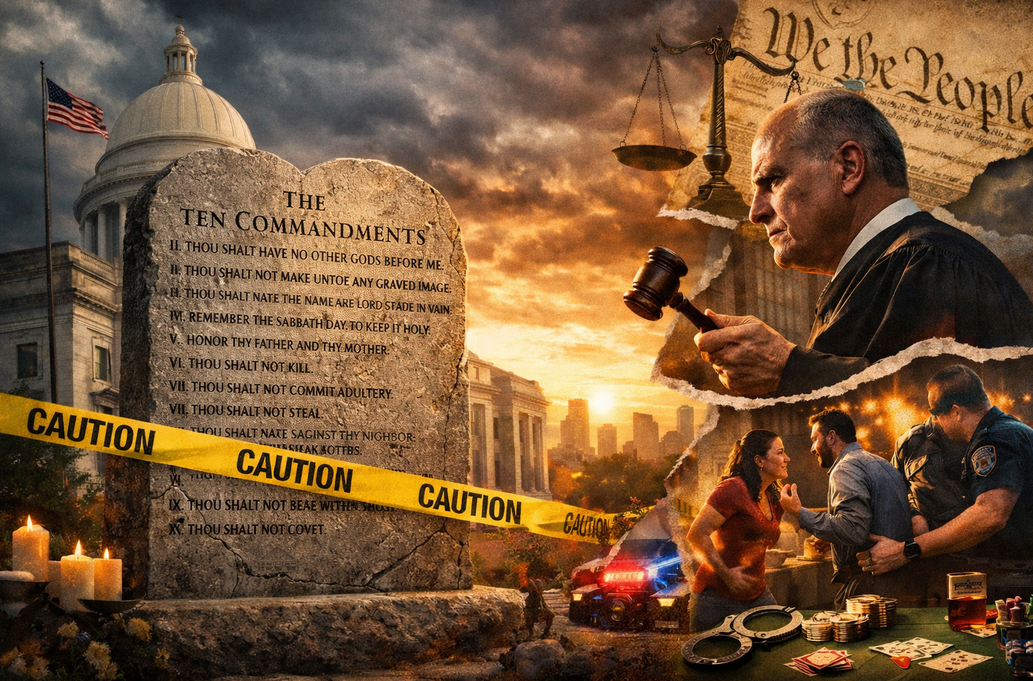
What a court ruling reveals about morality, history, and constitutional tradition.
by Rev. Mark Creech
RevMarkCreech.org
A federal judge has ruled that a Ten Commandments monument must be removed from the Arkansas State Capitol grounds because it is, in the court’s view, simply “too religious.”
The reasoning follows a now-familiar path. The monument, the judge concluded, has a primarily religious purpose and effect. It reflects the intent of lawmakers who supported it for faith-based reasons. It may signal a preference for one religion over others. Without sufficient historical framing, it crosses the constitutional line from acknowledgment to endorsement.
That is the argument.
But it rests on a flawed assumption – one that deserves closer scrutiny.
If the Ten Commandments are too religious to be displayed in the public square, what exactly are we saying about the moral foundation they represent?
After all, the Commandments are not obscure theological musings. They are straightforward moral directives: do not murder, do not steal, do not lie. Honor your parents. Be faithful in marriage. Do not covet what belongs to another.
These are not merely religious ideas; they are the very principles upon which any stable and just society depends.
For much of our nation’s history, this was widely understood. Public acknowledgments of God and the moral law were not seen as constitutional violations, but as reflections of the cultural and ethical framework that made ordered liberty possible.
Moreover, the Supreme Court has never held that all such displays are unconstitutional.
In fact, in Van Orden v. Perry, the Court upheld a Ten Commandments monument on the grounds of the Texas State Capitol, recognizing its historical and moral significance. More recently, in Kennedy v. Bremerton School District, the Court made clear that the Constitution does not require the government to purge all religious expression from public life. Rejecting older frameworks that treated religion as something inherently suspect, the Court emphasized an approach rooted in this nation’s history and traditions.
That matters.
Because for most of our history, the presence of religious expression in public life was not considered an establishment of religion, but an acknowledgment of the moral order that undergirds the law itself.
Yet, here we are again being told that the Ten Commandments are simply too religious to stand in the public square.
This raises another question worth considering:
If the Ten Commandments are too religious to be displayed there, are they also too dangerous to be followed?
Imagine, for a moment, a society where people actually lived by the Ten Commandments.
Oh, the horror!
A world where no one murdered, not merely because of legal consequences, but because life was regarded as sacred. A world where no one stole, because respect for others’ property was a matter of conscience, not just enforcement. A world where truth was so consistently spoken that trust, not suspicion, became the very grounds of human interaction.
What a frightening prospect!
Consider what it would mean if husbands and wives remained faithful, if children honored their parents, if envy no longer fueled resentment and division, and if an inordinate affection for money – greed and avarice – were replaced by contentment and generosity.
What would become of our courts, our prisons, our need for endless laws and regulations? How many industries built on deception, exploitation, and vice would quietly disappear? What would the nightly news even report?
Yes, what a terrible world this would be. Perish the thought!
We would live in a world marked by honesty, stability, faithfulness, and peace – a world where moral clarity replaced confusion, and people lived not only for themselves, but with a sense of accountability to something higher.
Surely, we must be protected from such a thing! How could society – how could the state – possibly endure such scandalous goodwill?
Of course, no one truly believes this.
The real issue is not that the Ten Commandments, which come from a religious tradition, could be harmful to some. It is that they are universal and authoritative. They point beyond us to a standard that never changes, never bends, and never asks for our permission.
That is what really makes them unwelcome.
It is easier to remove a monument than to confront what it represents.
It’s easier to call something “too religious” than to admit it may be uncomfortably true.
Whether the Ten Commandments stand carved in stone on a Capitol lawn or not, the deeper question remains.
What kind of society are we trying to build?
One that distances itself from the moral foundations that shaped it? Or one that has the courage to acknowledge them – even when they challenge us – even if they call our character into question?
In the end, the issue is not whether the Ten Commandments can stand in the public square, but whether they can stand in us.