
by Rev. Mark Creech
RevMarkCreech.org
“Thou shalt not kill” forbids the deliberate and unjust taking of innocent human life. Yet Christ teaches that the evil addressed by this commandment begins before blood is shed. Anger, contempt, hatred, and the desire to remove another person from our midst belong to the same destructive moral movement, even though they are not identical to homicide (Matthew 5:21–22).
That broader moral principle raises a troubling question about religious liberty in the United States. What should Christians conclude when governmental power is used not merely to regulate a ministry but to burden it with investigations, legal expenses, financial penalties, or restrictions that make continued operation nearly impossible?
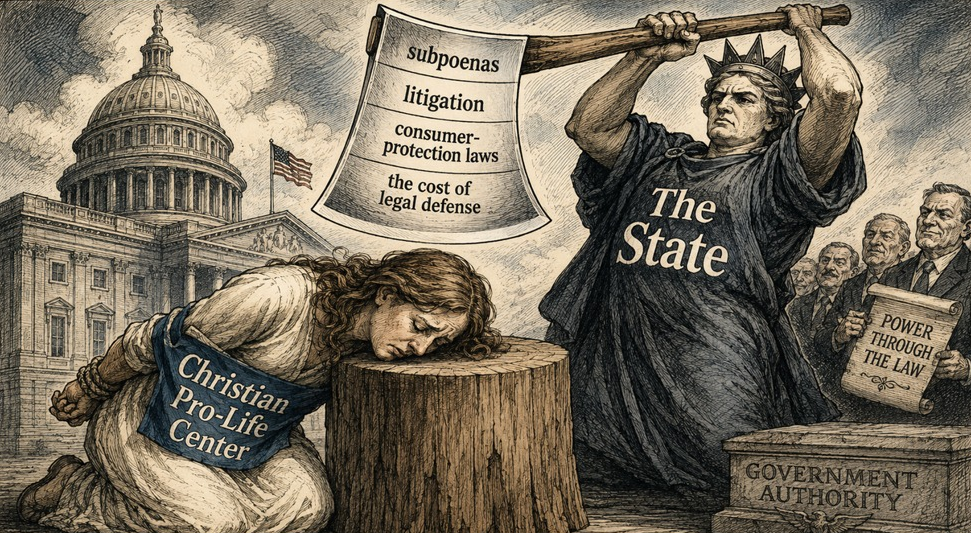
A recent Washington Examiner commentary by religious-liberty advocate Andrea Picciotti-Bayer warns of a developing strategy in Democratic-led states: using subpoenas, litigation, consumer-protection laws, and the cost of legal defense to weaken or bankrupt Christian ministries. The commentary raises serious concerns.
One example is First Choice Women’s Resource Centers, a Christian pro-life pregnancy center in New Jersey. According to a Washington Examiner article, the state attorney general pursued the ministry through sweeping administrative subpoenas seeking years of internal documents, donor information, and other records. First Choice argued that the demands threatened its constitutional rights and challenged them in federal court.
The dispute eventually reached the United States Supreme Court, which ruled that the ministry’s constitutional challenge was ripe for federal court review. First Choice did not have to wait for the state’s enforcement proceedings to conclude before seeking federal relief. The Court did not decide whether the investigation or subpoena was unconstitutional, but the case illustrates an important danger: a religious organization can suffer substantial harm before any wrongdoing is proven.
Legal defense is expensive – very expensive. Producing records, protecting donor privacy, retaining attorneys, and responding to public accusations can drain the money, time, and attention that would otherwise support a ministry’s work. Even when an organization ultimately prevails, the process itself can be a form of punishment.
Of course, the government has a legitimate duty to protect the public. Religious organizations are not entitled to commit fraud, conceal abuse, neglect those in their care, or disregard the law by invoking conscience. Moreover, Christians should not label every disagreement with the government as persecution.
But religious liberty is not merely a privilege granted by the state. The government may regulate conduct, but it may not selectively burden religious institutions, treat their beliefs as disqualifying, or require them to abandon their convictions as the price of public participation.
The crucial question is whether the state is enforcing a neutral law fairly or using legal power to suppress a disfavored religious witness. If comparable secular organizations are treated more leniently, if officials begin with public accusations and only later seek evidence, or if the practical demand is that a ministry renounce its beliefs or close, the regulation begins to resemble coercion.
When the purpose or foreseeable effect of state action is to ruin a ministry, silence its witness, and exclude it from public service, that action participates—at least analogically—in the destructive spirit forbidden by the commandment against murder. It does not take physical life, but it seeks to extinguish a ministry’s public presence and to force its convictions out of the civic square.
This comparison must remain precise. A subpoena is not an execution; financial loss is not homicide; and institutional closure is not the same as the death of a human being. The analogy concerns the underlying impulse to eliminate what one refuses to tolerate.
A ministry is more than a legal entity. It is a community of workers, volunteers, donors, and beneficiaries, united in a religious mission. To destroy it is to harm not only the institution but also the people it serves.
Christians who accept financial loss, professional exclusion, damaged reputations, or even the closure of a ministry rather than violate their conscience are enduring a genuine form of religious persecution. Their suffering is not martyrdom in the strict sense of dying for the faith, but it reflects the same willingness to suffer rather than deny what they believe to be true.
Christian tradition has sometimes called such suffering “white martyrdom.” Because that phrase may be mistaken for racial language, “bloodless martyrdom” is clearer. It describes faithful witness that does not end in physical death but still requires courage, sacrifice, and perseverance—and that arises when hostile powers, figuratively speaking, seek to extinguish the life of a ministry or any public witness they don’t accept.
This charge should not be made lightly. Not every legal dispute involving a Christian organization constitutes persecution, and the evidence may not establish a formally coordinated multistate campaign. But when government officials repeatedly use selective investigations, ruinous legal processes, or coercive regulations to force ministries to abandon their beliefs, the pattern should be recognized as an abuse of state power and a genuine form of religious persecution.
For Christians who accept such losses rather than betray their faith, this is a contemporary, bloodless form of martyrdom.