
by Rev. Mark Creech
RevMarkCreech.org
By almost every modern measure of successful ministry, Jesus’ sermon would have been considered a disaster.
Jesus had attracted thousands. He had miraculously fed five thousand men, besides women and children. His popularity had soared so dramatically that the people intended to take Him by force and make Him king.
What preacher wouldn’t want to keep that kind of appeal?
Then Jesus preached.
He told them that He was “the living bread that came down from heaven.” He spoke of eating His flesh and drinking His blood (John 6:51-58). His language was startling and offensive to many of His hearers.
“Many therefore of his disciples, when they had heard this, said, This is an hard saying; who can hear it?” (John 6:60).
Jesus knew they were complaining about His message. Yet He didn’t call everyone back and announce that He had chosen an unfortunate illustration. He didn’t apologize or say that he had misspoken. He didn’t convene an emergency meeting about the sudden drop in attendance.
He continued speaking the truth.
Then came the devastating report:
“From that time many of his disciples went back, and walked no more with him” (John 6:66).
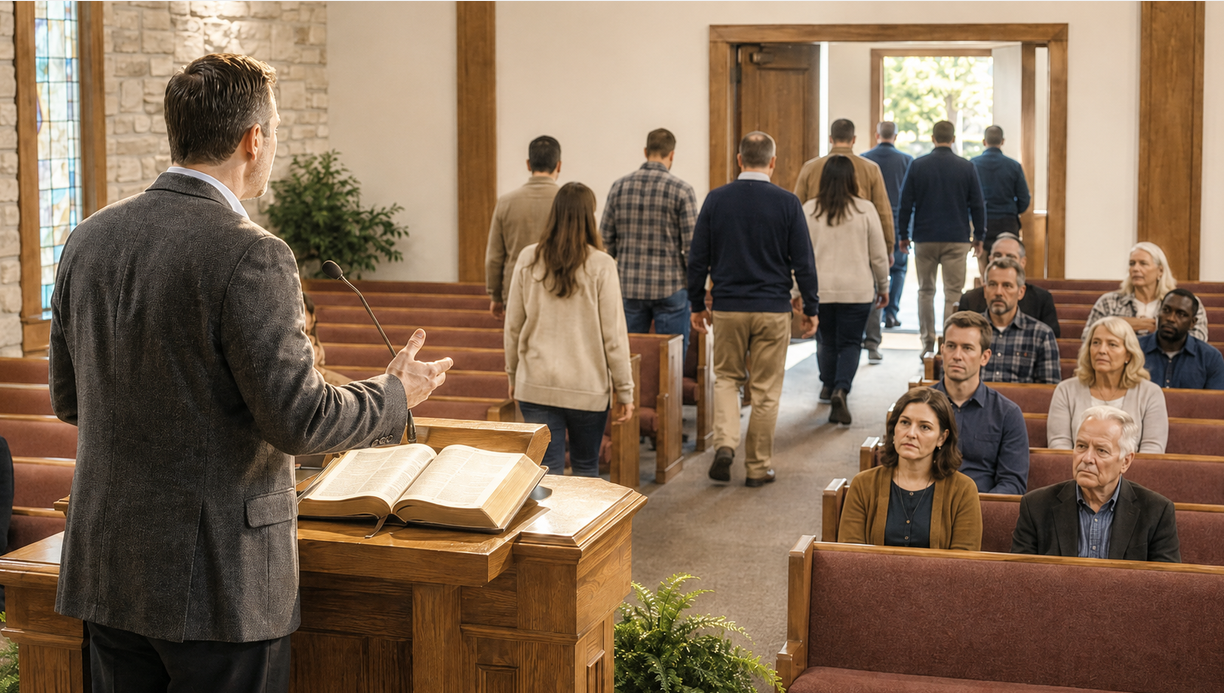
By modern standards, Jesus’ sermon had emptied the church, so to speak.
Of course, Jesus was not advocating cannibalism. Earlier He had explained, “He that cometh to me shall never hunger; and he that believeth on me shall never thirst” (John 6:35). He was making unmistakably clear the necessity of receiving Him personally and wholly. Christ was inviting people to partake of Him by faith as the means of eternal life.
But many didn’t want what Jesus was offering.
Then He turned to the Twelve and asked, “Will ye also go away?” (John 6:67).
Jesus would not compromise the truth to keep the crowd.
The American pulpit desperately needs this lesson.
There is no virtue in being offensive merely for the sake of being offensive. A preacher can be harsh, reckless, unnecessarily provocative, and then congratulate himself for “taking a stand.” That is not faithfulness. Faithfulness requires courage without cruelty, conviction without recklessness, and truth without unnecessary offense.
Neither should the pulpit become the campaign headquarters of a political party. The church does not exist to baptize Republican politics or Democratic politics.
It exists to proclaim the truth of God.
But there is another error.
A preacher can become so determined not to be “political” that he avoids the very issues on which his people desperately need a word from God.
During one of my previous pastorates, I grew increasingly troubled by the moral breakdown in our country and the confusion it created, even among Christians. I became convinced that preaching “all the counsel of God” required addressing moral questions that had also become politically controversial.
I knew preaching this way could cost me. People might leave the church. Attendance could suffer. I might even get fired from my pastorate.
But conviction prevailed, and in the words of Esther I said, “If I perish, I perish” (Esther 4:16).
So I began carefully preaching on the divisive issues of the day from a biblical worldview. To my surprise, although a few congregants were unhappy, most were hungry for it, and church attendance actually increased.
However, I realize that the outcome could have been very different. That was not the point. Faithfulness could not depend upon whether people stayed or walked away.
When the culture politicizes a moral issue, it does not cancel the church’s responsibility to speak to it.
Abortion is political.
Marriage and sexual morality are political.
Gambling and substance abuse are political.
Parental authority and religious liberty are political.
Human dignity and justice are political.
Does that mean the preacher must remain silent about them?
God forbid!
The church should not oppose the destruction of unborn human life because Republicans oppose abortion. Christians should defend the unborn because human beings bear God’s image and Scripture affirms the sanctity of human life at every stage.
The church shouldn’t defend marriage as the union of one man and one woman because that position appears in a political platform. It should do so because marriage originated with God; it belongs to God and not the government.
The same principle must apply regardless of political party.
When Democrats contradict biblical teaching, Christians should speak up. When Republicans embrace policies or conduct contrary to God’s standards, Christians should speak up. No politician becomes exempt from biblical moral scrutiny merely because Christians approve of some of his policies.
The preacher’s target is not the Democratic Party or the Republican Party. His target is whatever defies the will of Almighty God. That is the church’s prophetic role – to speak God’s truth without fear or favor.
Neither party owns the pulpit, and neither should be exempt from its biblical scrutiny.
That means faithful preaching will sometimes make people uncomfortable – very uncomfortable – even angry.
Jesus knew this.
He did not deliberately make truth offensive. Neither did He make truth negotiable simply to retain an audience.
After the crowds departed, Jesus asked the Twelve, “Will ye also go away?” (John 6:67).
Peter answered:
“Lord, to whom shall we go? thou hast the words of eternal life” (John 6:68).
Perhaps the American church needs to recover Peter’s conviction.
We should welcome everyone, remove every unnecessary offense, and preach with compassion, humility, and love. But neither should we become so desperate to keep the crowd that we withhold the words the crowd most desperately needs to hear.
Jesus preached, and many walked away. He let them go.
Truth mattered more than acceptance or attendance.
And the church that forgets this may someday discover that by trying to keep the crowd at the expense of truth, it lost both – the crowd and the words of eternal life.