
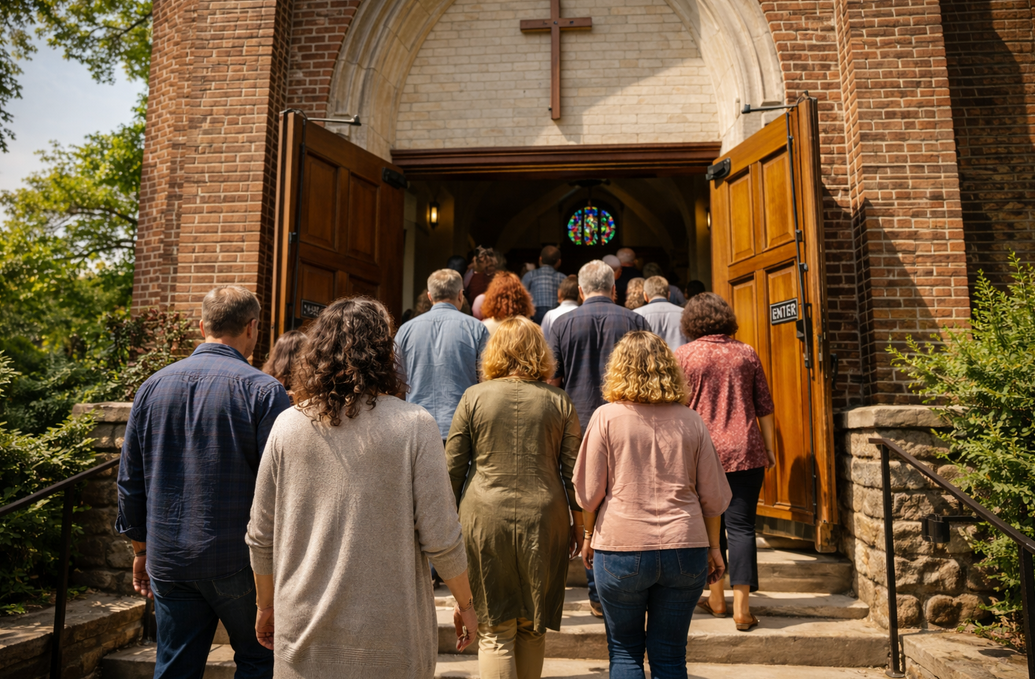
Rediscovering the necessity and beauty of gathered worship among the people of God.
by Rev. Mark Creech
RevMarkCreech.org
Psalm 132 is not the easiest of the Psalms to follow. It reaches back into Israel’s history, reflects on God’s covenant with David, and points forward to promises ultimately fulfilled in Christ. But at its heart, the Psalm is deeply simple—and deeply searching.
It is about a man who could not rest until God had His rightful place.
David declares:
“Surely I will not come into the tabernacle of my house… until I find out a place for the Lord, an habitation for the mighty God of Jacob” (Psalm 132:3–5).
David’s statement is quite remarkable. He essentially says, “I will deny myself comfort until God is honored.” His concern was not first for his own house, but for the Lord’s.
This psalm is not simply about constructing a building – far from it. It is about one’s priorities. It is about a heart that says, “God must not be an afterthought in my life – He must be at the center.”
Then the Psalm takes a turn. Up to this point, David has been speaking of a personal longing. But now, that longing begins to expand beyond himself. He moves from private desire to public worship, and his words become a corporate invitation:
“Let us go into his tabernacles: we will worship at his footstool.” (Psalm 132:7)
In other words, his passion spreads. What began as a personal burden in David’s heart now moves outward, becoming a shared pursuit. The people of God are called not merely to believe—not merely to worship in their own hearts—but to gather with others of like mind, to worship corporately, and to seek the Lord together.
This is where this Psalm gently confronts our modern way of thinking.
We live in a time when many say, “I can worship God anywhere. I don’t need the church. I can worship on the beach, on the golf course, or out in the woods.” In one sense, they are right. God is not confined to buildings made with hands. The heavens declare His glory (Psalm 19:1), and a believer may indeed lift his heart to God in any place.
But this truth, taken alone, becomes dangerously incomplete.
Because while Scripture affirms that we can worship anywhere, it never suggests that we are meant to worship alone as a substitute for gathering with God’s people.
The New Testament is clear:
“Not forsaking the assembling of ourselves together, as the manner of some is…” (Hebrews 10:25).
Private worship and corporate worship are not interchangeable. They are complementary. One does not replace the other.
You may pray on a shoreline – but the shoreline cannot shepherd your soul.
You may reflect on a golf course – but the fairway cannot preach the Word.
You may feel awe in the woods – but the forest can never function as the body of Christ.
God has ordained something far richer than isolated spirituality. He has called a people to assemble – to sing together, to hear the Word of God, to bear one another’s burdens, and to grow in grace together.
David understood this, even under the Old Covenant. That is why he longed for a place where God would be honored among His people. That is why he rejoiced in the thought of assembling with them there. Worship, for him, was not a casual option. It was a consuming desire.
Perhaps that is the real issue for us.
The question is not, “Can I worship elsewhere?”
The real question is, “Do I long – do I yearn to worship with God’s people?”
Too often, when people speak of worship as something purely personal, what they are actually describing is worship on their own terms—when it is convenient, comfortable, and personally satisfying. But corporate worship calls for something deeper and more beneficial. It calls for humility. It calls for submission. It calls for love toward imperfect people in a gathered body.
It forms us in ways private worship never can.
Psalm 132 then gives us one of the most comforting truths in all of Scripture. After David expresses his desire for God, the Lord responds:
“This is my rest for ever: here will I dwell; for I have desired it” (Psalm 132:14).
Think of that.
God is not distant or reluctant. He is declaring His own desire: He delights to dwell among His people and to make His presence known among them.
For those walking through difficult seasons of life, this truth becomes an anchor—not in isolation, but in the gathered presence of God among His people.
When life feels unsettled…
when relationships are strained…
when the “house” you thought you built seems to have fallen…
God still offers Himself as a dwelling place—and He does so not only in private comfort, but in the fellowship of His people.

There is something about walking into a gathering of God’s people when your own heart feels weak. You may come in distracted, discouraged, or even doubting. You may come in carrying anger, or with a spirit of bitterness you have not yet laid down – but you hear others singing of grace, of forgiveness, and of mercy. You may not feel like singing, but you hear others singing. You may struggle to pray, but you witness others praying.
Slowly, almost imperceptibly, you are carried along by a faith that is not yours alone.
When I was a boy, the pastor of a local Baptist church came to visit my grandparents. My grandfather had not attended church for many years. As the pastor spoke with him, he walked over to the fireplace, took a single coal, and set it by itself on the hearth. Before long, it began to grow cold.
Then he pointed to the fire and explained that a coal left by itself will eventually lose its heat, but when it is placed among the others, it burns brightly.
In much the same way, believers who live in isolation grow spiritually cold. But when they gather with God’s people, their faith is strengthened, warmed, and renewed.
Psalm 132 calls us back to something we may have lost in a distracted age – a longing – an earnest yearning – for the presence of God – expressed not only in private devotion, but in the gathered assembly of God’s people.
It should be said that there are those who are unable to gather with God’s people -those hindered by illness, age, or circumstances beyond their control. The Lord knows their situation and is gracious toward them. But for many others, the absence is not born of necessity, but of neglect – or preference.
That is where this Psalm speaks most directly.
It asks us, gently but firmly:
Do we attend worship… or do we ache for it?
David would not rest until God had a place – a place where he could go to gather with fellow believers for worship.
Perhaps that is where it must begin for us: asking God to give us that same kind of desire.