

by Rev. Mark Creech
RevMarkCreech.org
There has been considerable discussion recently in Christian circles after Kirk Cameron expressed discomfort with the traditional doctrine of hell. His concern is neither new nor insincere. It is, in fact, the very question many quietly carry: How can a loving God punish someone forever for sins committed in a finite lifetime?
At first glance, the question seems compelling. It appeals to our sense of fairness. It sounds humane. But it also reveals something deeper, something often misjudged. It assumes that sin is a smaller matter than it really is, that guilt is limited, and justice can be measured merely by the clock.
Jesus addresses this very issue in a parable recorded in the Gospel of Matthew (Matthew 18:23-35). A servant is brought before his king owing a staggering sum – ten thousand talents, an amount so vast it could never be repaid. It is not meant to be calculated, but felt – a debt completely beyond recovery.
Yet the king does something astonishing. He covers the debt himself and releases the man from it.
But the story takes a darker turn. That same servant, newly freed from an unpayable debt, goes out and seizes a fellow servant who owes him a comparatively small amount. He shows no mercy. He casts him into prison “till he should pay the debt” (v. 30) – a demand made all the more cruel because imprisonment makes repayment impossible.
When the king hears of this, he is outraged. He calls the man “wicked,” (v. 32) requires the debt he owed before to be paid, and delivers him to the tormentors “till he should pay all that was due unto him” (v. 34).
At this point in the story, Jesus adds these sobering words: “So likewise shall my heavenly Father do also unto you, if ye from your hearts forgive not every one his brother their trespasses” (v. 35).
This is not merely a lesson about kindness and forgiveness. It is a window into eternal reality.
The servant’s original debt had been stricken – but when mercy was rejected, the debt became his to bear.
This is where the modern objection often falters. The issue is not simply the duration of punishment. It is the nature of the offense.
Sin is not merely the breaking of a rule. It is rebellion against God’s person and authority, His holiness, His rightful place as the eternal Sovereign and King. As David confessed, “Against thee, thee only, have I sinned” (Psalm 51:4). The seriousness of sin is not measured only by what is done, but by whom it is done against.
And God is not finite. He is infinite.
If the debt of sin remains – if it is not covered through Christ – it is not something the sinner can ever satisfy. Like the servant in the parable, he is left to pay what he cannot pay, to answer for what he cannot answer. “Till he should pay all” is not a path to release. It is a sentence that never reaches its end.
As Dr. Erwin Lutzer explains in One Minute After You Die:
“What if, from God’s viewpoint, the greatness of sin is determined by the greatness of the One against whom it is committed? Then the guilt of sin is infinite because it is a violation of the character of an infinite being. What if, in the nature of God, it is deemed that such infinite sins deserve an infinite penalty, a penalty that no one can repay…The Bible tells of the love and mercy of God…But it also has much to say about his justice…To put it clearly, we must accept God as He is revealed in the Bible, whether he suits our preferences or not.” [1]
Therefore, Hell is not the result of a punishment that is too long. It is the result of a debt that must be paid and is too great to ever be paid.
Nor is the matter confined to sins committed in this life alone. Scripture indicates that the condition of the heart does not change after judgment. The Bible repeatedly teaches that when the unjust are cast into hell, there will be “weeping and gnashing of teeth” (Matthew 8:12; 13:42; 13:50; 22:13; 24:51; 25:30; Luke 13:28). Yet no one in that place weeps because he has offended God; he weeps for himself, because he is forever lost. And the gnashing of teeth speaks of rage – an unrelenting anger directed toward God and His justice.
There is no true repentance there – no love for God or submission to His ways. The unregenerate man remains what he was, only now fixed eternally in that condition. In life, he was at enmity with God, and that enmity does not cease; it continues without end. The opportunity for transformation, for repentance, for redemption from rebellion, is gone. Thus, the rebellion of the heart does not soften; it endures forever.
As has often been said, the flames of hell are not fueled merely by the sins of a lifetime, but by a soul that remains in perpetual opposition to God. The judgment, therefore, is not only because of what has been done, but because of what continues to be. The sinner never turns toward genuine contrition – his lost and unregenerate spirit remains forever set against the God he has rejected.
Hell endures forever because rebellion endures forever.
But this is not where the Gospel leaves us.
The same parable that warns of judgment begins with an act of astonishing mercy. The king was willing – eager – to cover the entire debt – providing a totally clean slate. The problem was not the size of the debt. It was the disrespect, lack of appreciation, and refusal of the amazing grace offered.
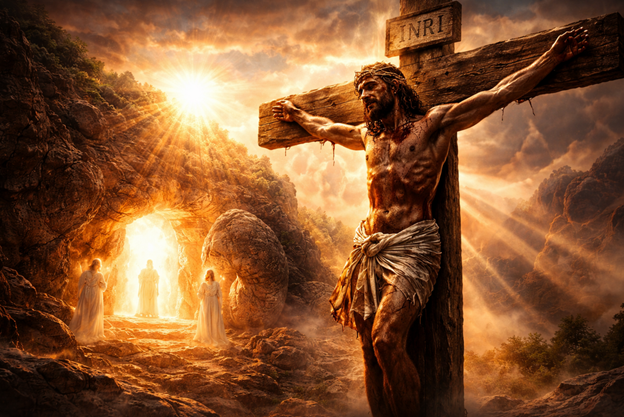
Here is the glory of the Christian message: what we could never pay, Christ has paid in full at the Cross. He took our punishment. He bore all of it. And His resurrection from the dead is God’s declaration that the debt has been settled in full. The Cross was not merely an example of love – and it was certainly more than the death of a religious martyr – it was a transaction of justice – and the empty tomb is Heaven’s receipt.
This is why the question of hell cannot be separated from the finished work of Christ on our behalf. If Christ’s death on the Cross – as the infinite Son of God – atoned for our infinite offenses against God (and it did), then sin has been fully and sufficiently addressed. If He rose from the dead (and He did), then death and separation from God have been decisively defeated. Forgiveness is freely offered, a new nature – a new heart – is promised, and eternal life is given to all who trust in Christ as Savior and Lord.
But if the offer of God’s grace in Christ is refused, the debt remains. It will not be dismissed; it must be borne by the one who rejects so great a salvation. And bear it they will – forever and ever.
The real question, then, is not whether Hell seems too severe.
The question is whether we will receive the incredible mercy that cancels the debt altogether.
In the end, no one is lost because their sin was too great to be forgiven.
They are lost because the forgiveness purchased for them was refused.
[1] Erwin Lutzer, quoted in Bill Wiese, Hell (Charisma House, 2008), 54.