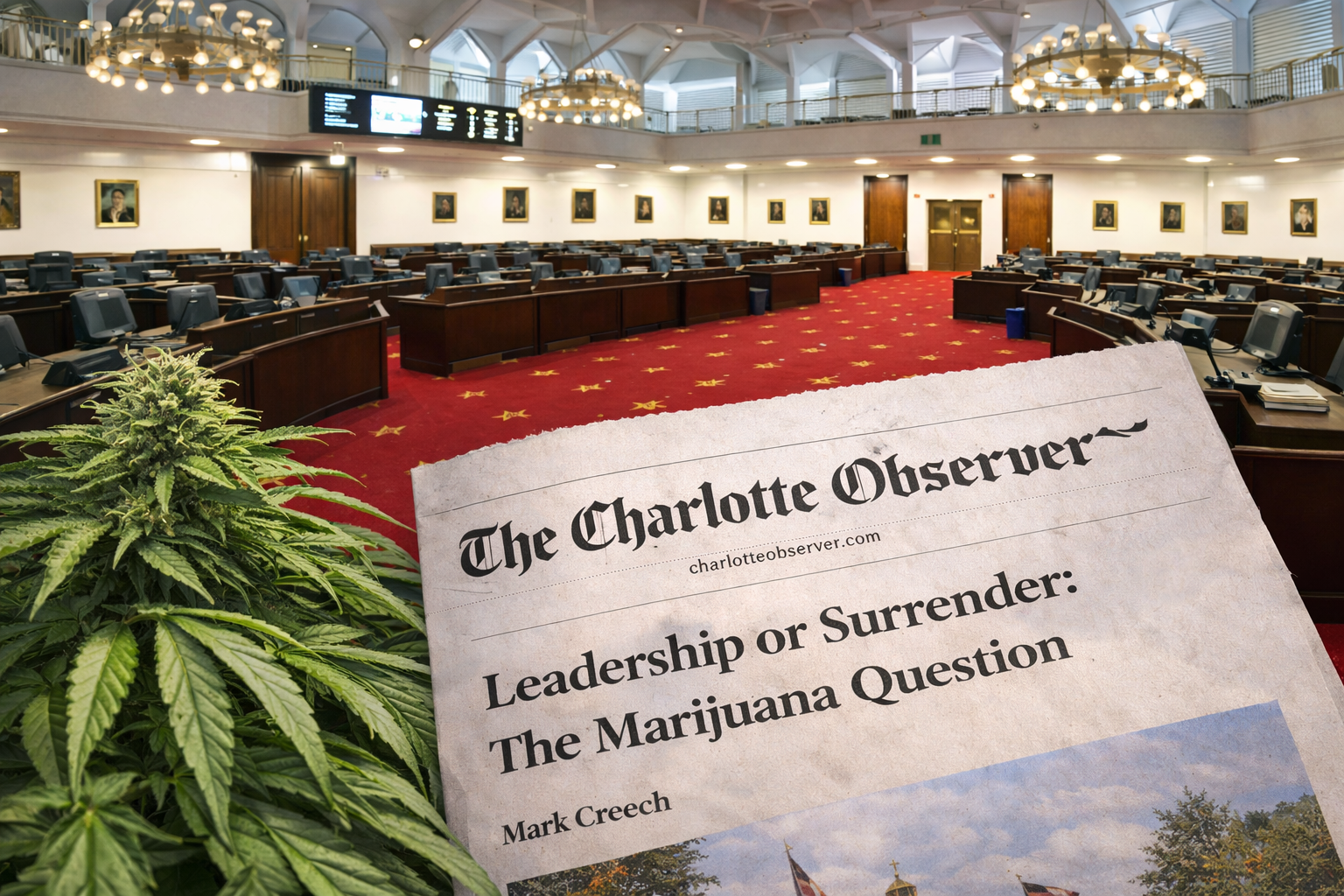
This article first appeared in the Charlotte Observer. The link is here: https://www.charlotteobserver.com/opinion/article315377742.html
by Mark Creech
A state advisory council appointed by Governor Josh Stein is urging North Carolina lawmakers to legalize recreational marijuana, presenting the move as a sensible response to an expanding and largely unregulated THC market. The argument is familiar: regulation will bring order, protect minors, generate tax revenue, and correct past injustices.
Beneath these assurances lies a profoundly flawed premise. Legalization does not solve the problems associated with marijuana; it expands them.
We have seen this pattern before. When proponents speak of “regulation,” they suggest the state can control a substance’s harms by placing it under official oversight. Yet in practice, legalization does not replace the illicit market; it operates alongside it, and total use increases as a result. Black markets adapt. Legal markets grow. The problem’s overall footprint widens.
Perhaps the most troubling claim is that legalization will protect minors. Experience elsewhere suggests the opposite. When something is legalized, it becomes normalized, and therefore more accessible. High-potency products, flavored edibles, and sophisticated marketing have all contributed to increased youth exposure in states that have gone down this road. The perception of risk declines even as marijuana’s potency rises.
We are also told that marijuana legalization will provide a new stream of tax revenue for education, infrastructure, or addiction services. This is also a dangerous illusion. Any revenue gained is surpassed by the social costs: increased healthcare burdens, higher rates of dependency, impaired driving, and diminished workplace productivity. It is poor governance to fund public priorities by promoting what undermines public well-being.
Some argue that because THC products are already widely available through loopholes in hemp regulations, the state should legalize marijuana and regulate it more comprehensively. This reasoning turns logic on its head. If unregulated THC products are a problem, the answer is to close the loopholes, certainly not expand access. We should not respond to disorder by legitimizing it.
At its core, this debate is about more than public policy. It is about the kind of society we are building. Legalization signals not merely tolerance, but acceptance. It reflects a willingness to normalize a clearly dangerous intoxicant and weave it into everyday life. Over time, such normalization reshapes expectations, lowers inhibitions, and increases participation.
We have seen similar arguments made for the expansion of other vice industries, especially alcohol and tobacco. They are framed in terms of economic benefit, personal freedom, and regulatory control. Yet those approaches have not eliminated harm; they have entrenched it.
Moreover, as Professors Mark A. R. Kleiman, Jonathan P. Caulkins, and Angela Hawken note in Drugs and Drug Policy, creating a legal market for an abusable drug incentivizes businesses to sustain heavy use, since a small group of high-frequency users consumes most of the product.
One of the most common arguments for marijuana legalization is not really an argument at all, but a resignation. We are told legalization is inevitable. The problem is already too widespread. Therefore, we may as well regulate it and profit from it.
An argument about inevitability in this case is nothing more than surrender falsely dressed as realism.
We have faced public health challenges deeply embedded in our culture before – smoking, drunk driving, and others, and made significant progress – not by normalizing them – but by confronting and challenging them. The same can be done here. A renewed effort at public education is essential, especially since many Americans remain unaware of the dangers of modern marijuana and its increased potency.
Education alone, however, will not suffice; real cultural change requires leadership. Progress came when leaders across society – government, business, and even entertainment – spoke clearly and consistently about the risks. When this happens, perception shifts, and behavior follows.
We are not without good options. We can resist the spread of harmful practices rather than institutionalize them. The easier path is legalization. The better path is leadership.
North Carolina has typically exercised caution in the face of such pressures. That caution has never been backward, but wise. It reflects an understanding that not everything that can be legalized should be legalized.
The question before us is not whether marijuana use is widespread. The question is whether the state should give it its full endorsement and infrastructure. Legalization is not a neutral act, it is an affirmative one. It confers legitimacy, expands access, and invites participation.
North Carolina should not take that step. It should choose courage over convenience, protection over profit, leadership over surrender.
Rev. Mark Creech is the former executive director of the Christian Action League and currently serves as director of government relations for Return America. He lives in Raleigh.