by Dr. Mark Creech
Director of Government Relations
Return America
The North Carolina General Assembly has now passed and sent Governor Josh Stein a roughly $34 billion State Budget. After a prolonged budget standoff, the final votes came Thursday, July 2, with the House approving the measure 88-21 and the Senate approving it 35-10. The Governor now has the option to sign the budget, veto it, or allow it to become law without his signature.
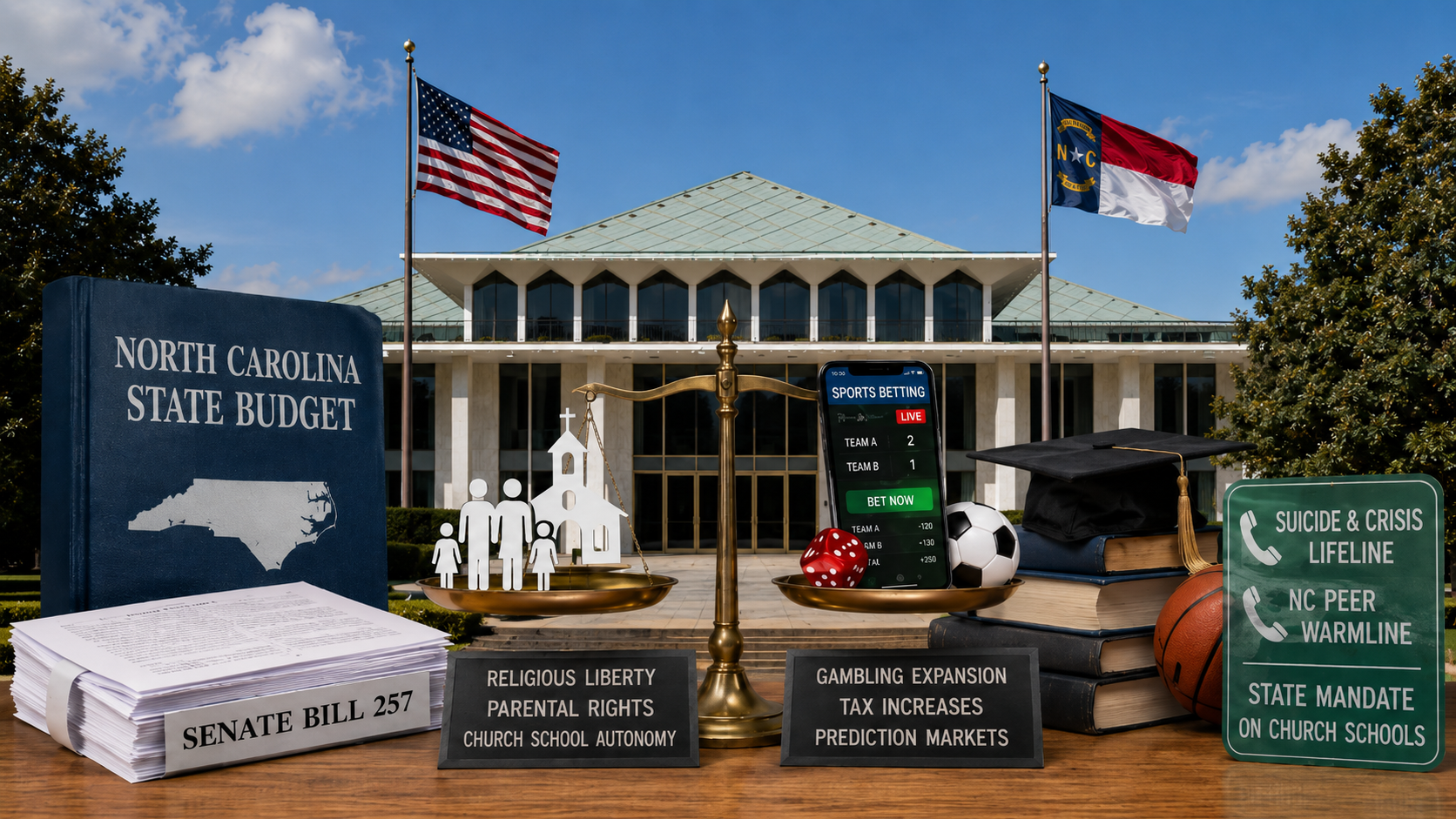
As with most State budgets, Senate Bill 257 – 2026 Appropriations Act contains many ordinary spending provisions. It includes pay raises, tax changes, Medicaid funding, Hurricane Helene recovery money, and numerous agency appropriations. But modern budget bills often carry much more than appropriations. They frequently become vehicles for significant policy changes that might receive far more scrutiny if considered as stand-alone bills.
That is the case with this budget.
It should also be noted that the provisions discussed in this report were included in a budget conference report, which became the budget bill. That matters procedurally.
A conference committee is appointed to negotiate a compromise between the House and Senate versions of a bill, but its work is not conducted in the same public manner as regular committee debate. By the time the conference report is released, it generally goes directly to the floor of both chambers for an up-or-down vote, without amendment.
Consequently, Return America had no meaningful opportunity to address these particular provisions before they were placed before lawmakers for final passage. Had these items been considered as stand-alone bills or in the ordinary committee process, they could have been reviewed, debated, and publicly challenged. Instead, several significant policy matters were embedded in the State Budget and advanced through a process that allowed little or no opportunity for public input.
Return America is concerned about several provisions in SB 257 that touch gambling, religious liberty, church-school autonomy, and the protection of minors.
A New Doorway for Prediction-Market Gambling
The most serious gambling concern in the budget is found in Section 44.9, titled “Prediction Market Trading Fees Tax.” This section creates a new Article 2F in Chapter 105 of the General Statutes called “Tax on Prediction Markets.”
At first glance, this may sound like a simple tax provision. It is not. The language defines an “event contract” as a swap traded on a federally regulated market where the event or contingency “involves sports.” It also defines a “prediction market” as any physical or electronic platform through which a consumer may buy, sell, or exchange event contracts, including platforms located outside North Carolina if North Carolina consumers trade on them.
In plain language, these platforms allow people to put money on whether a future event will happen. When the event involves sports, this begins to look very much like sports gambling, even if it is described in the technical vocabulary of financial markets.
The most troubling language is the “Authority” subsection. It says that a prediction market registered and licensed by the Commodity Futures Trading Commission that offers event contracts, including sporting event contracts, to North Carolina residents “may operate within the State lawfully” because of its federal registration and compliance with federal law.
That language is concerning. It does not merely tax something that is already occurring. It appears to recognize federally registered sports-related prediction markets as lawful in North Carolina.
The budget then imposes a 6% tax on each prediction-market operator’s net trading fee revenue apportioned to North Carolina. The tax applies when a North Carolina resident, domiciled and present in the State at the time of the trade, pays trading fees connected to an event contract. The bill also says the tax does not impose any State licensing, registration, or other regulatory requirements on prediction markets.
Return America has long warned that gambling expansion rarely comes all at once. It comes in increments, often through unfamiliar terms, technical language, and carefully crafted exceptions. Prediction-market gambling may prove to be one of the next major fronts in the gambling debate. North Carolina should not quietly open this door in a budget bill.
Greater Dependence on Sports-Wagering Revenue
The budget also increases the tax on interactive sports wagering operators. Section 44.7 raises the tax rate from 18% to 23% of gross wagering revenue.
Some may argue that increasing the tax on sports betting companies is a good thing. But the larger concern is not simply the rate. The greater concern is that North Carolina is becoming more financially entangled with gambling revenue.
The budget also modifies the distribution of sports-wagering tax proceeds. Those funds are tied to a variety of uses, including collegiate athletics, youth sports and outdoor recreation grants, major events, and the General Fund.
This creates a dangerous incentive. The more State programs, universities, and athletic interests become dependent on gambling proceeds, the harder it becomes for future lawmakers to restrain gambling. Government begins to rely on the very activity it should be cautious about promoting.
Gambling money is never free money. It comes from citizens, families, and communities. The State may collect revenue, but many North Carolinians will pay in broken homes, depleted bank accounts, addiction, and spiritual harm.
State Mandates on Private Church Schools
Another provision that deserves careful review is Section 7.33, which requires schools to provide students with the Suicide and Crisis Lifeline number and the NC Peer Warmline number.
No one should minimize the seriousness of suicide prevention or the need to help young people in crisis. The concern here is not the goal of helping students. The concern is the precedent of the State mandating what private church schools and schools of religious charter must publish and where they must publish it.
The bill adds a new statute requiring each private church school or school of religious charter to provide students with these numbers. The required language must appear on any new student identification issued to students in grades six through twelve, on the school website, on the home screen of any electronic device issued to students, on any school agenda or calendar, on documents used during suicide awareness activities, and on registration documents.
Again, the stated purpose may be commendable. But church schools have historically guarded their independence from unnecessary State control. Even well-intended mandates can create precedents. If the State can require church schools to publish one message it believes important today, future legislatures may be tempted to require other messages tomorrow.
Return America believes that churches and Christian schools should be free to minister to students in crisis in ways consistent with their faith, pastoral responsibilities, and biblical convictions.
Released-Time Religious Instruction: A Positive Provision
Not every policy item of interest in the budget is negative. Section 7.54 includes a provision on released-time religious instruction.
The bill requires public school units to adopt a policy allowing a student to be excused from school to attend religious instruction offered by a private entity during the school day. The policy must include parental consent, documentation of attendance, make-up work for missed assignments, and a prohibition on the use of State or local funds to facilitate instruction, except for minimal administrative costs. It also provides that religious instruction generally may not be offered on school property unless allowed under a neutral facility-use policy.
This is a favorable religious-liberty provision. Released-time religious instruction has a long history in American law, provided it is properly structured. It recognizes that parents, not the State, bear the primary responsibility for the spiritual formation of their children.
Return America welcomes provisions that respect parental rights and create lawful space for religious instruction outside the direct control of government schools.
IOLTA Restrictions Related to Gender-Transition Advocacy for Minors
The budget also contains language concerning North Carolina Interest on Lawyers’ Trust Accounts, commonly known as IOLTA grants. Section 16.25 restricts certain IOLTA grants from going to entities engaged in specified kinds of representation, assistance, or advocacy.
Among those restrictions, the budget says IOLTA grants shall not be awarded to any entity that provides representation, assistance, or advocacy in matters related to surgical gender-transition procedures, puberty-blocking drugs, or cross-sex hormones for minors.
Return America would view this as a positive provision. Tax-advantaged or court-related grant structures should not be used to support efforts that facilitate life-altering gender-transition interventions for children.
Children deserve protection. Parents deserve truth. Public policy should not subsidize advocacy that places minors on a path toward irreversible physical consequences.
The Larger Concern
The State Budget contains items many North Carolinians may support, including raises, tax relief, public safety investments, and Hurricane Helene recovery funds. But no budget should be beyond moral scrutiny simply because it funds needed services.
For Return America, the first major concern is the precedent set by the State’s mandate for private church schools and religious charter schools. The issue is not whether students in crisis should be helped. They should. The issue is whether the State should compel church schools to publish government-directed messages in specific places and formats.
That precedent should concern every friend of religious liberty. If the State can require church schools to publish one message today, what prevents a future legislature from requiring other messages that conflict with the convictions of Christian schools and the families they serve?
The second major concern is the continued normalization of gambling. North Carolina only recently entered the online sports-betting business. Now, this budget raises the sports-wagering tax and creates a new framework for taxing sports-related prediction markets. Gambling expands by legalization, then taxation, then dependence.
Return America believes North Carolina needs moral courage from its leaders. The State should not intrude unnecessarily into the life and ministry of church schools, nor should it balance its books on human weakness.
As Proverbs 14:34 declares, “Righteousness exalteth a nation: but sin is a reproach to any people.” Lawmakers have now adjourned until Monday, July 27. In the meantime, please watch for our forthcoming Legislative Update, where we will address several other measures that Return America continues to monitor closely until the General Assembly finally adjourns sine die.