by Dr. Mark Creech
Director of Government Relations
Return America
As North Carolina approaches another legislative session, supporters of marijuana legalization are preparing an aggressive campaign to persuade lawmakers. Backed by a multibillion-dollar industry, advocates will frame legalization as compassionate, practical, and economically beneficial. For those committed to protecting public health and community well-being, it is essential to be ready with clear and thoughtful responses.
Below are several of the most common arguments for legalization—and the reasons they fall short.
Claim #1: “Legalization will eliminate the black market.”
Response:
Experience from states that have legalized recreational marijuana shows that illicit markets often persist. High taxes and regulatory costs allow illegal sellers to undercut legal prices, while some consumers continue to seek products that bypass state restrictions. Rather than eliminating the black market, legalization frequently results in two parallel systems—legal and illegal— both contributing to increased overall availability and use.
Claim #2: “Legalization will protect minors.”
Response:
Legal status tends to normalize marijuana use, reducing the perception of risk among young people. In states with legalization, youth report easier access to high-potency products, including edibles designed to resemble candy or snacks. Commercial marketing and social acceptance can further erode safeguards intended to protect minors.
Claim #3: “Marijuana legalization will generate significant tax revenue.”
Response:
While legalization does produce tax income, the financial benefits are often offset by increased societal costs. These include higher healthcare expenditures, addiction treatment, impaired driving incidents, workplace productivity losses, and expanded regulatory and enforcement needs. Funding public priorities through the promotion of a harmful substance is a precarious and short-sighted strategy.
Claim #4: “Because THC products are already widely available, legalization is the logical next step.”
Response:
The proliferation of intoxicating THC products through hemp-related loopholes is indeed a serious concern. However, the appropriate response is to strengthen and clarify regulations to close these gaps—not to legalize recreational marijuana. Expanding access only compounds the existing problem.
Claim #5: “Legalization is inevitable.”
Response:
Assertions of inevitability are not arguments; they are expressions of resignation. History demonstrates that determined leadership and public engagement can change cultural norms and reduce harmful behaviors. Progress in reducing smoking rates and combating drunk driving occurred because communities chose action over surrender.
Claim #6: “Legalization promotes social justice.”
Response:
Concerns about fairness in the enforcement of drug laws deserve serious attention. However, legalization is not the only—or the best—means of addressing these issues. Targeted criminal justice reforms can correct inequities without introducing the broader societal harms associated with commercialized marijuana.
A Call to Grassroots Action
The marijuana industry possesses vast financial resources and will advocate forcefully for legalization in the upcoming legislative session. In contrast, the most powerful influence available to concerned citizens is their collective voice.
Supporters of Return America can play a vital role by:
- Contact your legislators to express opposition to recreational marijuana.
- Speak out about the risks associated with legalization.
- Engage in advocacy efforts to raise awareness.
- Encourage faith and civic leaders to speak publicly against marijuana legalization.
- Stay informed through Return America’s updates and action alerts – be ready to act when your voice is needed.
It is also important to recognize the timing and political dynamics surrounding this debate. For some time, the North Carolina House and Senate have struggled to reach agreement on a state budget, and there is increasing pressure to resolve that impasse as the current session moves forward. Under such conditions, legislative negotiations can sometimes produce difficult trade-offs in order to secure final passage of a budget. There is concern that marijuana-related provisions—whether involving a commercial medical program, or a broader adult-use framework—could be drawn into such bargaining. Additionally, any final budget package remains subject to a potential gubernatorial veto, adding another layer of uncertainty to the process. Would the governor veto something the legislature wants if the marijuana initiative is not moving as he thinks it should? The governor has expressed strong support for marijuana legalization, raising additional questions about how executive-legislative tensions might shape final outcomes.
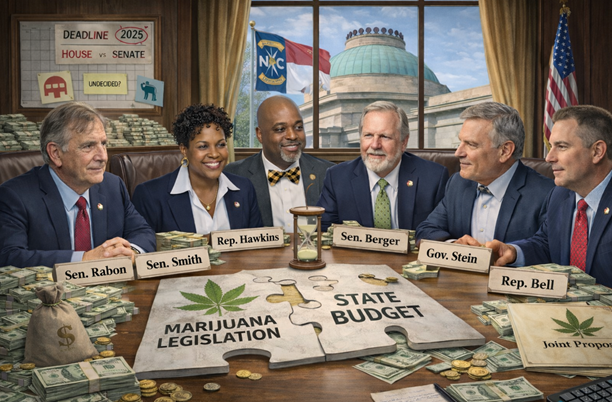
Complicating matters further, Senate President Pro Tempore Phil Berger, a central figure in shaping Senate priorities, is entering a period of political transition as he approaches the end of his tenure in 2027, introducing additional uncertainty regarding future leadership dynamics in the chamber. Could Senator Berger’s departure have some impact on the consideration of marijuana legalization? Medical marijuana legislation has been strongly advocated by his longtime colleague and ally, Sen. Bill Rabon, who is chairman of the powerful Senate Rules Committee, which further underscores the importance of internal Senate dynamics in shaping the debate.
The General Assembly is scheduled to reconvene for the latter portion of its 2025–2026 session on April 21, and lawmakers could very well revisit several cannabis-related proposals that have carried over. Notably, while the Senate has previously advanced medical cannabis legislation in both 2022 and 2023, those efforts ultimately did not become law, due in part to opposition on the House side.
The current Advisory Council on Cannabis includes legislative members from both parties, including Reps. John Bell (R-Wayne) and Rep. Zack A. Hawkins (D-Durham), along with Sens. Bill Rabon (R-Brunswick) and Sen. Kandie Smith (D-Edgecombe), reflecting the bipartisan nature of ongoing discussions.
The debate over marijuana legalization is not merely about policy – it is about the kind of communities we wish to cultivate. By preparing now and speaking with clarity and conviction, Return America’s thousands of grassroots advocates can help ensure that North Carolina rejects legalization and upholds the public interest.