by Dr. Mark Creech
Director of Government Relations
Return America
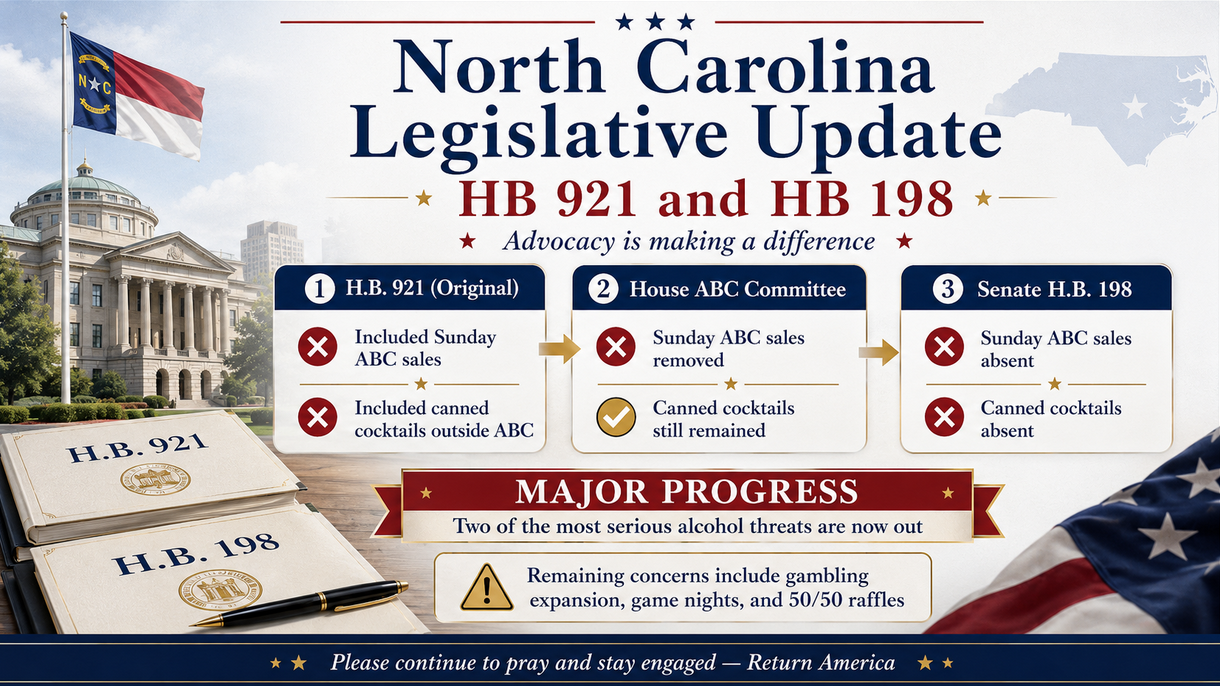
Recently, Return America has been sounding the alarm about H.B. 921, the ABC & Gaming Omnibus Bill. That measure originally contained several troubling provisions that would have weakened North Carolina’s alcohol control system and significantly expanded alcohol access.
Two provisions were particularly concerning.
First, H.B. 921 would have allowed Sunday sales at ABC stores. That would have added another day of access to spirituous liquor, weakened a long-standing public-health pause on liquor sales, and bypassed the voters who originally approved ABC stores and their hours and days of sale through local-option elections.
Second, H.B. 921 contained a dangerous provision on premixed or canned cocktails. Under current law, these products are treated as spirituous liquor and are therefore subject to North Carolina’s ABC control model because they are liquor-based cocktail products. H.B. 921 would have moved them into ordinary commercial channels, allowing them to be sold more like beer or wine.
Return America strongly opposed both provisions.
Thankfully, when H.B. 921 passed the House ABC Committee at its second hearing, the Sunday ABC sales provision had been removed, a significant and welcome development.
However, the canned cocktail provision remained in H.B. 921, and we continued to warn lawmakers that it would undermine the ABC control system by moving liquor-based cocktail products outside the traditional ABC store model.
Then, on Thursday, the Senate surprised many observers by taking up H.B. 198 – ABC Omnibus of 2026. Originally, H.B. 198 was a narrow ABC procedural bill addressing notice of ABC violations, not a sweeping alcohol-and-gaming package. It has since been rewritten as the much broader omnibus bill.
Here is the good news: in H.B. 198, both Sunday ABC sales and the dangerous canned cocktail provision appear to be absent.
That is huge progress!
These were two of the most serious alcohol-related threats in H.B. 921. Seeing Sunday sales removed from H.B. 921 and then seeing both Sunday sales and canned cocktails left out of H.B. 198 is a major encouragement.
We should first thank the Lord for this progress. We also thank all who prayed and contacted their legislators about this serious issue.
To be clear, H.B. 198 still contains alcohol provisions that warrant scrutiny. It includes provisions on serving two mixed drinks at once, mobile bar services, social districts, service business permits, in-stand sales at concerts, and temporary ABC permits. These provisions are not ideal, and lawmakers should examine them carefully. However, they do not carry the same urgency as Sunday ABC sales or the canned cocktail provision that would have moved liquor-based products outside the ABC control system.
There is still much to do.
H.B. 198 still contains serious gambling provisions that should deeply concern every North Carolinian who believes gambling should not be further normalized in our civic and charitable life.
The bill would expand game-night events by increasing the number of game-night events an exempt organization – a nonprofit – may conduct or sponsor from 4 per year to 24 per year. It also changes the limit for qualified facilities from 2 game nights per calendar month to 24 per year.
That is a major expansion. It takes what has been treated as a limited exception and turns it into something far more frequent and routine.
Years ago, when casino-style “game night” legislation was first debated in North Carolina, I described these events as“gambling on training wheels” and compared them to giving candy cigarettes to children. The point was simple: these events may be promoted as harmless nonprofit fundraisers, but they teach communities to treat casino-style gambling as normal, charitable, and socially acceptable. H.B. 198 would expand that very practice from 4 events per year to 24, turning a limited exception into a routine form of gambling conditioning.
H.B. 198 also changes the law governing 50/50 raffles. It defines 50/50 raffles and exempts nonprofit and government 50/50 raffles from many standard raffle restrictions, including limits on the number of raffles, prize limits, and other safeguards.
Return America opposes the normalization of gambling in North Carolina’s civic and charitable life. A charitable or governmental purpose does not eliminate the social risks of gambling. Expanding game nights and loosening raffle limits normalize chance-based wagering, increase youth exposure, encourage impulse participation, and move communities toward viewing gambling as an ordinary fundraising tool.
Once gambling is treated as a normal method of fundraising, it becomes easier to justify the next expansion, and then the next. What begins as an exception can quickly become an accepted part of community life.
North Carolina should not go any further down that road.
Today, we are encouraged — yet still watchful.
We are grateful that Sunday ABC sales were removed from H.B. 921 and that both Sunday ABC sales and the canned cocktail provision appear to be absent from H.B. 198. That is a major answer to prayer and a sign that our advocacy is making a difference.
However, we must continue to pray and remain engaged.
Please pray for lawmakers to have wisdom and courage. Pray that the remaining harmful provisions will be removed. Pray especially that North Carolina will resist further normalization of gambling and preserve stronger safeguards for our families and communities.
Addendum: Other Significant Legislative Votes This Week
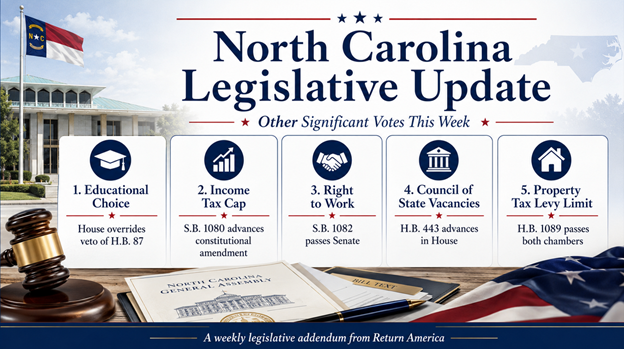
While much of our attention has been on H.B. 921 and H.B. 198, several other important measures also passed the North Carolina House this week. These included a veto override on educational choice, as well as several proposed constitutional amendments that, if ultimately approved, would be submitted to the people for a statewide vote.
Veto Override — HB 87 – Educational Choice for Children Act
The House voted this week to override the Governor’s veto of HB 87 – Educational Choice for Children Act. The bill elects for North Carolina to participate in the federal tax credit program for contributions to certain scholarship-granting organizations.
The House overrode the veto on May 20 by a vote of 73-46. The measure was then sent to the Senate, where it was referred to the Senate Committee on Rules and Operations.
Income Tax Cap Amendment — Senate Bill 1080
SB 1080 – Lower Taxes for All NC proposes a constitutional amendment to reduce the maximum allowable income tax rate on incomes from 7% to 3.5%, effective for taxable years on or after January 1, 2027. The measure would place the question before voters in the 2026 general election.
The Senate passed the measure on May 19 by a vote of 30 to 18. The House passed it on May 20 by a vote of 73 to 46.
Right to Work Amendment — Senate Bill 1082
SB 1082 – NC Right to Work Amendment proposes a constitutional amendment to protect North Carolinians’ right to be employed without being forced to join or pay dues to a labor union or association. If approved by the General Assembly, the measure would be submitted to voters at the November 2026 general election.
The Senate passed the measure on May 20 by a vote of 30-16. After its passage in the Senate, it was sent to the House and referred to the House Committee on Rules, Calendar, and Operations.
Council of State Vacancies Amendment — House Bill 443
HB 443 – Constitutional Amendment: Council of State Vacancies, would change how vacancies are filled for certain statewide elected executive offices. Under the proposal, when a Council of State officer who was elected as the nominee of a political party leaves office before the end of the term, the Governor would fill the vacancy from a list of qualified nominees submitted by that political party, if the party submits such a list.
The House passed the measure on May 20 by a vote of 73-46. It was then sent to the Senate, where it was referred to the Senate Committee on Rules and Operations.
Property Tax Levy Limit Amendment — House Bill 1089
HB – 1089 – Constitutional Amendment: Property Tax Levy Limit, proposes amending the North Carolina Constitution to require the General Assembly to enact general laws that limit how much property tax levies may increase, with possible exceptions.
The House passed the measure on May 20 by a vote of 73-46, and the Senate followed later the same day by a vote of 31-15. The measure has since been ratified and chaptered as Session Law 2026-5.
Note on the Vote Totals
The official General Assembly records list several of these House votes as 73-46. That reflects support from all House Republicans, as well as the two unaffiliated House members, Representatives Carla Cunningham and Nasif Majeed.