
by Rev. Mark Creech
RevMarkCreech.org
Occasionally, life creates moments when people who would never otherwise cross paths are drawn together by a single reality – a tragedy, a celebration, or a truth too large to belong to only one kind of person. In such moments, social distinctions fade, familiar boundaries give way, and what matters most is not who we are or where we come from, but what we have encountered.
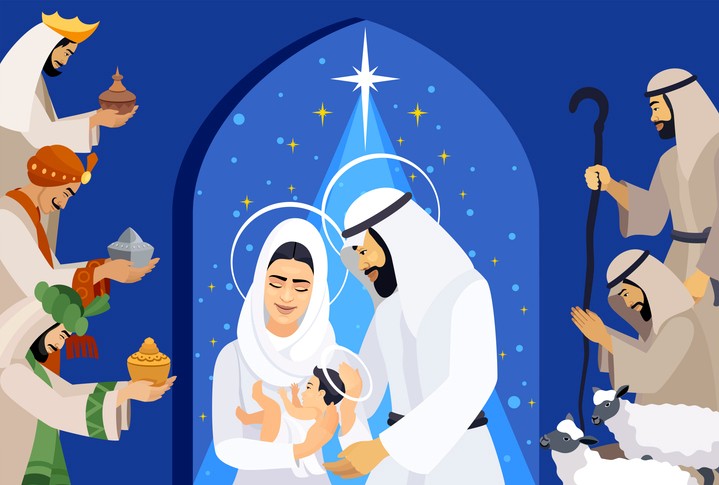
The birth of God’s Son is such a moment. From its very beginning, the coming of Christ reaches across cultures, classes, and continents, uniting the world around a single, redemptive act of God. The Christmas story brings together two unlikely groups: shepherds watching their flocks by night and wise men traveling from distant lands. One group was poor and overlooked, the other educated and venerated. One lived on the margins of society, the other moved comfortably among wealth, power, and esteemed learning. One labored with his hands, the other with his mind, so to speak. Yet God chose both to bear witness to the birth of His Son. Their shared appearance in the Christmas narrative is not accidental.
In bringing such different people to the same Christ, God was not merely telling a story; He was showing how His grace reaches us, how faith responds, and how the good news is carried into the world.
Here are seven timeless truths from the Wise Men and the Shepherds.
God Resists the Proud and Reveals Himself to the Humble
Scripture is unambiguous about God’s posture toward pride. “Pride goeth before destruction, and an haughty spirit before a fall” (Proverbs 16:18). “Everyone that is proud in heart is an abomination to the Lord” (Proverbs 16:5). “A man’s pride shall bring him low: but honor shall uphold the humble in spirit” (Proverbs 29:23). From a biblical worldview, pride is not merely an attitude problem; it is a spiritual condition that places the soul in opposition to God Himself.
Pride, at its core, is the refusal to acknowledge dependence on God, on grace, or on mercy. It is the quiet insistence that we are sufficient, deserving, or self-justifying. Billy Graham once wrote that pride is “the greatest sin that will keep men and women from the kingdom of God,” because no one can come to God clinging to self-exaltation. God does not negotiate with pride; He resists it.
This is precisely why the first witnesses of Christ’s birth are so revealing. God did not announce the arrival of His Son to the self-assured, the self-important, or the self-satisfied. He revealed Christ to shepherds – men with no standing to protect, no reputation to maintain, and no illusions of self-worth to defend. And He revealed Christ to wise men who, though learned and esteemed, were willing to bow, to kneel, and to worship a child who was not one of their own.
Pride is not confined to the wealthy or the powerful; the poor can cling to it just as fiercely. Neither is humility the exclusive possession of the underprivileged in life; it may also be found in kings and scholars who willingly lay down their pretensions. Anyone may be bound by pride, but only those who put it away will see Christ. God reveals His Son not to those impressed with themselves or confident in their own understanding, but to those who humble themselves, come to the Cross, and receive what they cannot earn.
God Draws Both the Near and the Far to Christ.
When an important signal is sent, such as an emergency broadcast, a radio transmission carried across the airwaves, it is not intended only for those standing nearest the source. Some receive it clearly because they are close; others hear it from great distances, perhaps faintly, yet unmistakably. The signal itself is not limited by geography. It is meant to be heard wherever it reaches.
So, it is with the birth of Christ. The shepherds were local men, sons of the soil, close to Bethlehem and close to the unfolding events of that holy night. They belonged to the covenant people of Israel and lived within reach of God’s long-standing promises. The wise men, however, came from far away. They were Gentiles, outsiders to Israel’s religious life, strangers to its temple, sacrifices, and ceremonial law. Yet they were drawn by the same God, guided by the same divine purpose, to the same child.
But “near” and “far” are not only matters of distance; they are also matters of the heart. Some grow up surrounded by the story of Jesus Christ. They’ve been raised in the church. They are familiar with Scripture and fluent in the language of faith. Yet they remain far from Christ personally. Others come from great distances, without religious background or inherited belief, yet find themselves drawn to the Lord with a clarity and urgency they cannot explain.
In gathering the shepherds and the wise men to Jesus, God was declaring from the outset that the birth of His Son would not be confined to one people or one place. Christ was not merely Israel’s Messiah or a local hope, but the Redeemer of the world. He belongs to those who have always been near the story and to those just discovering it – to the insider and the outsider, the familiar and the distant, Israel and the nations alike. Christmas reminds us that no one is too far to be reached, and no one is so near that humility and faith are not necessary.
The Revelation of God’s Will Demands a Response
When a genuine warning is given, delay is never neutral. When God reveals His will, it is not offered merely to inform the mind; it is meant to summon action. To see danger clearly and yet remain still is not prudent.
A modern illustration of this truth emerged amid the chaos of September 11, 2001. Stanley Praimnath was working on the 81st floor of the South Tower when the first plane struck the North Tower. Initially, he was told that his building was secure and that there was no immediate danger. He could have stayed. He may have waited. Many like him did. But when Stanley saw with his own eyes that something was terribly wrong and was urged to evacuate, he chose to act. On the 78th-floor stairwell, he encountered Brian Clark, who likewise refused to wait for further assurances or explanations. Together, they moved downward and out of the building. And they lived.
Other survivor accounts tell a similar story. Many who escaped did so because they acted immediately rather than waiting for official confirmation or perfect clarity about the situation. One man later testified that he survived from the 105th floor because he took the stairs as soon as danger became evident. Others who hesitated or trusted there would be time later did not survive. In moments of true crisis, delay can be fatal.
So, it is when God reveals His will for us. When God speaks, He does not invite prolonged hesitation. The shepherds did not debate the angel’s message; they went to Bethlehem “with haste” (Luke 2:16). The wise men did not wait for safer conditions or fuller explanations; they set out on a long and costly journey, guided only by what God had made known to them. Faith that hears God’s word yet refuses to act is not biblical faith at all.
Jesus Himself underscored this truth with sobering clarity. When one man expressed his willingness to follow Christ but added, “Let me first go and bury my father” (Luke 9:59).Jesus replied, “Let the dead bury their own dead, but you go and proclaim the kingdom of God” (Luke 9:60).Jesus was not being harsh; He was telling the man he needed to prioritize – nothing, absolutely nothing, is more important than to act immediately on God’s will. The man was not rejecting Christ outright; he was postponing obedience. Yet Jesus made clear that the call of the kingdom does not permit delay. To say “later” is, in effect, to say “no.”
When God makes His will known, the only proper response is not hesitation or qualification, but submission. The shepherds went with haste. The wise men set out without guarantees. Christ Himself teaches that following Him cannot be deferred to a more convenient moment. Faith that waits for the perfect time often never moves at all.
Pursuing Christ Can Require Leaving Comfort and Security
The shepherds left their flocks in the middle of the night – not simply for a casual visit, but at genuine risk to their livelihood and reputation. In a world without fences or modern protections, flocks could easily fall prey to thieves or predators. To abandon them, even briefly, was to risk loss without recompense. Yet the heavenly summons called them away from comfort into total commitment.
The wise men likewise forsook security. Leaving behind home, status, and wealth, they embarked on a long and dangerous journey. Their travel took them across hostile terrain, exposed them to bandits, and ultimately brought them into contact with a jealous ruler, King Herod, whose murderous intent they narrowly escaped. Their pursuit of Christ required costly faith, not mere curiosity.
This pattern of cost continues throughout Christian history. After Pentecost, the apostles proclaimed Christ with boldness, and almost all of them, as recorded in early church tradition, suffered violent deaths for following the Lord. Believers in the early centuries of the church faced systematic persecution in the Roman world: imprisonment, torture, mutilation, crucifixion, being torn by wild beasts, or burned in arenas simply for openly acknowledging Christ. Their courage under threat drew many to the gospel precisely because their faith stood undiminished in the face of such suffering and sacrifice.
The pattern does not end in antiquity. Around the world today, Christians still pay for their testimony. Tens of thousands are persecuted every year; thousands are killed because of their faith; churches are attacked, families are displaced, and believers are imprisoned or abused for refusing to renounce Christ. The cost of discipleship in many places where people follow Jesus is steep.
Even in societies where religious freedom has long been taken for granted, public witness sometimes carries unexpected danger. On September 10, 2025, Christian conservative, apologist, and activist Charlie Kirk was fatally shot while speaking at a university event in Utah. This public assassination stunned America but underscored how volatile the climate of public expression, especially Christian expression, has become. Kirk was speaking on a campus to a crowd of about 3,000 when he was shot in the neck and later died from his wounds; a suspect was arrested and charged with aggravated murder in connection with the killing. While the circumstances behind the attack are still under investigation, the tragic event illustrates a stark reality of our age: putting oneself forward in the public square – especially on matters of conviction, conscience, and faith – can carry grave risks.
From the fields around Bethlehem to the arenas of ancient Rome, and from crowded chapels to modern public forums, the journey of faith has always required the willingness to leave comfort and embrace cost. The call to follow Christ is not an invitation to convenience, but a summons to obedience, courage, and unwavering commitment – even when that path draws possible scrutiny, hostility, or danger.
Christ is Worthy of True Worship from Every Heart and Walk of Life
When the shepherds found the child, they responded with awe, praise, and proclamation. When the wise men found Him, they fell down and worshiped, offering gifts of great value. Their expressions differed, but their devotion was the same. True worship is not uniform in form or style, but it is unified in focus. Christ is worthy of worship from the poor and the wealthy, the learned and the unlearned, the local and the foreign.
Today, this truth confronts many of the assumptions we bring into worship. We are tempted to believe that certain people, cultures, or styles of expression belong more naturally in the presence of God than others. Yet at the manger, shepherds and scholars stand side by side. Heaven makes no distinction between the worth of their worship.
This also challenges the notion that worship must look a certain way to be authentic. Some, like the shepherds, respond with spontaneous joy and testimony. Others, like the wise men, express their devotion through careful preparation and a costly offering. Both forms belong in the kingdom of God. True worship is not measured by volume, vocabulary, or venue, but by whether the heart is truly bowed before Christ.
Dr. Jerry Vines once shared a story told to him by a deacon in his church. The deacon dreamed that an angel escorted him into a Sunday worship service. The sanctuary was full, the choir in place, the pastor in the pulpit – yet something was terribly wrong. When the congregation sang, their lips moved, but no sound was heard. The choir lifted their voices; still silence. The pastor preached with passion, yet the room remained mute. Finally, the deacon asked the angel, “Why can’t I hear anything?” The angel replied, “Because heaven is not hearing. These people are only going through the motions. Their lips are moving, but their hearts are not engaged. Worship without heartfelt devotion never reaches the throne of God.”
True worship is not about form, but about the heart.
It is not about class, but about the heart.
It is not about race, but about the heart.
True worship of the Savior is unified by devotion, not defined by style.
In a divided world, the church remains one of the few places where the poor and the wealthy, the native and the foreign, the accomplished and the forgotten are invited to kneel together at the same throne. Christmas reminds us that Christ did not come to gather one class of people, but a people drawn from every class, and every one of them is called to worship God with every part of their being.
Encountering Christ Changes the Direction of Our Lives
After seeing the child, the shepherds returned to their fields, “glorifying and praising God” (Luke 2:20). They went back to the same hills, the same flocks, the same responsibilities, but they were not the same men. Heaven had broken into their ordinary world, and they could never again see the world in quite the same way.
The wise men experienced a different, but equally decisive, change. Warned in a dream, they returned to their country “by another way” (Matthew 2:12). Their path was quite literally altered. What began as a journey of inquiry ended as a journey of obedience. They did not simply admire the Christ child and then resume life on their own terms; they adjusted their direction in response to His presence.
This is always the mark of an actual encounter with Christ. No one who genuinely meets Him goes back the same way he came. Some changes are immediate and visible, like the wise men’s new route home. Others unfold quietly over time, like the shepherds’ transformed hearts. But the transformation is real in every case. Christ does not enter a life as a decoration; He enters as a King.
Pandita Ramabai, once a prominent Christian leader in India, used to tell the story of her own spiritual experience. She had followed the religions of her homeland from childhood into adulthood, yet none of them satisfied the longing of her heart. When she first heard of Christianity, she said, “That is what I want. Christianity will satisfy the longings of my heart.” She embraced the Christian faith, traveled to England, was baptized and confirmed, and, for eight years, lived what appeared to be an exemplary Christian life.
Then one evening, she heard a gospel message about the new birth in Christ – a message she had never truly understood before. Convicted by the Holy Spirit, she responded in that moment and received Jesus Christ as her personal Savior. Reflecting on her experience, she later said, “I found the Christian religion, but I did not find the CHRIST of the religion.” She had embraced Christianity, but she had not yet encountered Christ Himself. That encounter changed everything.
This is the difference. Some people adopt Christianity as a religion, but never encounter Christ as their living Lord. And when there is no real encounter, there is no lasting change. The direction of one’s ambitions, values, dreams, and affections remains largely untouched. Life continues much the same, only now with a religious veneer laid over it.
This is not to say that a genuine Christian never stumbles into sin or struggles with it. But it does mean that a person who has genuinely been born again can never remain the same, and cannot continue in a life that casually ignores, neglects, or defies the will of God. To meet Christ means the arc of one’s life begins moving – sometimes slowly, sometimes painfully, but always forward. Those who genuinely encounter Him do not simply resume life as it was; they move ahead changed in heart, purpose, and direction.
God Uses the Educated and the Uneducated Alike to Advance His Kingdom
From the very beginning, God has delighted in using both the sophisticated and the simple, the learned and the unlettered, to proclaim His truth. The Christmas story itself unites shepherds and wise men in witness. The pattern continues throughout Scripture and the life of the church.
In the New Testament, Peter was a fisherman – ordinary, untrained in the schools of his day, often blunt and impulsive. Paul, by contrast, was a towering intellect, educated under Gamaliel, fluent in Scripture, philosophy, and rhetoric. Yet God used both men mightily. One preached with the fire of a transformed heart; the other with the precision of a mind disciplined by godliness. The gospel advanced through both.
I once witnessed the same truth in my home church. There was a man who had been radically converted to Christ who could not read or write. He was illiterate. But he knew the Bible very well. For hours, he would listen to Scripture on cassette tapes until the Word of God was written on his heart. He became one of the most remarkable Sunday School teachers our church ever had. People, many of them well educated, loved to hear him teach.
In the same church, another man served as a Sunday School teacher who had been the principal of two public schools. He was highly educated, thoughtful, and well-ordered in his teaching. God used him powerfully as well. The methods and manner of these two men could not have been more different, but the Spirit of God was at work through both.
This is the beauty of the kingdom of God. The Lord is not limited by academic degrees or the lack of them. He does not wait for polish before He calls. He uses fishermen and scholars, laborers and leaders, the unsophisticated and the refined. What He seeks is not credentials, but consecration.
When the night around Bethlehem finally grew quiet again, the world had changed – though most of it did not yet know it. A child lay sleeping in a borrowed cradle. Heaven had touched earth, and nothing would ever be the same. Shepherds had returned to their fields with praise on their lips. Wise men were traveling home by a different road.
In that gathering of shepherds and scholars, God revealed the pattern of His kingdom: pride must fall and humility must rise; the near and the far must be gathered; truth must be answered; comfort must be surrendered; worship must be genuine; lives must be transformed; and God’s work must be carried forward by all whom He calls – learned and unlearned alike.
These are not merely Christmas reflections. They are the architecture of the Christian life.
Every December, the world revisits the story, but the story itself confronts every heart. It asks whether we will bow like the wise men, make haste like the shepherds, worship with the heart, follow at great cost, turn in new directions, and offer ourselves – not merely our words – to the Christ who came for us.
The manger still stands as both an invitation and a dividing line. Those who truly come to Christ never leave the same. They go back by another way. They return to ordinary places with uncommon joy. Through them, the light of Bethlehem continues to spread.
This is the enduring wonder of Christmas: not simply that God entered the world, but that He still enters hearts, and when He does, everything changes.