by Rev. Mark Creech
RevMarkCreech.org
I came across a passage the other day in an old sermon book I’ve kept on my shelf for years. It quoted John W. Gardner, former Secretary of Health, Education, and Welfare under President Lyndon B. Johnson, who told a graduating class at Cornell University in 1968 that the institutions of his day were caught between “uncritical lovers” and “unloving critics.” Some people were so protective of the institutions they loved that they wouldn’t face their faults. Others could tell you everything that was wrong and could scarcely find anything worth saving.
The passage applied Gardner’s observation to the church. As I read it, I found myself thinking about America. We spend a good deal of time talking about what’s wrong with our country. There certainly are problems that deserve our attention. I’ve spent much of my working life drawing attention to some of them. Thanksgiving gives us an opportunity to pause and think about what’s right with our country and to thank God for it.
The psalmist says, “Forget not all his benefits” (Psalm 103:2, KJV). I think the benefits we’re most likely to forget are the ones we enjoy every day.
The Freedom to Worship and Live Out Our Faith
Our freedom to worship and live out our faith is one of the greatest blessings of our country.
Over the years, I’ve stood in a good many pulpits across the Tar Heel State and beyond. Every time, I was free to open my Bible and preach what God had given me to say from His Word. And afterward, no one ever beat me. Oh, plenty of people have beaten me with their gums. When I preached in India, I met pastors who had literally been beaten for sharing the Gospel. They knew firsthand what it could cost to do what I’d done with tremendous liberty for years.
Moreover, the people in the pews were free to come and hear the Bible taught. Parents were free to teach their children the same Scriptures at home. A lifetime of Sundays can make all of that seem so ordinary that we hardly think to thank God for it.
Here in America, the First Amendment protects the free exercise of religion. We remain among the freest places in the world to practice our faith, and Christians must stay vigilant and speak up whenever that liberty is threatened. The next time I walk through a church door with a Bible in my hand, I hope I’ll pause long enough to thank God that I can.
That’s something right about America, and we ought to be thankful.
The Freedom to Speak Our Minds
I’m thankful, too, for the freedom to speak to those who govern us. After 27 years as a registered lobbyist at the North Carolina General Assembly, I still appreciate what it means for any citizen to walk the halls of the legislature, knock on a lawmaker’s door, and say, “There’s something important I’d like you to hear.” I’ve walked out of some of those offices knowing I hadn’t changed anyone’s mind, but I could still come back another day and make my case again. What a blessing that is.
I think of Frederick Douglass, who had escaped slavery and was invited to speak at an Independence Day commemoration in Rochester, New York, in 1852. After the Declaration of Independence was read aloud, Douglass boldly stood before the crowd and asked, “What, to the American slave, is your 4th of July?” He asked Americans celebrating their own liberty to reckon with the fact that millions of people in their country were still held in slavery. It was a hard truth for many Americans to hear, and it desperately needed to be said. By then, Douglass was a free man, and he used his freedom to speak out for the freedom of those still enslaved.
Now let’s look at something more recent. This past Fourth of July, as Philadelphia celebrated America’s 250th birthday, a small group gathered near Washington Square, holding signs that read “No celebrations of empire” and “All empires fall.” In the very city where the Declaration of Independence was adopted, protesters used the anniversary of our independence to wrongly label America an empire and to speak of its downfall. Those words struck me as contemptuous of the country I love.
On the same Fourth of July, members of Patriot Front, a white supremacist group, marched near the United States Capitol, carrying Confederate flags and chanting, “Reclaim America.” Their manifesto claims that even a U.S. citizen of African descent cannot truly be American. That is white supremacy, and I wholeheartedly reject it. Our constitutional republic belongs to Americans of every race.
It’s easy for me to give thanks that Frederick Douglass could stand up and tell America a truth it sorely needed to hear. It takes more thought to give thanks for that same freedom when someone uses it to say something I find offensive. Yet the First Amendment protects their right to speak and my right to respond.
That’s something right about America, and I thank God for it.
The Neighbors Who Show Up
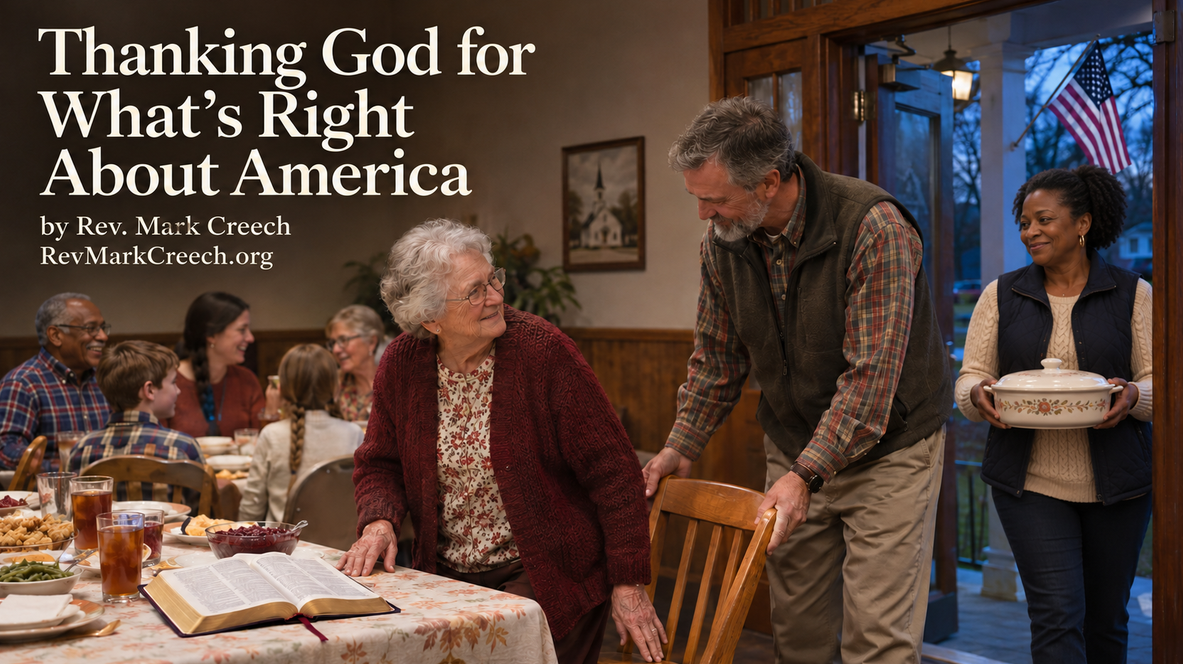
Then there’s the good that rarely makes the news. A family loses someone, and by supper there are more dishes on the bereaved family’s kitchen counter than the refrigerator can hold. A heavy snow falls on a senior citizen’s driveway, and a neighbor comes over to clear the snow and ice. A volunteer firefighter sits down for Thanksgiving dinner and gets called away before the first bite. If you’ve ever been on the receiving end of such kindness, you probably remember who showed up. You may even remember what they brought.
I think of Bill White of Arden, North Carolina. He was 86 when Hurricane Helene brought down at least ten trees on his property, including a large oak that landed on his house. He was about to climb onto the roof to assess the damage when three volunteers with North Carolina Baptists on Mission pulled into his driveway. They got out, unloaded their chainsaws, and went to work. As White watched, tears filled his eyes. “It’s unbelievable that they do this,” he told a reporter.
Scripture says, “Bear ye one another’s burdens, and so fulfill the law of Christ” (Galatians 6:2, KJV). Sometimes bearing a burden means removing an oak tree from someone’s roof. Sometimes it means bringing supper to a family that has had a hard day.
That’s something right about America, and we ought to be thankful.
This Thanksgiving, I’m exceedingly grateful for the people who have done similar things for others, including me, and I hope I’ll be quicker to notice when someone needs me to show up.
When we bow our heads at Thanksgiving dinner this year, there’s much more to be thankful for than what’s on the table. Think of the farmer who grew the food, the truck driver who hauled it, and the grocery clerk who stocked it. Think of the hands that prepared it. Most of us will never know all the people whose work went into that one meal. God knows each of them.
Gardner’s words moved me because I want to love my country as I should. That means being honest about its troubles and paying enough attention to recognize its many blessings. When I remember what I’ve received, I’m more inclined to ask what I can do for someone else. Sometimes that means speaking up. Other times, it simply means giving my neighbor, who doesn’t have a car, a ride to the doctor.
Before we pass the first dish this Thanksgiving, perhaps we could each name one thing about life in America we’ve grown so accustomed to that we’ve seldom thanked God for it. I suspect that once we get started, one thing will lead to another, and the food may have to wait a little longer than we planned.