
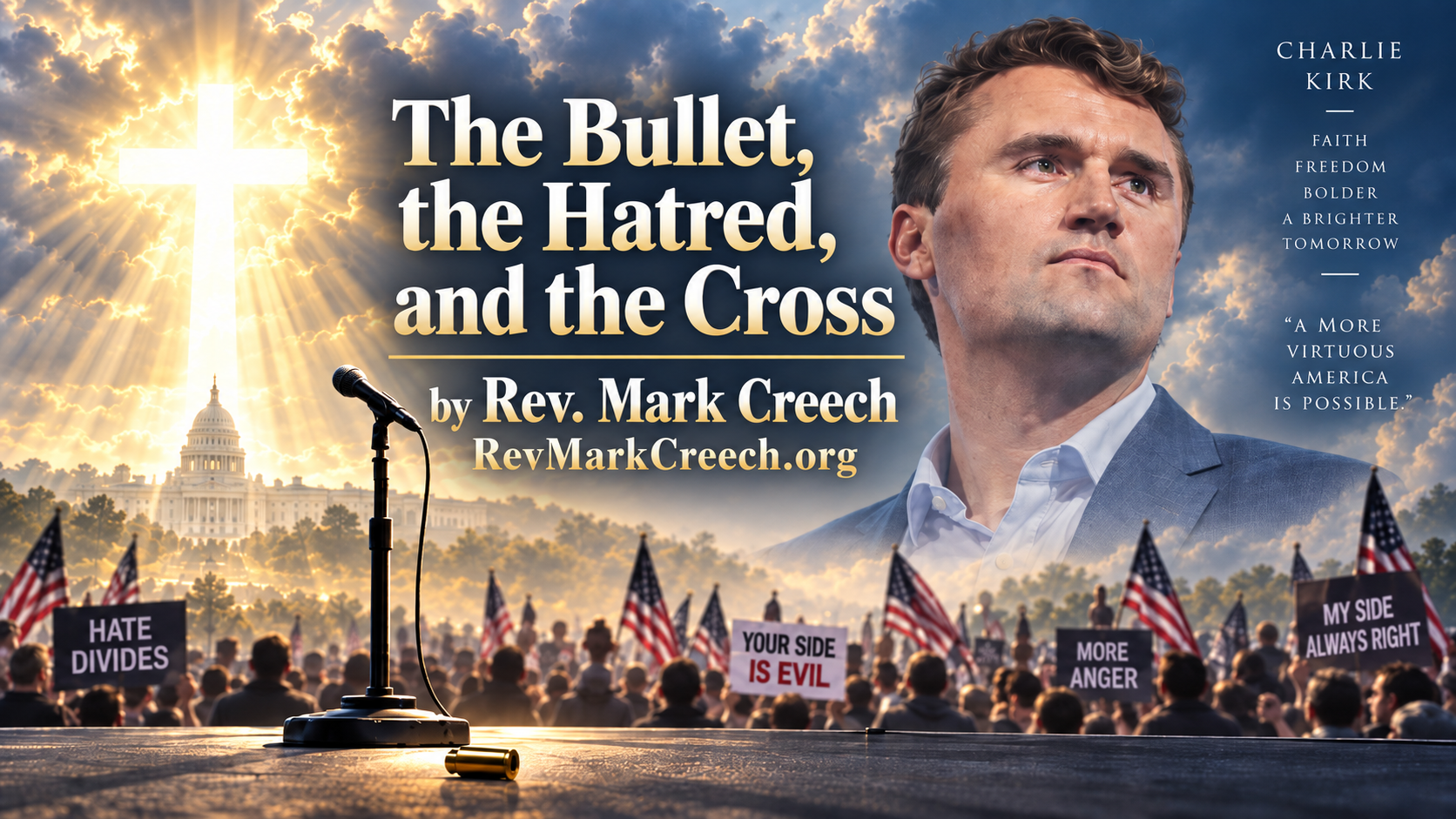
by Rev. Mark Creech
RevMarkCreech.org
A year has passed since Charlie Kirk was assassinated, but the spirit that fueled such violence has not died with him.
On September 10, 2025, Kirk was shot and killed while speaking at Utah Valley University. Whatever one thought of his politics, he was exercising the rights citizens in a free society should have: to speak openly, debate ideas, challenge opponents, and attempt to persuade.
Instead, a bullet ended his life.
Surely such an atrocity ought to have sobered our nation. One might have hoped that Americans across the political spectrum would resolve that disagreement must never become dehumanization and that dehumanization must never become violence.
But a year later, recent events indicate the deeper sickness remains.
At St. Andrew’s Presbyterian Church in Austin, Texas, Rev. Babs Miller was recorded saying that some members of the congregation still wished the young man who shot Donald Trump in Butler, Pennsylvania, had “been more successful.” Miller was reporting others’ sentiments, not expressly endorsing them. Still, the picture is revolting: people sitting in a church pew wishing an assassin’s bullet had struck more accurately and ended a man’s life.
Earlier this month in Massachusetts, a woman pleaded guilty in federal court to assaulting federal agents during an immigration enforcement operation. According to prosecutors, she shouted at them, “Charlie Kirk died, and we love it,” then threatened, “We’re coming for you, gonna kill you.”
Here, Kirk’s assassination was celebrated and then invoked in the course of another threat to kill.
At a Republican gathering in Dallas, the ugliness surfaced on the other side. As Sen. Ted Cruz mentioned several Democratic political figures, a man in the audience repeatedly shouted, “He should be shot!”
Not defeated at the ballot box.
Not answered in debate.
Shot.
In the opening days of September alone, federal authorities brought at least two separate cases against men accused of threatening President Trump’s life.
The circumstances and ideologies differ, but the ugliness is hauntingly similar. Political opponents are increasingly spoken of not as fellow citizens who are wrong, but as enemies who are vile, dangerous, and somehow deserving of suffering and even death. A missed assassin’s bullet becomes a regret. A political rival becomes someone to shoot. A public figure becomes someone to threaten, stalk, or terrorize.
That is neither vigorous political disagreement nor mere political polarization. That is moral rot. And it is the same spirit of hatred that made Charlie Kirk’s murder possible.
Perhaps Jesus gave us the most searching description of what happens when lawlessness takes hold: “And because iniquity shall abound, the love of many shall wax cold” (Matthew 24:12).
That is what makes the present moment so disturbing. It is not simply the violence itself, but the coldness that can surround it – the ability to contemplate another person’s suffering or death without sorrow, and sometimes even with satisfaction.
When lawlessness abounds, love grows cold.
Scripture tells us where such violence originates.
In the Sermon on the Mount, Jesus said, “Ye have heard that it was said by them of old time, Thou shalt not kill; and whosoever shall kill shall be in danger of the judgment” (Matthew 5:21).
But Jesus did not stop at the physical act of murder. He looked beyond the act to the heart from which it comes: “But I say unto you, That whosoever is angry with his brother without a cause shall be in danger of the judgment” (Matthew 5:22).
Christ was showing that murder has a history before the weapon is ever raised.
It starts when anger hardens into contempt. A person we disagree with ceases to be seen as made in the image of God and becomes an object of scorn. Contempt then makes hatred easier, and hatred eventually makes violence seem permissible.
The apostle John was even more direct: “Whosoever hateth his brother is a murderer” (1 John 3:15).
John was not equating hatred with homicide in civil law. He was identifying the same corruption at its source. Before another person is attacked physically, he is often first stripped of dignity in the imagination.
He is no longer someone to persuade but someone to silence. He is no longer someone whose arguments should be refuted but someone whose very existence becomes intolerable.
Christians, above all people, should understand this, because the central event of our faith was an execution carried out through a convergence of political power, religious hostility, false accusations, and public fury.
Jesus Christ was condemned on the charge of claiming to be a king. Pilate yielded to political pressure. The crowd cried, “Crucify him, crucify him” (Luke 23:21). The Roman state carried out the sentence, nailing Him to the cross.
Yet from that Cross, Christ did not respond to hatred with hatred. He prayed, “Father, forgive them; for they know not what they do” (Luke 23:34).
Here is the wonder of the Gospel: the very instrument used to kill Christ became the means by which hateful and violent hearts are transformed.
Billy Graham once witnessed that transforming power in a remarkable way.
During his 1959 Southern Cross Crusade in Australia, a violent gang reportedly came to one of Graham’s meetings to assassinate him. One of the men, George Palmer, brought a gun into the meeting.
But before they could carry out their diabolical plan, they listened to Graham’s preaching about Christ. Palmer said the Gospel pierced his heart. He laid down his weapon and decided to follow Christ. According to the Billy Graham Library, nine of the ten gang members made decisions for Christ that night.
Men who came intending to take a life left having received new life.
That is what the Gospel can do.
Laws can punish political violence. Security can protect public officials. Police or even the government might take away guns. Still, none of these measures can remove hatred from the human heart.
Only Christ can do that.
The Gospel can take a man who came carrying a weapon and send him home carrying God’s grace in his soul. It can turn an enemy into a brother. It can teach us to look upon those whose politics we despise not as people to destroy but as persons for whom Christ died to redeem.
A year after Charlie Kirk’s assassination, the spirit of political hatred is alive and well in America. Yet a greater power endures – the power of the Cross. Hatred can pull a trigger, but only the Gospel can transform the heart that wants to pull it. And there is a Savior, Jesus Christ, who can change us.