by Dr. Mark Creech
Director of Government Relations, Return America
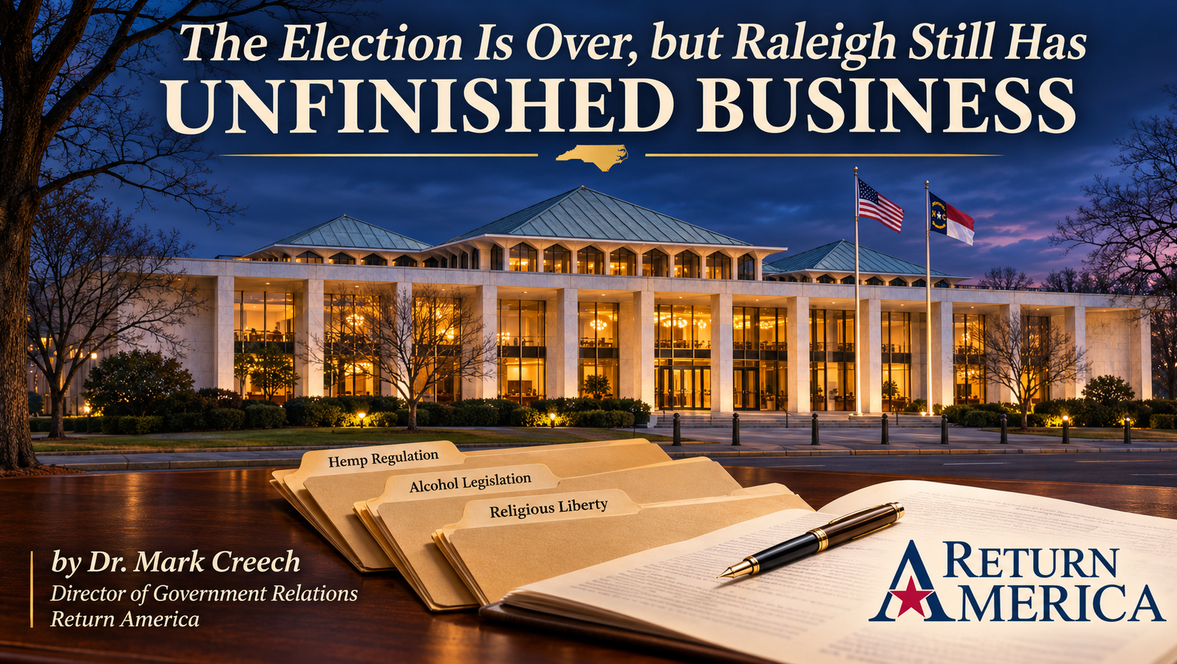
The election is over, but North Carolina’s present General Assembly still has work to do. Lawmakers are scheduled to return Monday, November 16, for a lame-duck session, with opportunities through December to address consequential unfinished business.
What they will consider remains uncertain. Legislative leaders have not announced a detailed agenda. Nevertheless, Return America supporters should watch closely. These remaining weeks could present opportunities to protect children and families, correct troubling provisions affecting religious institutions, or advance proposals that merit opposition.
The strongest opportunity concerns House Bill 328, which regulates hemp-derived consumables and kratom.
The Senate adopted a conference report in July, but the House has not yet approved it. The pending proposal would prohibit hemp consumables with more than 0.4 milligrams of total THC per container and products containing synthetic or chemically converted cannabinoids. It also includes restrictions on sales to and possession by people under 21, along with provisions addressing kratom.
The US Congress recently acted to restrict intoxicating hemp products, although most of the new federal restrictions have been delayed until December 11. House Bill 328 would establish comparable protections in North Carolina law, giving the state independent enforcement authority and preserving its safeguards should federal policy later change. Federal action strengthens the case for completing this legislation. Families need clear protections that state authorities can enforce.
Return America has supported strong restrictions on these products. Lawmakers should complete this work while the opportunity remains.
Another measure requires a different response: House Bill 198, the 2026 ABC Omnibus.
The House rejected the Senate’s changes, and both chambers appointed negotiators. The bill remains unresolved. The Senate version includes numerous alcohol-related changes, including provisions on mobile bar services. Any final agreement warrants careful examination.
Alcohol legislation is often framed as modernization or convenience. Yet greater availability carries consequences for families and communities. Return America supporters should remain vigilant for provisions that weaken safeguards or further normalize drinking across public life.
Religious liberty also requires attention, particularly when already enacted legislation needs correction or clarification.
Section 7.33 of Senate Bill 257, the enacted budget, requires private church schools and other nonpublic schools to distribute and post designated crisis-service information. The requirements apply to school websites, certain student identification cards, school-issued electronic devices, and other school materials.
The importance of helping students in distress is beyond dispute. However, requiring Christian schools to carry state-prescribed messages and referrals raises a serious question about institutional independence. Religious schools must retain the freedom to care for students in keeping with their faith and mission. Return America has sought a correction, and this concern should not disappear simply because the original legislation has passed.
House Bill 517, which revised North Carolina’s nonprofit corporation laws, presents another need for clarification.
In correspondence and a meeting with Rep. Heather Rhyne, I acknowledged the bill’s purpose and the assurances during Senate debate that it was not intended to regulate churches. I requested language that expressly protects church doctrine, worship, polity, membership, and internal governance, while limiting annual reporting to necessary corporate information.
Such language would give pastors and congregations greater confidence that nonprofit reporting requirements will not be construed as authority over the church’s spiritual affairs. Clear statutory safeguards would reinforce lawmakers’ expressed intent.
Outstanding vetoes could also return for consideration. Five measures await House action: concealed carry without a permit, unauthorized public camping and drug-free zones, expedited removal of unauthorized occupants, court changes, and election-law changes. The Senate still must act on the veto override of the prohibition on DEI programs in state agencies. None should be treated as a guaranteed vote.
A lame-duck session does not relieve lawmakers of their responsibility to govern carefully and openly. Nor does an election erase the legitimate work left unfinished during their terms.
For Return America, the standard remains the substance of each proposal. Does it protect children? Does it strengthen families? Does it respect the independence of churches and Christian schools?
We cannot yet predict the session’s agenda. We can identify the responsibilities that remain, and urge lawmakers to meet them faithfully.