A Memorial Day Reflection on Black Soldiers, Sacrifice, and America’s “New Birth of Freedom”
by Rev. Mark Creech
RevMarkCreech.org
Americans complain a great deal these days. We grumble about inflation, gasoline prices, political dysfunction, cultural turmoil, and the inconveniences that come with uncertain times. Some of those complaints are understandable. Life has grown harder for many. Yet Memorial Day calls us to pause and recall a desperately needed perspective.
There was a time in this nation when men endured not mere inconvenience but agony – not mere frustration but death – so that others might live free.
Among the most remarkable of these were Black soldiers who fought for the Union during the Civil War. Many had once been enslaved. Many had known the sting of the lash, the cruelty, and the humiliation of being treated as less than human. Yet these same men willingly marched into gun and cannon fire for a country that had not yet fully recognized their dignity.
They believed that America could become better than it was.
They fought not only for their own freedom but also for what Abraham Lincoln would later call “a new birth of freedom.”
One of those men was William H. Carney.
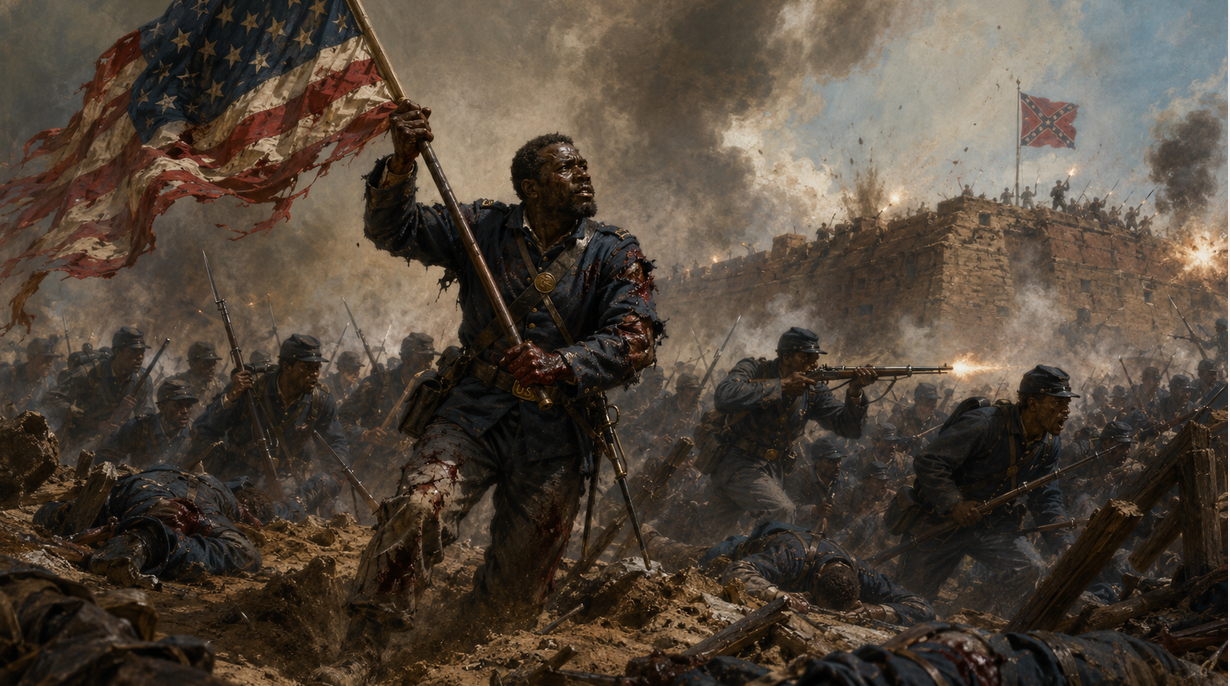
Born into slavery in Virginia, Carney escaped to the North and enlisted in the famed 54th Massachusetts Infantry Regiment, one of the first official Black regiments organized by the Union Army. In July 1863, the regiment was ordered to assault Fort Wagner, a heavily fortified Confederate stronghold near Charleston, South Carolina.
The battle was nothing short of a slaughter.
Union soldiers were cut down by cannon and rifle fire as they advanced across the sand. Amid the chaos, the regiment’s flag bearer fell. The American flag began to fall toward the ground. Carney saw it happen.
Without hesitation, Carney rushed forward through a hail of bullets, seized the flag, and continued the charge. He was shot multiple times. Witnesses said he pressed onward despite his wounds, planting the colors near the enemy fortifications before retreating with the surviving soldiers.
Bleeding and near collapse, Carney finally reached Union lines, clutching the flag.
Then he spoke words that history would make immortal:
“Boys, the old flag never touched the ground.”
Think carefully about that for a moment.
A man once treated as property under that same flag heroically refused to let it fall.
There is something profoundly convicting about that kind of patriotism. It exposes the shallowness of modern cynicism. Today, many Americans speak of the nation with casual contempt. We have become experts at pointing out America’s failures, sins, hypocrisies, and contradictions. Certainly, America has had them all. Slavery itself remains one of the great stains on our national story.
But these Black Union soldiers believed the answer to America’s sins was not the destruction of America, not tearing it down, but its redemption.
And redemption always costs blood.
Nowhere was that clearer than at Fort Pillow in Tennessee in 1864. Black Union soldiers stationed there were overwhelmed by Confederate forces. Numerous eyewitness accounts testified that even after surrendering, many Black soldiers were mercilessly executed. Some were reportedly burned alive, and others were shot while kneeling.
Yet these men had fought anyway.
They knew the risks were higher for them than for white Union soldiers. Capture would likely mean torture and death. Nevertheless, they stood their ground, believing freedom was worth the price.
Memorial Day exists because freedom has always exacted a sacred and terrible price.
It is quite fashionable today to speak endlessly about rights. Much less fashionable is it to speak of sacrifice. Yet every liberty Americans now casually enjoy rests atop the graves of men who surrendered their futures, families, comfort, dreams, and even life itself.
Some died on the beaches of Normandy.
Some died in the jungles of Vietnam.
Some died in deserts halfway across the world.
Some died wearing Union blue, believing that America, by the grace of God, might yet become more faithful to its founding creed:
“We hold these truths to be self-evident, that all men are created equal, that they are endowed by their Creator with certain unalienable Rights, that among these are Life, Liberty and the pursuit of Happiness.”
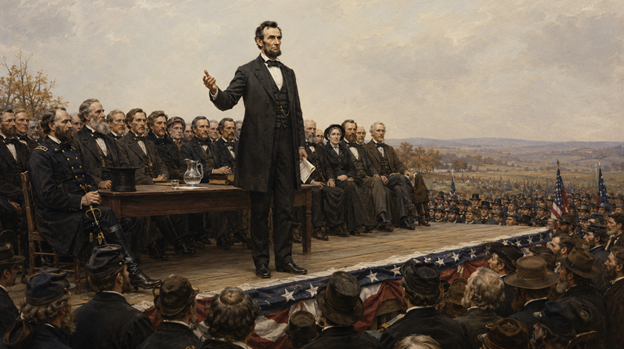
When Lincoln stood at Gettysburg and declared that “this nation, under God, shall have a new birth of freedom,” he was speaking of a freedom purchased with blood. Black soldiers, men whose freedom had been denied and whose full realization of liberty would still take more than a hundred years to perfect, were among those paying the high price.
Memorial Day should humble us greatly.
It should remind us that freedom is not self-sustaining. Nations survive only when enough people love something greater than themselves. The men we honor on Memorial Day knew this.
William Carney understood it.
Although he was wounded and nearly killed, he carried that flag through the smoke and terror of battle and, with his dying strength, declared:
“The old flag never touched the ground.”
May it never touch the ground in our generation.