
by Rev. Mark Creech
RevMarkCreech.org
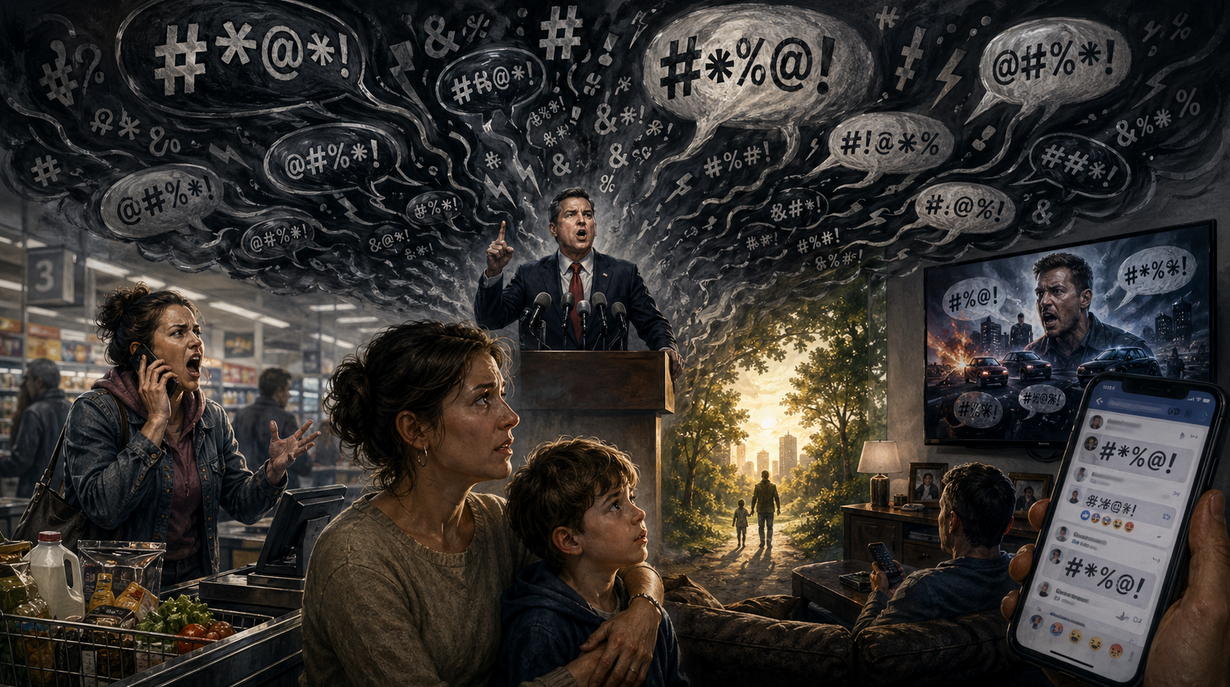
There was a time when profanity in public life was considered shameful. It was muttered under one’s breath, spoken behind closed doors, or perhaps heard in places where people were expected to be rough around the edges. But today, vulgarity has walked out of the back alley, entered the living room, climbed onto the debate stage, and now seems quite comfortable at the podiums of public officials.
Several recent news stories have highlighted the issue. Axios highlighted “the rise of the political potty mouth,” noting that elected officials and candidates are now using profanity in press conferences, campaign rallies, and even official settings. The Deseret News likewise reported on the rise of profanity in American politics, citing research suggesting that swearing in politics is more prevalent than ever. Northeastern Global News recently asked whether politicians have “lost” their profanity filter, with experts observing that some public figures now use expletives to signal authenticity and an emotional connection with voters.
One survey of congressional aides found that 62 percent believe profanity by members of Congress is “seldom or never” acceptable in professional or public settings. That statistic is encouraging, but the fact that such a survey is even necessary says a great deal about where we are.
The problem, however, is not confined to Washington. It is everywhere.
A few years ago, I wrote about standing in a grocery store checkout line and hearing a woman use one of the foulest expressions in English. Nearby, another woman was on her cell phone, using the same kind of language without the slightest embarrassment. I described the moment then as feeling like “drowning in a cesspool of profanity.” Sadly, that description seems even more accurate today.
Annie Holmquist, writing for The Epoch Times in 2021, made a similar observation. She described walking in a park and hearing a man calmly on the phone, with expletives dropping from his mouth as casually as ordinary adjectives. Her point was not that the incident was unusual, but that it had become painfully ordinary. Holmquist also cited a 2017 study led by psychologist Jean Twenge, which found that books published in the mid-2000s were far more likely to contain certain swear words than those published in the 1950s.
That should not surprise us. What begins in books, films, television, and music eventually spills into the streets. What is normalized in entertainment soon becomes normalized in conversation. What leaders practice in public, citizens imitate in private and then in public as well.
Some will say, “What is the big deal? They are just words.”
But words are never “only words.” They reveal. They wound. They corrupt. They bless. They curse. They can build a home or poison it. They can calm a child or frighten him. They can dignify a public office or drag it into the gutter.
As Bob Greene of the Field Newspaper Syndicate once wrote, the casual public use of obscenity can feel like “a violation of privacy.” He argued that foul language is “an assault on the senses” and that profanity often communicates “ugliness and aggressiveness” as well as disrespect for civil behavior. I agree with Greene, except on one point. He said his concern was not primarily moral. I believe it most certainly is moral!
Jesus said, “A good man out of the good treasure of his heart bringeth forth that which is good; and an evil man out of the evil treasure of his heart bringeth forth that which is evil: for of the abundance of the heart his mouth speaketh” (Luke 6:45).
That is the heart of the matter. Profanity is not merely a vocabulary issue. It is a heart issue.

Phil Robertson, the late Duck Commander patriarch of Duck Dynasty fame, often spoke bluntly about the connection between a person’s words and his spiritual condition. He understood what Scripture teaches plainly: the tongue is a window into the soul.
That does not mean every person who has ever uttered a profane word is beyond redemption. Even some Christians have a slip of the tongue, every now and then. It does mean, however, that our words are diagnostic. Like a fever reveals infection in the body, foul speech may reveal disorder in the heart. The cure is not merely washing out the mouth. The deeper need is for Christ to cleanse the heart.
This is why the mainstreaming of profanity should trouble us. It is not just that Americans are using rougher language. It is that we are becoming a rougher people. Our discourse is more hostile, our entertainment more vulgar, our politics more vicious, and our public spaces less considerate. Even children are routinely exposed to language that earlier generations would have considered disgraceful.
Some argue that profanity makes a person sound authentic. Yet authenticity can be far removed from virtue. A man may authentically reveal that he is angry, crude, or undisciplined, but that does not make him admirable. A politician who swears into a microphone may sound “real” to some, but he may also be demonstrating a lack of the restraint and dignity required for good and steady leadership.
Others claim that profanity is a sign of intelligence because some studies suggest that people who know swear words may also possess verbal fluency. But as Holmquist noted in her Epoch Times article, the better question is not whether a person is capable of swearing, but whether he has the wisdom and vocabulary to say something better – words that build up. A large vocabulary should give a person more options, not fewer. If frustration is expressed in vulgar language, that is not eloquence. That’s just intellectually lazy!
The apostle Paul admonished, “Let no corrupt communication proceed out of your mouth, but that which is good to the use of edifying, that it may minister grace unto the hearers” (Ephesians 4:29). That command is not limited to church services or Sunday school classrooms. It applies at home, in the car, at work, at the grocery store, on social media, in politics, and wherever our words reach others’ ears.
Profanity should never be excused as cute, harmless, or inevitable. I once saw a sign on a secretary’s desk that read, “I love Jesus, but I cuss a bit.” I realize the secretary was joking, but the sign implied she had made peace with a habit the Lord calls us to confess and forsake.
The Christian’s speech should be different because the Christian’s heart has been changed. Colossians 4:6 says, “Let your speech be always with grace, seasoned with salt.” Grace-seasoned speech is not weak, dishonest, or timid. It is speech governed by holiness, charity, truth, and self-control. It’s the speech we should aspire to in life – the kind of talk every child of God must always strive for.
Our nation does not need more vulgarity. It needs leaders who can speak forcefully without resorting to filth. It needs parents who teach their children that language matters. It needs citizens who remember that liberty is not the freedom to pollute every public space with verbal sewage.
We may not be able to clean up every television program, movie script, political rally, or social media feed, but we can start with our own mouths.
America may have lost its profanity filter, but Christians must not lose theirs.
Our culture may be drowning in a cesspool of profanity, but we need not add to the stench. Our speech can still be full of grace, seasoned with salt, and fit to minister to those who hear us.