by Rev. Mark Creech
RevMarkCreech.org
Europe’s streets are sending a warning. Are Americans listening?
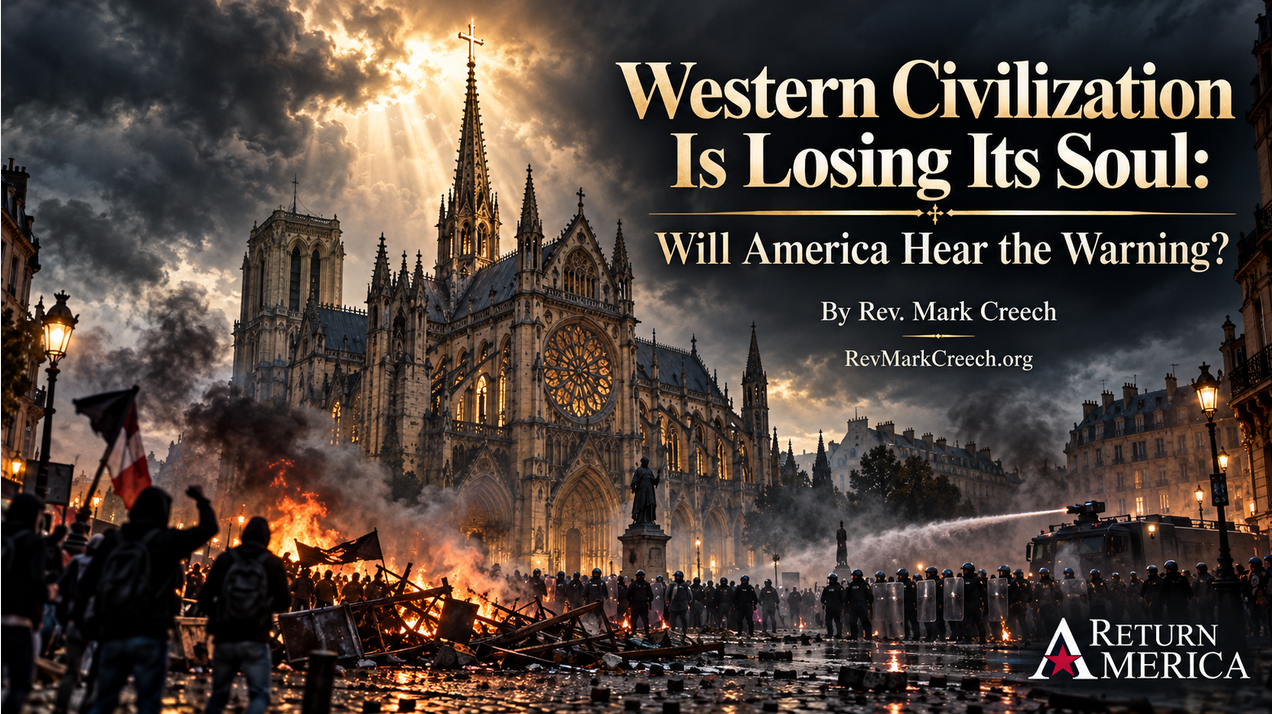
In France, demonstrations have drawn hundreds of thousands into the streets. Schools have been barricaded, buildings damaged, fires set, and protesters and police injured. What began as grievances over deteriorating schools has broadened into anger over economic conditions, government policies, and the future of French society. In Italy, demonstrators have protested rising living costs and military spending, while police in Rome have used water cannons during confrontations.
These events are said to have different immediate causes. Nevertheless, when considered alongside growing cultural tensions, immigration controversies, political radicalization, and public distrust, they raise a troubling question: Could all of this be connected to Western civilization losing the convictions that made it powerful and prosperous?
A Civilization Losing Confidence in Itself
Conservative commentator Dennis Prager addressed the French unrest on October 23, warning that multiculturalism, Islamist extremism, and the erosion of Western values are set to create similar problems in America. His concern extends beyond immigration. When people are taught to despise their nation’s history rather than understand its achievements and failures, they lose the collective memory essential to preserving it.
No nation can expect future generations to defend principles they have been taught to regard as oppressive or unworthy of preservation.
This does not mean Western civilization has been without grievous sins. Slavery, colonial abuses, religious persecution, and racial injustice are undeniable parts of its history. But acknowledging these wrongs is not the same as concluding Western civilization has contributed too little to be worth celebrating or defending.
Constitutional government, religious liberty, the rule of law, scientific inquiry, and protections for individual rights constitute an extraordinary inheritance. These achievements emerged from a complex history, profoundly shaped by biblical teachings on human dignity, moral accountability, and a law higher than the state.
Another striking warning came from Argentine President Javier Milei, who spoke on October 21 at the Nueva Economía Fórum in Madrid. Milei traced Western civilization from Greece, Jerusalem, and Rome to Christianity, arguing that these traditions helped advance freedom and human achievement.
He also criticized socialism, excessive government dependence, and immigration policies that neglect cultural integration. In his view, nations that surrender economic freedom, undermine personal responsibility, and neglect cultural cohesion invite decline.
His memorable conclusion, translated from Spanish, was: “Decline is not destiny, but a choice.”
Are you listening, America?
Whatever one thinks of Milei’s economic prescriptions, his larger warning deserves consideration. Civilizations cannot be sustained by prosperity alone. They require shared convictions about right and wrong, freedom and responsibility, justice and authority.
Immigration poses a particularly difficult challenge. Christianity commands compassion toward strangers and recognizes the God-given dignity of every human being. Yet compassion does not require governments to disregard national security, abandon immigration laws, or tolerate movements that seek to destroy religious liberty and constitutional government.
Peaceful Muslim immigrants who respect the laws and liberties of their adopted countries must be distinguished from Islamist extremists advocating coercion or violence. Nevertheless, we cannot afford to ignore the troubling elements within Islamic scripture and historical jurisprudence that have been used to sanction religious warfare, the persecution of religious minorities, and severe punishments, including death, for those who abandon Islam. Such religious beliefs stand in serious tension with the Western commitment to freedom of conscience and religion.
The Spiritual Vacuum at the Heart of the Crisis
Historian Victor Davis Hanson has similarly warned that Western societies face an internal crisis of confidence, leaving them vulnerable to external pressures. Yet economic and political difficulties alone cannot explain the West’s predicament. Beneath these troubles, I believe, lies something far more profound—a spiritual emptiness, a brokenness of the human soul, and a hunger that neither prosperity, political power, nor earthly pleasures can satisfy. Western civilization is not merely struggling to preserve its institutions and traditions; it is grappling with the consequences of drifting from its spiritual moorings.
For centuries, Christianity shaped Europe’s understanding of marriage, family, human dignity, moral duty, charity, and government accountability. Although Western nations often failed to uphold these standards, biblical principles provided a moral framework for judging their failures.
Today, however, the landscape is dotted with magnificent church edifices, many standing empty – silent monuments to a faith that once animated the life of the European nations. Even more tragic, many active churches have surrendered their allegiance to biblical truth, trading the authority of God’s Word for the shifting values of the age. Rather than confronting the culture with the transforming power of the Gospel, they have accommodated themselves to it, becoming little more than religious reflections of the very societies they were called to redeem.
The masses want human dignity without acknowledging humanity’s Creator, justice without a moral standard above themselves, and freedom without the responsibilities needed to preserve it.
When people no longer believe in anything transcendent, politics can take religion’s place. Government becomes the anticipated savior, political ideologies become articles of faith, and opposing viewpoints become moral heresies deserving punishment and suppression. Earthly movements are expected to satisfy longings no political system can fulfill.
These dangers are not confined to Europe alone. America is experiencing its own ideological struggles. In Michigan, Abdul El-Sayed’s Democratic Senate primary victory illustrates the growing influence of the party’s progressive-populist movement. Although El-Sayed does not identify himself as a socialist, his success, alongside victories by candidates openly associated with democratic socialism, reflects an intensifying debate over government’s responsibilities and America’s political future.
Americans can legitimately disagree on taxation, health care, and public assistance. Such disagreements do not necessarily signal a civilizational crisis. The greater danger arises when government is treated as the ultimate source of security, moral authority, and human flourishing, or when political power is pursued without regard for truth, justice, and liberty. This temptation is not confined to one political party. Power can become an idol for conservatives and progressives alike.
Here, Scripture provides the perspective we most urgently need.
The psalmist declares, “Except the LORD build the house, they labour in vain that build it” (Psalm 127:1).
A nation may possess a magnificent constitution, a powerful economy, a formidable military, and a distinguished history. Yet none of these can substitute for the moral character of its people. Proverbs 14:34 reminds us, “Righteousness exalteth a nation: but sin is a reproach to any people.”
When a civilization abandons its Christian foundations, the spiritual vacuum does not remain empty. Other ideologies and belief systems compete for its people’s allegiance. History offers sobering examples of the material deprivation and spiritual oppression experienced under socialism, communism, and coercive religious regimes. Many nations governed by such systems have suffered widespread poverty, while even some materially prosperous countries severely restrict freedom of conscience and religion. A society that casts aside its Christian inheritance without considering what may replace it risks exchanging liberties it has long taken for granted for forms of bondage it never imagined.
The Harvest Is Plentiful, but Where Are the Laborers?
This is where the Christian response must go beyond political commentary. Preserving Western civilization is a most
worthy concern, but Christianity is not merely a cultural inheritance to defend, nor is Jesus Christ simply a symbol of Western identity. Jesus is the Savior of the world. The Gospel transcends nationality, race, and political allegiance. Its message calls all people to repentance and faith, and its truth judges every civilization, including our own.
The greatest need throughout Western civilization is not simply better immigration policies, stronger economies, or different political leadership, important as these may be. Our greatest need is a spiritual awakening and renewal.
When Jesus looked upon the multitudes, He was moved with compassion because they were weary and scattered, like sheep without a shepherd. He told His disciples, “The harvest truly is plenteous, but the labourers are few; Pray ye therefore the Lord of the harvest, that he will send forth labourers into his harvest” (Matthew 9:37–38). Multitudes wander, spiritually lost, searching for meaning and satisfaction in possessions, pleasure, political ideologies, and philosophies that cannot save. The harvest is plentiful, but where are the laborers?
Faithful Christians must pray that God will raise up faithful Gospel preachers to proclaim the whole counsel of God. Pray for stalwart churches that confront, not accommodate, the culture. Pray for Christian homes grounded in biblical truth. And pray for believers whose lives reflect the righteousness they profess. We need to earnestly implore the Lord for a renewed missionary burden for the nations that have forgotten God, remembering that human flourishing cannot endure without virtue and that virtue cannot be sustained by legislation alone.
The prophet Jeremiah condemned a people who had forsaken God, “the fountain of living waters,” and had fashioned broken cisterns that could not hold water (Jeremiah 2:13).
Is that not a picture of Western civilization? Having turned from the living God, we seek fulfillment in material prosperity, political promises, and human wisdom. Many now seek it in a false religion – one that has left many nations materially and spiritually impoverished. These cisterns are obviously broken, and Western civilization is parched and dying of thirst.
Still, there is hope. No nation is beyond God’s power to awaken, nor any generation beyond His grace. Although Scripture doesn’t guarantee that any earthly civilization will endure forever, the Gospel remains “the power of God unto salvation to every one that believeth” (Romans 1:16). Christians must continue to defend righteousness, fulfill their civic responsibilities, and seek the welfare of their communities. Above all, the unadulterated Gospel of Jesus Christ must be proclaimed boldly, for no political reform can accomplish what only the regenerating power of God’s Spirit can do when people hear the Word.
President Milei declared that decline is a choice. His words challenge nations to reconsider their direction. Scripture presses with a deeper question: Will we continue turning from the God whose truth alone provides the surest foundation for mankind’s highest good?
Europe’s troubles should concern us. America’s direction should concern us. Indeed, the spiritual condition of the entire Western world should move the Church to its knees and send its people into the harvest fields.
Are you listening, America?
The greatest danger to Western civilization may not be that others are determined to destroy it, but that those who inherited its many blessings are losing sight of their origins.