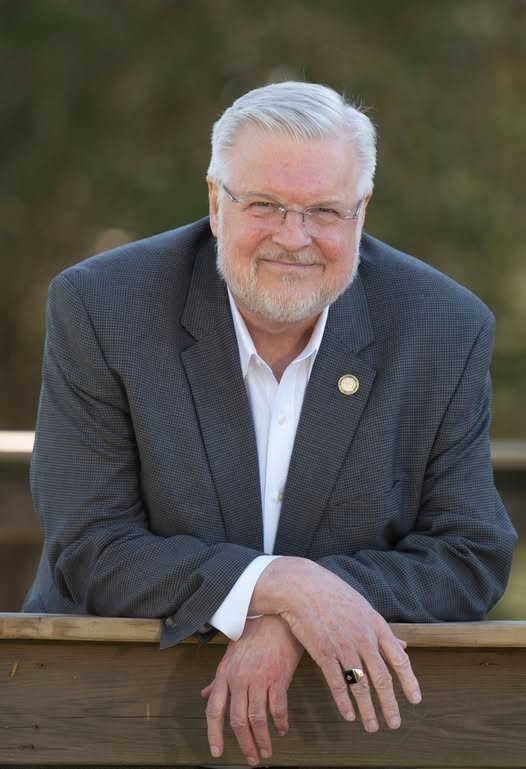

by Rev. Mark Creech
RevMarkCreech.org
Recently, in an interview with Tucker Carlson, Ambassador Mike Huckabee was pressed about a striking passage from Scripture – God’s promise to Abraham that his descendants would inherit land “from the river of Egypt unto the great river, the river Euphrates” (Genesis 15:18). Carlson’s question was simple but loaded: Do you really believe that? It was one of those moments where modern skepticism collided with ancient prophecy. For some, the idea seems implausible, even dangerous. For others, it raises a deeper and more important question: can the Bible really be trusted when it speaks about the future?
That question matters far more than any single political implication, because the Bible is not merely a religious book offering moral guidance or spiritual comfort. It boldly declares what will happen before it happens. In fact, it is estimated that more than 25 percent of the Bible consists of predictive prophecy. That alone sets it apart from any other book in human history. But the real issue is not simply that the Bible contains prophecy; it is whether those prophecies come true.
When we examine the record, the answer is unmistakable. Consider the prophecies concerning Jesus Christ. Centuries before His birth, the Old Testament foretold where He would be born, the nature of His birth, the details of His suffering, and even the price of His betrayal. These were not vague statements that could be broadly interpreted after the fact. They were specific, detailed, and written long before the events they describe. Yet, in the life of Jesus of Nazareth, they were fulfilled with remarkable precision.
What makes this even more compelling is the mathematical reality behind it. Drawing on Peter Stoner’s Science Speaks, apologist Ray Comfort writes in his pamphlet, Scientific Facts in the Bible:
“Couldn’t Jesus have ‘accidentally fulfilled all the dozens of prophecies? No. The scientific probability that any one person could fulfill just eight of these prophecies is 1 in 10 to the seventeenth power. [That is one in one hundred quadrillion.]
“Now, let’s try to imagine the likelihood of that. If we took that number of silver dollars (100,000,000,000,000,000), drew a black X on only one, and laid them over the state of Texas, they would cover the state two feet deep. Now, blindfold a man and tell him to travel as far as he wishes, and then pick up only one silver dollar, and it must be the marked one. What chance would he have of picking up the right one? It would be exactly the same odds as if just eight of the messianic prophecies came true in any one person, yet they all came true in Christ.
“Even one real case of fulfilled prophecy would be sufficient to establish the Bible’s supernatural origin. But in all, there are over three hundred prophecies that tell of the ancestry, birth, life, ministry, death, resurrection, and the ascension of Jesus of Nazareth. All have been literally fulfilled to the smallest detail.”
This is not a coincidence. This is not religious imagination. This is evidence that the Bible is exactly what it claims to be: the Word of God, written by the One who knows the end from the beginning.
Now, back to Mike Huckabee and the prophecy he mentioned in Genesis 15. The Bible also foretold the history of the Jewish people – that they would be scattered among the nations, persecuted, yet never destroyed; that they would remain a distinct people, never fully assimilated; and that in the latter days they would be regathered to the land God gave them. Against all historical odds, these things have come to pass. Nations have vanished, empires have crumbled, and entire peoples have been absorbed into history. Yet the Jewish people remain, preserved in a way that defies every natural explanation. Their existence is a living testimony that God keeps His Word. Moreover, they have regathered and are still returning to their homeland – just as God promised they would. Decades ago, no one would have ever thought it possible. Yet it has come to pass.
So, when someone references a passage like Genesis 15 and speaks of God’s promises to Israel, the real issue is not whether one agrees with every political conclusion that might be drawn from the text. The real issue is whether we believe God means what He says and does what He declares. Because if the Lord has fulfilled prophecy with such exactness in the past, then what He has spoken concerning the future will definitely come to pass with the same certainty.
The Bible speaks not only of Christ’s first coming, but of His return. It speaks of God’s coming judgment of all the nations and every individual. It speaks of eternity. It speaks of salvation, offered freely now, but not indefinitely. The sobering truth is that biblical prophecy is so reliable that what God says will happen is as certain as if it has already happened. The only question left is not whether these things will come to pass, but whether we are prepared when they do.
There is a scene in one of the Indiana Jones films where the character, played by the remarkable actor Harrison Ford, stands before a vast chasm with no visible way across. He holds an ancient text in his hand that tells him the only way forward is to take a step – a step that appears to lead into a frightful empty space. Everything in him hesitates. Every instinct warns him not to trust it. But finally, he steps out in obedience to that text. For a moment, it looks as though he will fall to his death. Then his foot lands on solid ground. What seemed like nothing was, in fact, a path that had been there all along – a path hidden from his sight but entirely real.
That is not a bad picture of what it means to trust God’s Word. The path is not imaginary. It is not uncertain. It is already there. The question is whether we will believe what God has said enough to step forward. Scripture has proven itself again and again to be true. Its prophecies have been fulfilled with astonishing accuracy. Which means trusting Christ as Savior and Lord is not a leap into the dark – it is a step onto ground that is already sure.
What is truly dangerous is not faith, but delay. Because when it comes to God’s promises, the future is not uncertain – it is settled, certain, and as sure as if it has already come to pass.