By Rev. Mark Creech
RevMarkCreech.org
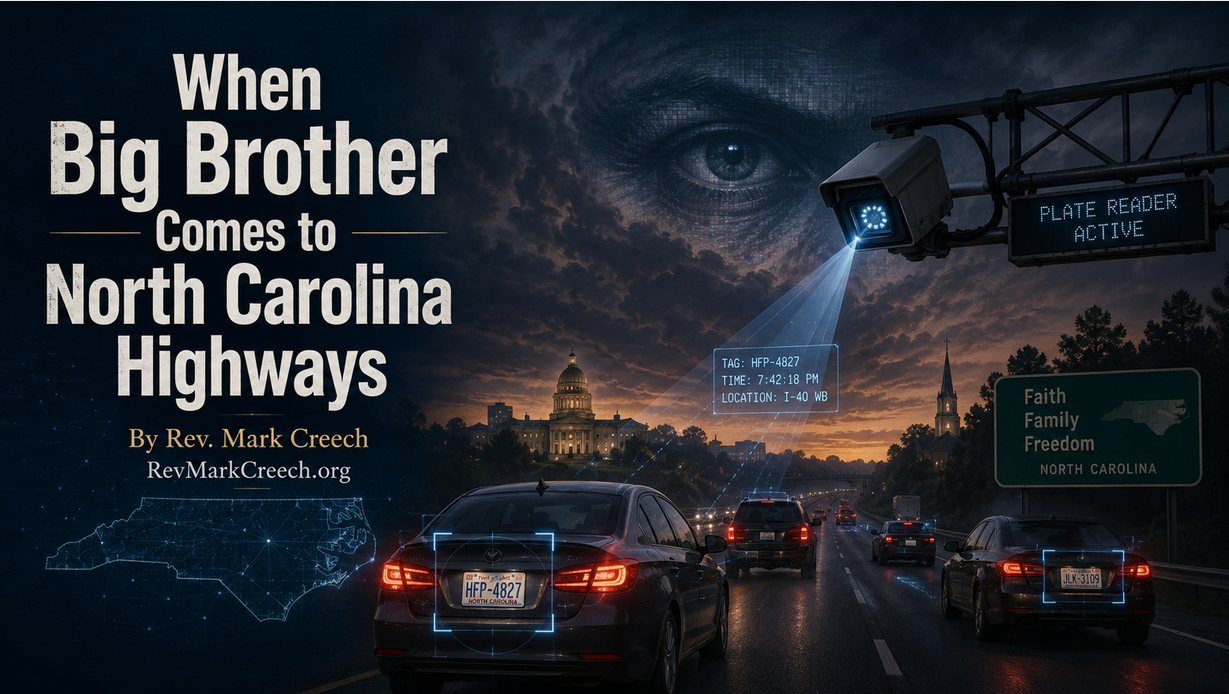
North Carolina lawmakers are considering making a highway surveillance program permanent, which allows automatic license plate readers on state road rights-of-way. At first glance, that may sound like a routine law enforcement matter. But it raises one of the most urgent questions of our time: How much liberty are we willing to surrender in the name of security?
More than seventy-five years ago, George Orwell coined a chilling phrase in his novel 1984: “Big Brother is watching you.” Orwell imagined a society where citizens were constantly monitored by an all-seeing state, where privacy was nearly extinguished, and where the government’s watchful eye served as a tool of control.
For many years, Orwell’s warning seemed like a dark fiction from another age. Today, however, with cameras capable of recording where citizens drive, worship, work, shop, and gather, it feels uncomfortably relevant.
According to WRAL reporting carried by WECT News, North Carolina lawmakers advanced House Bill 206 – DPS/Other Changes, a measure that would make permanent the State Bureau of Investigation’s automatic license plate reader program on state highways. The program began as a pilot after lawmakers authorized the use of readers on state-owned highways and roads. It was set to expire on July 1, 2026, unless extended.
Supporters argue that the technology helps law enforcement solve crimes more quickly and locate missing people. Caring about public safety is noble and right. The scriptures teach that civil authorities have been ordained of God to restrain evil and protect the innocent (Romans 13:1-4; 1 Peter 2:13-14). Police officers face dangerous situations, and tools that help find a stolen car, rescue an abducted child, or identify a violent criminal should not be dismissed lightly.
But good intentions do not erase serious constitutional and moral concerns.
License plate readers do more than glance at passing vehicles. They capture a plate number along with the vehicle’s date, time, and location. In some systems, the information can also include the vehicle’s make, model, color, distinguishing marks, and images that may reveal bumper stickers or other identifying details. Once gathered, that data can become part of a searchable record of a person’s movements.
The North Carolina SBI’s initial report on the pilot program shows how quickly the numbers grow. As of March 15, 2026, 17 agencies had installed 140 camera locations in North Carolina Department of Transportation rights-of-way under the pilot program. Those agencies reported millions of license plate captures. New Hanover County alone reported more than 35 million captures. Burlington reported more than 31 million. Raleigh, with only three camera locations, reported more than 14 million.
That is not a small, targeted investigative tool. It is mass data collection.
CBN News (Christian Broadcasting News) recently highlighted the national scope of this issue in a report by Dale Hurd. The report said there are more than 94,000 automatic license plate readers across the United States, and that the number continues to grow. These systems, CBN reported, can turn Americans’ ordinary movements into searchable data points, revealing patterns in where people go and what they do.
This should concern every citizen, especially Christians.
A government or private database that tracks where citizens go can also reveal who attends church, who visits a pregnancy resource center, who participates in a political rally, who meets with a pastor, who supports a controversial cause, or who associates with people disfavored by those in power. Even if today’s officials are trustworthy, tomorrow’s may not be. Tools created for public safety can be repurposed for political pressure, intimidation, or social control.
CBN’s report cited concerns raised by civil liberties advocates, including Dave Maass of the Electronic Frontier Foundation and Robert Frommer of the Institute for Justice. Their warnings highlight a vital distinction. A license plate may be visible in public, but continuous tracking of that plate over time is altogether different. There is a moral difference between seeing a person once on a public road and building a long-term database of his movements.
Moreover, there are risks beyond government overreach. CBN reported concerns that license plate reader systems can be vulnerable to hacking, that license plate reader data has allegedly been offered for sale on the dark web, and that some law enforcement officers in various places have misused stored data for personal reasons, including stalking romantic interests. Any system that collects vast amounts of personal information creates temptation for abuse and becomes a target for criminals.
North Carolina’s House Bill 206 includes reporting requirements. The SBI would be required to submit annual reports to legislative oversight officials, including information on agency policies, data requests, and the number of cameras. That is a start, but reporting after the fact is not the same as strong protection before the fact.
Before lawmakers make this program permanent, they should answer several questions directly.
Who can access the data? How long is it retained? Can it be shared with federal or out-of-state agencies or with private vendors? Must law enforcement obtain a warrant before searching historical location data? Are citizens notified if their data is searched improperly? What penalties apply for misuse? Can private companies use or sell related data? Will the public know where these cameras are located? Are there clear limits on using this technology to monitor churches, political gatherings, or constitutionally protected activity?
Public safety is a noble aim, but it must never become a blank check for permanent surveillance. Free people should not have to accept being tracked wherever they drive as the unavoidable price of living in an orderly society.
The Fourth Amendment was written for a reason. It protects citizens against unreasonable searches and seizures because the Founders understood that power, once granted, is rarely given up voluntarily. Technology has changed, but sinful human nature has not. The same fallen nature of mankind that necessitates law enforcement also demands limits on that power.
Christians should be very careful here. We believe government is ordained by God, but we do not believe government is God. Its authority is real, but limited. Its power must be restrained by law, accountability, and respect for the dignity of people made in the image of God.
North Carolina lawmakers should not rush to make this program permanent. At a minimum, they should require strict safeguards: short data-retention limits, warrant requirements for historical searches, public transparency, independent audits, meaningful penalties for misuse, and firm prohibitions on using license plate data to monitor First Amendment activity.
The issue is not whether criminals should be pursued. They should be. The issue is not whether law enforcement should be supported. They need all the help they can get. The issue is whether the innocent should be quietly tracked in the process.
Orwell warned of a world where “Big Brother” was always watching. North Carolina should take care not to help build the machinery that could make such a world possible.
A society can maintain law and order without becoming a surveillance state. North Carolina should insist on both safety and liberty. Anything less would be a poor bargain for a free people.