
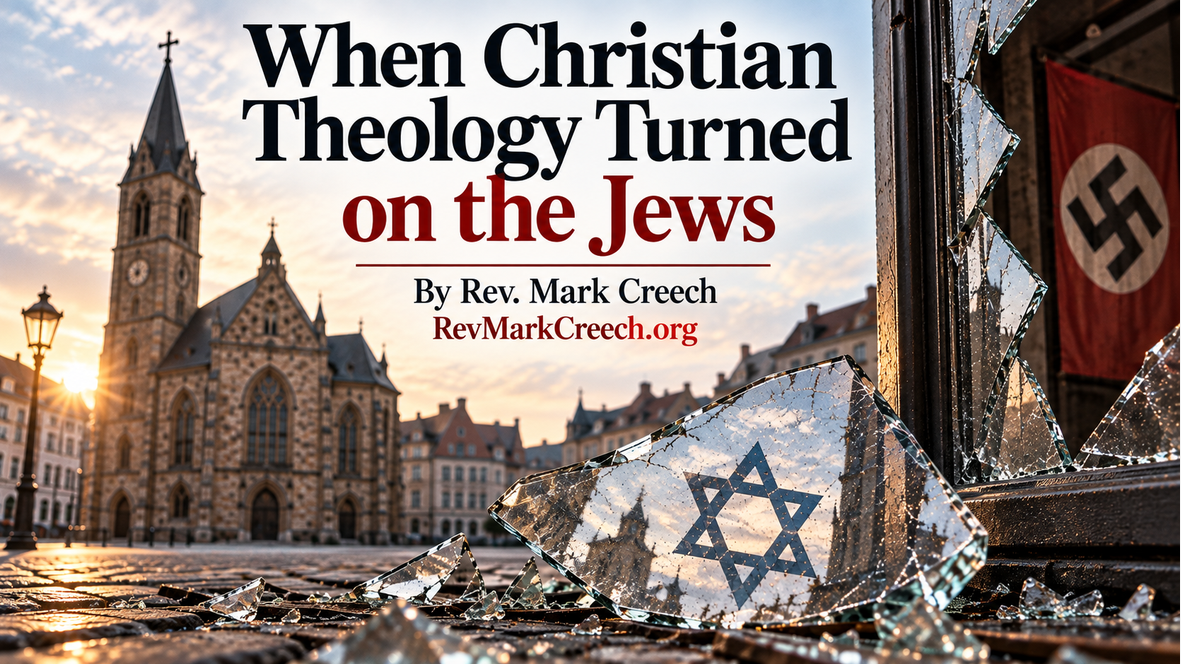
by Rev. Mark Creech
RevMarkCreech.org
Few events in human history are more horrifying than the Holocaust. Six million Jews were murdered under Nazi rule, not for anything they had done, but because they were Jews. Men, women, children, entire families, and communities were marked for destruction, hunted down like animals, and slaughtered.
The Holocaust was the product of a vicious racial ideology. It would be historically irresponsible to claim that Christian theology alone caused it or that what is commonly called “Replacement Theology” inevitably leads to genocide. Nevertheless, Christians should be willing to ask a very uncomfortable question: Did centuries of Christian teaching that portrayed Israel as rejected by God help create an atmosphere in which contempt for the Jewish people became easier to tolerate?
There is good historical evidence to believe it did.
The United States Holocaust Memorial Museum notes that Nazi racial antisemitism did not arise in a vacuum. It converged with anti-Jewish attitudes that had been widespread across Europe and had “deep roots in Christian history.” For too many Christians, traditional interpretations of Scripture appeared to support these prejudices. [1]
One of those theological ideas is what is commonly called supersessionism, [2] or Replacement Theology: the belief, expressed in various ways, that the Church has superseded Israel in God’s covenantal purposes and that Israel no longer holds a distinct place in those purposes. [3]
That does not mean everyone who holds some form of Replacement Theology is antisemitic. Such a charge would be unfair. Many faithful Christians within the Reformed and Covenantal traditions sincerely love the Jewish people and condemn antisemitism. They believe their beliefs are firmly grounded in Scripture. Nor should we reject a doctrine simply because some of its historical advocates held abhorrent prejudices. Every theological position must ultimately stand or fall by the Word of God alone.
Nonetheless, theology inevitably shapes how we see and relate to people.
A few years ago, while lobbying for a Christian activist organization in my home state of North Carolina, I became friends with a Jewish state lawmaker. One day, he told me he appreciated my work and the kindness I had shown him as a Jewish man. He added that he had not always experienced that from some professing Christians.
I told him, “The law of God came to me through your people, and I am indebted to the Jewish people for it. More than that, my Savior, Jesus, was a Jew.”
He gave a small smile but said nothing more. Yet we remained friends, and even long after his retirement from the legislature, he has continued to help me with questions about legislative matters.
I have often thought about that conversation. Whatever one’s theology regarding Israel, Christians should never forget how deeply indebted we are to the Jewish people. The Scriptures came through them. The prophets were of their race. The apostles were Jews. And according to the flesh, our Lord Jesus Christ was a Jew.
History, however, shows how easily we can forget that indebtedness.
Martin Luther offers a sobering example. Luther recovered magnificent biblical truths concerning salvation by grace through faith and the authority of Scripture. Protestants rightly recognize the Reformation’s extraordinary importance. But Luther’s later writings concerning the Jews were appalling. His hostility became so severe that he advocated harsh measures against Jewish religious and community life.
Luther was not creating Christian hostility toward Jews from nothing. He lived in a European Christian world where anti-Jewish theology and prejudice had existed for centuries. That history matters when we come to Germany several centuries later. [4]
When Adolf Hitler came to power in 1933, Germany was overwhelmingly Christian. Yet most German church leaders did not mount sustained public opposition to the persecution of Jews. Courageous exceptions included Dietrich Bonhoeffer, Corrie ten Boom, and Martin Niemöller. Bonhoeffer resisted the Nazi regime and paid with his life. Ten Boom and her family hid Jews from the Nazis and were imprisoned for it. Niemöller became a prominent leader of the Confessing Church, spent years in Nazi concentration camps, and later spoke openly about the failures of Christians and church leaders during those terrible years. [5]
But such figures were the exception, not the rule. Many church leaders remained silent, accommodated the regime, or limited their resistance largely to protecting the institutional church rather than confronting the persecution of Jews. Some were actively complicit. [6]
Within German Protestantism, the Deutsche Christen (“German Christians”) emerged and sought to accommodate Christianity to Nazi racial ideology. They sought an “Aryan” church, supported racial restrictions within the churches, and argued that Christians of Jewish ancestry could be excluded despite their baptism. [7]
This was neither historic Christianity nor traditional Reformed theology. It was a grotesque distortion of the faith under the pressure of racial nationalism. Yet it raises a troubling question: How could Christians who possessed a Bible filled with Abraham, Isaac, Jacob, Moses, David, Isaiah, Jeremiah, and the Jewish apostles become so detached from the Jewish roots of their faith? How could Christians worship a Jewish Messiah and yet regard Jews with contempt?
Perhaps part of the answer is that portions of the Church had spent centuries convincing themselves that Israel’s role in God’s purposes was essentially over.
Here, the issue ceases to be merely historical. It becomes biblical.
In Romans 11, the apostle Paul anticipated the danger of Gentile arrogance toward Israel nearly two thousand years ago. Writing to Gentile believers about unbelieving Israel, he warned: “Boast not against the branches” (Romans 11:18). Paul reminds Gentile Christians that they have been grafted into an olive tree whose roots they did not create: “Thou bearest not the root, but the root thee” (v. 18). Then Paul issues another warning: “Be not highminded, but fear” (v. 20).
History shows how real that temptation became. Instead of grieving over Jewish unbelief as Paul did, Christians sometimes treated it as evidence of Jewish inferiority. Instead of remembering that Gentiles had been grafted into Israel’s spiritual heritage, Christians sometimes behaved as though they had entirely displaced Israel.
Yet Paul’s language concerning Israel remains remarkable. He says that Israel has experienced blindness “in part” and that this condition lasts “until the fulness of the Gentiles be come in” (v. 25). He then declares, “And so all Israel shall be saved” (Romans v. 26).
And concerning Jewish people who presently reject the Gospel, Paul nevertheless writes: “As touching the election, they are beloved for the fathers’ sakes” (v. 28). Then he adds: “For the gifts and calling of God are without repentance” (v. 29).
Whatever theological system we embrace must take those words seriously.
There is only one way to salvation – Jesus Christ. Jews and Gentiles alike must be reconciled to God through Him. Paul never teaches two covenants of salvation. Neither should Christians romanticize modern Israel, excuse wrongdoing because a government is Jewish, nor assume that every action taken by the modern State of Israel fulfills biblical prophecy.
Paul’s argument leaves little room for the idea that God is permanently finished with Israel.
This author is not contending that the Holocaust was caused primarily by Replacement Theology. Nazism was a racial, totalitarian ideology that carried antisemitism into horrifying depths of cruelty and murder. Yet neither did Nazi hatred emerge into a Europe untouched by Christian anti-Judaism.
For centuries, Christians had sometimes spoken as though the Jews were rejected, cursed, displaced, and spiritually obsolete. As Nazi persecution escalated – from stripping Jews of their rights to violence and deportation, and ultimately to systematic murder – too much of the Church remained silent and lacked the theological instinct to cry out. [8]
No. These are the people through whom God gave us the Scriptures. These are the people from whom the apostles came. These are the people, according to the flesh, from whom Christ came. Gentile Christians have no biblical warrant whatsoever to boast against them.
Perhaps the Church needs to hear Paul’s warning again: “Boast not against the branches.” Perhaps we should ask whether Replacement Theology has always taken that warning seriously enough.
For if the tragic history of Christian antisemitism teaches us anything, it is that theological error does not always remain in books. It can shape how people see their neighbors, and sometimes the consequences are catastrophic.
Sources:
[1] United States Holocaust Memorial Museum, “The Role of Clergy and Church Leaders,” Holocaust Encyclopedia, accessed September 23, 2026, https://encyclopedia.ushmm.org/content/en/article/the-role-of-clergy-and-church-leaders.
[2] Got Questions Ministries, “What Is Replacement Theology / Supersessionism / Fulfillment Theology?” https://www.gotquestions.org/replacement-theology.html
[3] United States Holocaust Memorial Museum, “Antisemitism,” Holocaust Encyclopedia, accessed September 23, 2026, https://encyclopedia.ushmm.org/content/en/article/antisemitism.
[4] United States Holocaust Memorial Museum, “Christian Persecution of Jews Over the Centuries,” accessed September 23, 2026, https://www.ushmm.org/research/about-the-mandel-center/initiatives/religion-holocaust/resources/christian-persecution-of-jews-over-the-centuries; United States Holocaust Memorial Museum, “Blood Libel: History and Impact,” Holocaust Encyclopedia, accessed September 23, 2026, https://encyclopedia.ushmm.org/content/en/article/blood-libel.
[5] United States Holocaust Memorial Museum, “Dietrich Bonhoeffer,” Holocaust Encyclopedia, accessed September 23, 2026, https://encyclopedia.ushmm.org/content/en/article/dietrich-bonhoeffer; United States Holocaust Memorial Museum, “Corrie ten Boom,” Holocaust Encyclopedia, accessed September 23, 2026, https://encyclopedia.ushmm.org/content/en/article/corrie-ten-boom; United States Holocaust Memorial Museum, “Martin Niemöller: Biography,” Holocaust Encyclopedia, accessed September 23, 2026, https://encyclopedia.ushmm.org/content/en/article/martin-niemoeller-biography.
[6] United States Holocaust Memorial Museum, “The German Churches and the Nazi State.”
[7] United States Holocaust Memorial Museum, “The German Churches and the Nazi State.
[8] United States Holocaust Memorial Museum, “The German Churches and the Nazi State,” Holocaust Encyclopedia, accessed September 23, 2026, https://encyclopedia.ushmm.org/content/en/article/the-german-churches-and-the-nazi-state.