by Rev. Mark Creech
RevMarkCreech.org
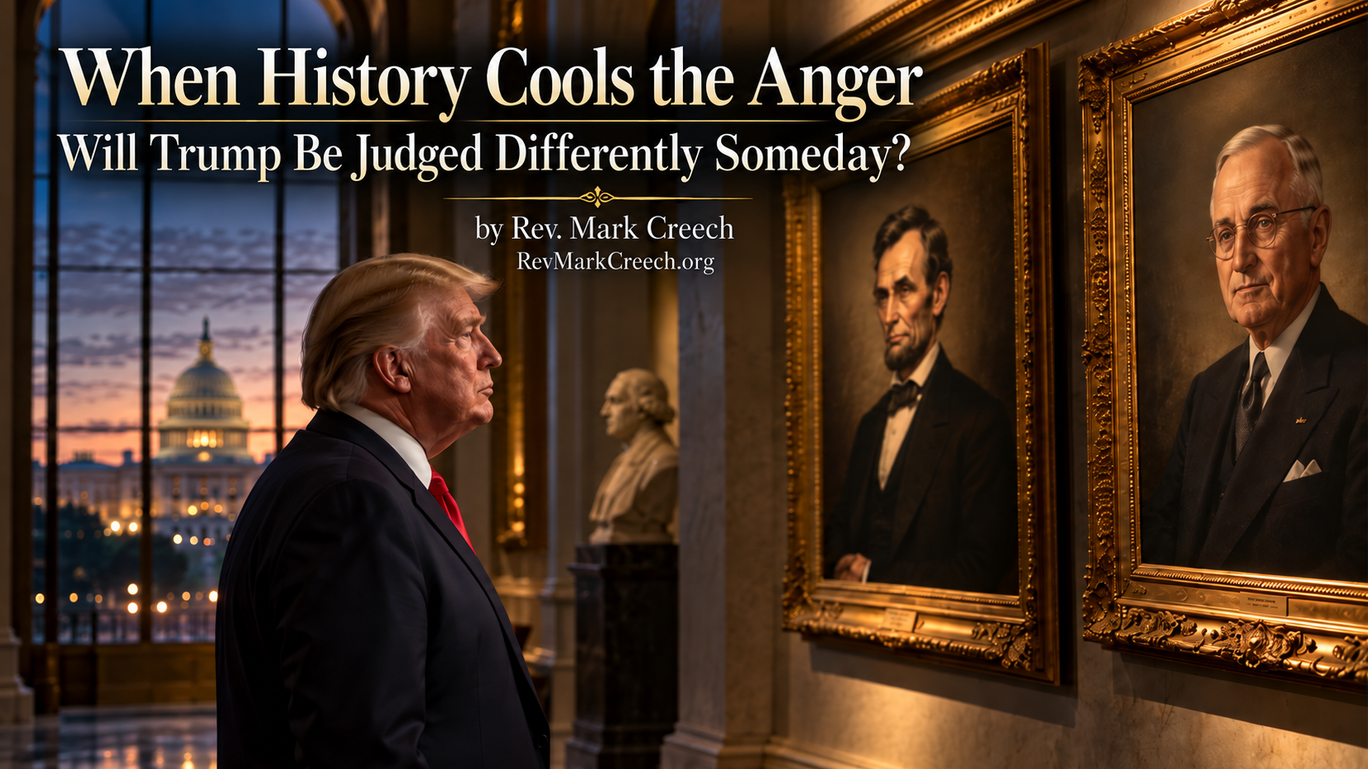
History sometimes views a president differently than the people who lived through his presidency.
Abraham Lincoln certainly knew what it meant to be despised. During the 1864 campaign, he was called a despot, liar, buffoon, usurper, fiend, butcher, and worse. As the Civil War dragged on and casualties mounted, Lincoln himself believed, for a time, that he might lose reelection. Today, Americans remember him primarily for preserving the Union and issuing the Emancipation Proclamation. He is now possibly the most memorable and beloved president in American history.
Harry Truman faced something similar. By February 1952, his Gallup approval rating had fallen to 22 percent. The Korean War dragged on, labor unrest and inflation troubled the nation, and corruption accusations battered his administration. Yet history later gave greater weight to the Marshall Plan, the Berlin Airlift, NATO, resistance to Soviet expansion, recognition of Israel, and the desegregation of the armed forces. Today, Truman is generally regarded far more favorably than he was when he left office and is frequently ranked by historians among the stronger American presidents.
None of this suggests Donald Trump is another Lincoln or Truman. But their stories remind us of something important: The passions of the present do not always produce the clearest judgment of a presidency.
What might Americans someday say about Trump when the anger surrounding him has cooled? Set aside his personality, rhetoric, and controversies for a moment and ask a simpler question: What has his administration actually done?
Border Security and Public Safety
At the southern border, the change has been dramatic. In May 2025, Border Patrol recorded 8,725 illegal crossings between ports of entry along the southwest border, a 93 percent decrease from May 2024. Border Patrol also reported releasing no illegal migrants into the country that month, compared with more than 62,000 the previous May.
Violent crime also fell sharply in 2025. FBI data show the violent-crime rate dropped 9.3 percent, with murder down 18.1 percent and robbery down 18.5 percent. Crime trends have many causes, but these developments are real and deserve acknowledgment.
The American Family and Household Economy
The Census Bureau reported that inflation-adjusted median household income reached a record $87,460 in 2025, while the official poverty rate fell to 10.2 percent—the lowest level in the past decade and below the decade’s average of roughly 11.4 percent. The official child-poverty rate also fell to a historic low of 13.4 percent. Trump also signed major tax legislation that increased the standard deduction and created or expanded deductions for tips, overtime, seniors, and qualifying car-loan interest. Not every family qualifies for every provision, but these are tangible changes affecting ordinary Americans.
Energy, National Security, and Veterans
U.S. crude-oil production reached another record in 2025, averaging about 13.6 million barrels per day. Trump also pressed NATO allies to assume greater responsibility for their own defense, culminating in a new commitment to significantly higher defense spending.
Trump has taken direct military action against Iran, a country the United States has long designated a state sponsor of terrorism and that has supported groups such as Hezbollah, Hamas, the Houthis, and Iranian-backed militias in Iraq and Syria. His administration has argued that confronting Iran itself – not merely its proxies – is necessary to weaken those networks and to prevent Tehran from acquiring a nuclear weapon.
Through Operation Epic Fury, Trump ordered military action to destroy Iran’s missile capabilities, cripple its navy, disrupt its support for terrorist proxies, and deny it a path to nuclear weapons. His administration has followed those operations with continued economic pressure on Iran and on organizations tied to its regional network.
The wisdom, costs, and long-term consequences of that war will undoubtedly be debated. But Trump has taken a far more direct approach to the Iranian regime than many previous administrations, confronting what successive U.S. governments have identified as a major source of terrorism and instability in the Middle East.
Veterans have also seen measurable improvements, with the VA reporting by July 2026 that its backlog of disability and pension claims had fallen by more than 74 percent since January 2025.
For Christians, There Is Another Part of the Record
For evangelical Christians, Catholics, and other religious conservatives, Trump’s record encompasses issues of even great moral significance.
Life and the Unborn
Perhaps no presidential decision has had greater consequences for the pro-life movement than Trump’s three Supreme Court appointments: Neil Gorsuch, Brett Kavanaugh, and Amy Coney Barrett. All three later joined the majority in Dobbs v. Jackson Women’s Health Organization, the 2022 ruling that overturned Roe v. Wade. For generations of pro-life Christians who had prayed, marched, organized, and voted for that day, it was no small accomplishment.
Since returning to the White House, Trump has directed stricter enforcement of the Hyde Amendment and related restrictions on taxpayer funding of elective abortion. His administration ordered federal agencies to review their policies, audit programs where prohibited abortion funding might have occurred, and report on their compliance. He also reinstated the Mexico City Policy, which restricts U.S. foreign assistance to organizations that perform or promote abortion abroad. His administration also ended federal reimbursement for certain abortion-related travel expenses and other policies it viewed as circumventing longstanding funding restrictions.
Religious Liberty and Conscience
Trump established the White House Faith Office, created a Religious Liberty Commission, and launched a Justice Department task force to investigate anti-Christian bias. His administration has also strengthened conscience protections and emphasized the religious rights of pastors, churches, students, teachers, chaplains, parents, and faith-based institutions.
Parents, Children, and Biological Sex
Trump has promoted parental rights and school choice, including access to religious education. His administration has also opposed federal support for gender-transition procedures for minors and restored a federal definition of sex based on the biological distinction between male and female. He further directed federal agencies to protect women’s athletics from male participation under Title IX.
For many Christians, these are not merely political questions. They concern human nature, parental authority, and the protection of children.
Israel and Faith in the Public Square
Trump has maintained a strongly supportive posture toward Israel and has directed additional federal action against antisemitism, particularly on college campuses. His administration has also adopted a much more welcoming posture toward public religious expression, repeatedly affirming that churches, pastors, religious schools, and believers have a legitimate place in American civic life.
For Christians who have watched traditional beliefs grow increasingly marginalized, that matters.
Why I Am Willing to Voice My Support
Someone may read all of this and still dislike Donald Trump. That is their prerogative. But disliking a man and refusing to acknowledge anything good he has done are two different things.
We see that distinction play out almost daily in real time. A border can become more secure, crime can fall, veterans can receive faster service, strong national-security measures can be taken against Iran’s nuclear ambitions and terrorist networks, religious-liberty protections can be strengthened, Roe v. Wade can be overturned, and policies protecting parental rights, unborn life, and women’s sports can be advanced. Yet for some, the first instinct is not to acknowledge the accomplishment but to minimize it, explain it away, or immediately change the subject to Trump’s personality and other controversies.
That does not mean every favorable development should be credited entirely to him, nor does it make criticism of him illegitimate. But when a man’s critics can’t admit even the obvious good, something more than ordinary political disagreement is at play. At that point, dislike begins to distort judgment.
That distinction matters especially to me because of something I learned years ago while in the pastorate.
I served six churches over twenty years. One of those pastorates became extraordinarily painful. A powerful faction had controlled the church for decades and resisted anything that threatened that control. My Christ-centered, evangelistic preaching did not sit well with them either.
The criticism became relentless, and most of it was unfair.
But the critics didn’t wound me most.
The silence of good people did.
There were members who knew the truth and knew that what was being said about me was wrong, yet many remained quiet and left me largely to defend myself. I have never forgotten that.
It taught me this: when a man is relentlessly attacked and you know there is another side to the story, silence is not always neutral. Sometimes silence merely leaves the field to the accusers. And that isn’t right!
That is one reason I am willing to write an article like this. I may lose some of the people who follow my work because of it. Nevertheless, I believe the constant barrage of criticism this president has faced has often gone far beyond fair political disagreement. Too much of it has become personal, relentless, and unwilling to acknowledge anything good.
News flash! Donald Trump has feet of clay.
So do I.
So did Lincoln.
So did Truman.
Trump has said and done things that some may legitimately criticize. Supporting a president should never require pretending otherwise. But fairness also requires giving a man his due.
I am proud to say that I support my President. I believe his administration has done considerable good for this country, especially in matters of profound importance to Christians.
History will render its own judgment. But I would not be surprised if, when today’s political passions have finally cooled, future generations look back and wonder why so many Americans seemed unable to acknowledge achievements that were plainly evident.
Lincoln’s critics had their day. Truman’s had theirs.
History kept writing after the shouting stopped. It will do the same with Donald Trump.
As for me, I do not want to look back someday and realize that when I believed fairness required a voice, I chose silence instead.