
(Part 2 of a 3-part series, No Time for the Light to Go Dim)
By Rev. Mark Creech
RevMarkCreech.org
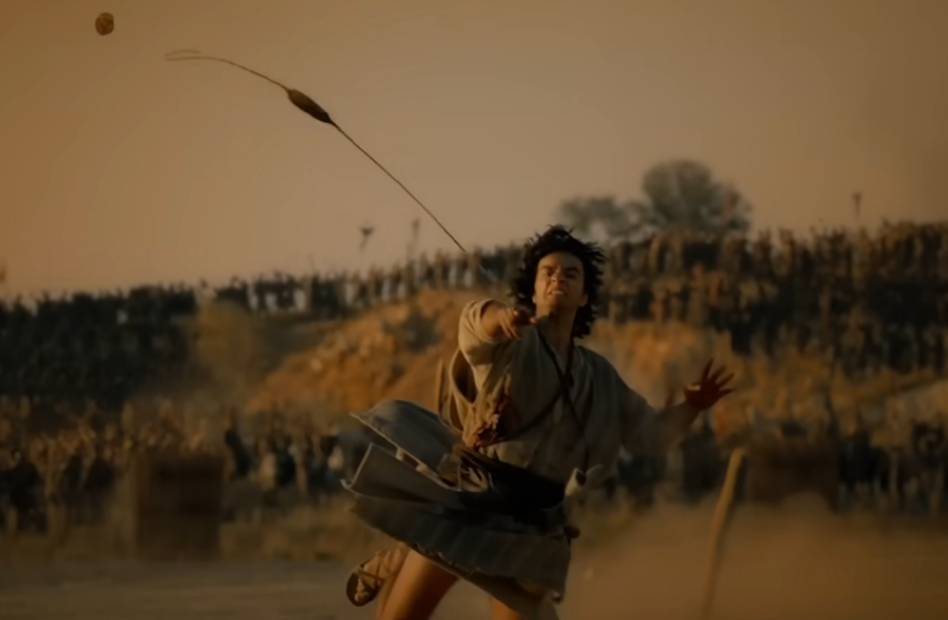
After watching an episode of House of David, I found myself drawn back into one of the most familiar and yet most profound scenes in all of Scripture.
It was the moment David faced Goliath.
On that battlefield, Goliath was more than just a giant – he was defiance personified. Day after day, he hurled insults not merely at Israel, but at Israel’s God. His size, his armor, his voice, his sheer presence all declared the same message: Your God cannot save you.
For a time, it seemed as though that message was winning. The armies of Israel trembled. Not a single man stepped forward. Not even the king.
Then came David.
A shepherd boy. No armor. No sword. No stature. No reputation as a warrior. By every human measure, he was utterly unqualified.
Yet David saw what others refused to see: this was not ultimately a contest between a giant and the Hebrews; it was a confrontation between a wicked blasphemer and the living God.
When David stepped onto that field, he did so with a confidence that defied all human reasoning. He had seen God’s hand before – in the paw of a lion, in the jaws of a bear- and he believed that the God who delivered him then would deliver him now.
Goliath laughed. The very sight of David seemed an insult. Surely Israel had lost its mind not to send a champion, but a boy.
Nevertheless, in that moment, something far greater was unfolding.
With a single stone from a shepherd’s sling, the giant fell.
What was Goliath’s rage, his blasphemy, his towering opposition? It became the very means by which God displayed His power to the world.
The defiance of man did not diminish God’s glory. Instead, it magnified it.
The wrath of man praised Him.
Scripture declares this truth with striking clarity:
“Surely the wrath of man shall praise thee: the remainder of wrath shalt thou restrain” (Psalm 76:10).
Psalm 76 reminds us that no opposition, no matter how fierce, can ultimately stand against God. More than that, it reveals something even more astonishing: God does not merely defeat His enemies; He overrules them. He sets limits to their rebellion, and He bends even their resistance into the accomplishment of His purposes.
What appears to threaten His glory becomes, in His hands, a means of displaying it.
That truth is not confined to ancient battlefields. It speaks directly to our present moment.
We are living in a time when defiance against God is no longer subtle. It is bold. It is organized. It is celebrated. Biblical truth is mocked. Moral absolutes are ridiculed. Foundational realities – concerning life, family, truth, and even human identity – are being aggressively dismantled.
In many ways, it feels as though Goliath has returned to the valley.
Too often, the response has been silence.
Many pastors and church leaders have grown hesitant to address these social issues. Some fear controversy. Others fear division. Still others have come to believe that such matters fall outside the scope of gospel ministry.
But David’s example, and Psalm 76, tell us otherwise.
There are moments when silence is not neutrality. It is surrender.
David understood that Goliath’s defiance was not merely a political or military problem. It was a spiritual affront. To ignore it would have been to be complicit with it – even to participate in it.
So David stepped forward.
Not because he was the most qualified. Not because he had others’ approval. But because he believed that God’s name must not go undefended.
That same zeal and conviction must be recovered in our own time.
To speak to the moral and cultural issues of the day with the truth of God’s Word is not a departure from the gospel; it is an expression of it. The gospel declares that Jesus Christ is Lord. If He is Lord, then His authority extends over every sphere of life, including the public square.
We do not engage because we trust in our own strength.
We engage because God reigns.
We speak because no opposition can ultimately prevail against Him.
We speak because even the wrath of man, however fierce it may appear, will, in the end, serve His purposes and bring Him glory.
I know something of this, not merely from Scripture, but from experience.
Nearly three decades ago, I became deeply convinced that as a minister of the gospel, I could no longer remain silent about the political and cultural issues that were plainly contrary to the Word of God. The moral drift I was witnessing, both in society and, increasingly, within the church itself, was not merely concerning. It was, in many cases, blasphemous.
I knew what it might cost.
I was serving a church at the time, and I understood that if I began addressing these matters from the pulpit, it could very well mean the end of my pastorate.
Still, the conviction would not leave me.
And so, with a sense of resolve that I can only describe in the words of Esther, I came to this conclusion: “If I perish, I perish” (Esther 4:16).
God’s truth must be declared.
I began to preach, not politically, but biblically, addressing the controversial ethical issues of our day and helping my congregation understand how to think about them through the lens of Scripture. My aim was not to inflame, but to disciple; not to divide, but to bring clarity where confusion had taken root.
What happened next surprised me.
I was not dismissed as expected.
Instead, it became clear that people were hungry for such preaching—sound, biblical preaching that spoke directly to where they lived. They needed wisdom from above to navigate the most pressing matters here below.
The church began to grow. Visitors came. New families were added. Opportunities opened – first to write, then to radio, and later to speaking engagements beyond the walls of my own church. Platforms of various kinds emerged that I could never have created for myself.
I am not a great intellectual. Though I have received an honorary doctorate, my formal theological training has been limited. Yet it has been God, in His providence, who has continued to enlarge my sphere of influence – not for my sake, but for His purposes and His glory.
Looking back, I can see it plainly: what I feared might destroy my ministry, God used to establish and strengthen it.
I would be disingenuous to say there was no pushback or backlash. Yet the opposition I experienced became, in His hands, an instrument for advancing His truth – most importantly, the truth of God’s saving grace in Christ.
The wrath of man praised Him.
Still, I must add that, after all these years, I remain burdened more than ever.
Because so many pastors, so many church leaders, so many denominations continue to hesitate stepping forward. The risks feel too great. The cost seems too high. Careers, reputations, and congregational stability are placed on one side of the scale, and faithfulness to speak the full counsel of God on the other.
Too often, silence wins the day.
What we are facing is not a minor challenge. It is not a passing trend. It is a Goliath – massive, defiant, open hostility to the truth of God. It threatens to mute the church’s witness and erode the very foundations of our liberties as a nation.
Like the armies of Israel, most stand back, waiting.
God has not changed. He is still able to take what seems small, what seems weak, what seems utterly insufficient, and use it to bring down what appears invincible.
The question is not whether the giants will rage. They will. They already are.
The question is whether there will be those who, like David, are willing to act – not in their own strength, but in the name of the Lord.
Who will rise to the challenge and declare that there is a God who rules over all?
Whoever does will discover what Psalm 76 has declared all along: The opposition they feared is not beyond God’s control. It never has been. It never will be.
And in the end, even the rage of arrogant and blasphemous giants will fall, and God will make the wrath of man to praise Him.
Picture: Screenshot from House of David, Season 1, Episode 8 (Finale), via YouTube. Used for commentary purposes.