by Rev. Mark Creech
RevMarkCreech.org
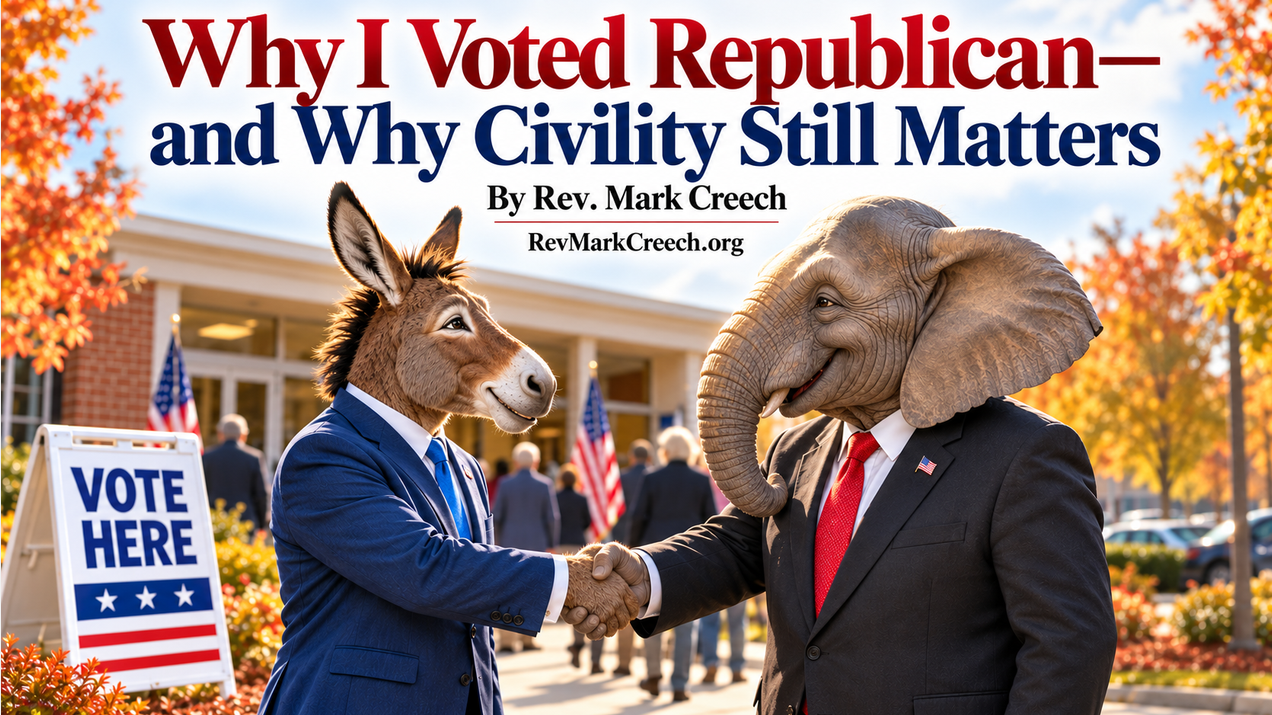
Saturday (October 24, 2026), I voted early in North Carolina’s midterm elections. I was alone, but before I even reached the polling place, I had an unexpected and memorable encounter.
As I walked toward the entrance, I met a United States congresswoman I’d known since her former days in the North Carolina General Assembly. She recognized me before I reached her and greeted me warmly. Believe it or not, we even hugged.
Someone accompanying her quickly handed me one of her campaign flyers, but she immediately intervened. “No, there’s no need for you to do that,” she said. “I can assure you that Rev. Creech will not be voting Democratic.” Everyone smiled. She was right.
Nevertheless, I took the opportunity to tell her and those nearby that, despite our political differences, I had always appreciated the civility of our relationship. I sincerely thanked her for her service to our state and nation. We exchanged farewells, and I continued into the polling place, where I cast my ballot for Republican candidates.
The encounter stayed with me because it illustrated something increasingly rare in American politics: two people who disagree profoundly on important issues can still treat one another with genuine warmth, dignity, and respect.
Another irony marked the occasion. I come from a family of “Yellow Dog Democrats,” who would vote for a yellow dog before voting for a Republican. My mother and father were Democrats. Both sets of grandparents were Democrats. In the North Carolina of their day, party labels often meant something quite different from what they mean now. Conservative Democrats were plentiful, especially in the South. On many moral and cultural questions, the distinctions between Democrats and Republicans were far less pronounced.
The political landscape has changed dramatically. Both parties have evolved, and their national platforms now reflect significant differences on issues that matter deeply to Americans of faith. Today, I voted Republican, unapologetically. But I believe it is worth explaining the issues that informed my decision rather than simply announcing my party preference.
The Sanctity of Human Life
For Christians who believe that human life has inherent dignity from conception, abortion remains a defining moral question.
The Republican national platform opposes late-term abortion and supports states’ authority to enact protections for unborn life. The Democratic platform emphasizes reproductive freedom and the restoration of nationwide abortion protections. The distinction is substantial, even though Republicans themselves differ on how far abortion restrictions should extend and which exceptions should be permitted.
Marriage, Family, and Human Sexuality
For generations, Christians have understood marriage and family through Scripture. Contemporary disputes over marriage, sexual ethics, gender identity, and the responsibilities of government have made these questions increasingly political.
The Democratic platform embraces LGBTQ+ rights, including protections based on gender identity. The Republican platform takes a different approach, opposing the participation of biological males who identify as female in women’s sports and supporting restrictions on their access to women’s bathrooms and locker rooms. Republicans also advocate restrictions on gender-transition procedures for minors, restrictions on taxpayer funding for sex-change surgeries, and restrictions on the promotion of gender transitions in public schools.
These disagreements raise consequential questions about privacy, fairness in women’s athletics, parental authority, religious convictions, and the protection of women and girls.
Religious Liberty
Religious liberty means more than the freedom to worship behind church doors. It also encompasses the freedom of religious institutions and individuals to act on their convictions in education, employment, charitable service, and public life.
Both national parties profess support for religious freedom. However, their approaches diverge sharply when biblical convictions concerning marriage, human sexuality, gender identity, and the sanctity of human life conflict with government policies and laws on abortion, sexual orientation, and gender identity. Then the religious liberty of Christians who view these matters as immoral is diminished or denied.
Parental Rights and Educational Freedom
Few responsibilities are more sacred to parents than raising and educating their children. Republicans have placed considerable emphasis on school choice, homeschooling, parental involvement, and families’ ability to select educational environments consistent with their values.
Democrats generally place greater emphasis on strengthening public education, public-school funding, and student protections, while opposing some programs that direct public funds to private schools. The disagreement concerns not only educational quality but also who should exercise primary authority over key educational decisions and how public resources should be distributed.
The Role of Government
The Republican Party traditionally associates itself with lower taxes, deregulation, individual responsibility, and limits on federal authority. Democrats generally advocate a broader governmental role in social programs, economic regulation, healthcare, and public investment.
Neither party’s governing record fully aligns with its rhetoric. Republicans have supported substantial spending and federal intervention; Democrats have at times embraced spending restraints and market-oriented policies. Still, the contrasting philosophies remain important when considering how government should serve citizens without unnecessarily burdening them.
Public Safety, Immigration, and the Rule of Law
Both parties say they support public safety and lawful immigration, but they differ significantly on enforcement priorities and methods.
Republicans emphasize border enforcement, deportation, and tougher criminal-justice policies. Democrats insist that they, too, support border security, but most often their policies have undermined that commitment. Yet we only need to point to the Biden administration’s narrowing of immigration enforcement priorities, record numbers of encounters at the southern border, and delayed adoption of tougher asylum restrictions as evidence of a troubling gap between the promises of the Democratic Party and their performance when in office. Democrats maintain that their policies sought to balance enforcement with humanitarian obligations and legal pathways to immigration. The disagreement is not simply whether the border should be secure, but which policies actually achieve that objective.
Since President Trump returned to office in January 2025, illegal crossings at the southern border have reached historic lows. Border Patrol apprehensions have declined by about 91 percent compared with the final year of the Biden administration. Stricter asylum policies, increased enforcement, expanded deportations, and a stronger deterrent effect have contributed to the decline. Although crossings had already begun to fall under Biden, the subsequent reductions under Trump have been substantial.
These debates reflect genuine tensions among national sovereignty, public safety, due process, compassion, and the fair application of the law.
The Courts and the Constitution
Judicial appointments can shape American law for generations. Republicans often favor judges associated with originalism and textualism, which emphasize the constitutional text and its original public meaning.
Democrats more often favor judicial approaches that weigh precedent, practical consequences, and the application of constitutional guarantees to changing circumstances. This is sometimes called the “living Constitution” approach, which allows constitutional interpretation to evolve with changing social values. But critics raise an important question: If the Constitution’s meaning can change to accommodate the prevailing culture, what prevents judges from reading into it what they believe it ought to say rather than what it actually says? There is a parallel here to interpreting Scripture. We would never say that taking the Bible out of context and imposing our own preferences upon its words constitutes faithful interpretation. Should we not also insist that those entrusted with interpreting our nation’s founding document remain faithful to its text and meaning? These competing judicial philosophies can have profound consequences for religious liberty, abortion, government authority, and many other constitutional questions.
Still, There Is Something More Important Than Party Loyalty
None of these distinctions means that every Republican candidate consistently embodies the principles his or her party professes. Nor does it mean that Democrats lack sincere convictions, religious faith, patriotism, or a commitment to the common good. I have known honorable people in both parties. I have also learned that political labels cannot substitute for character.
A Christian’s ultimate allegiance must never belong to a political party, a politician, or a political movement. It belongs to Jesus Christ. Political parties are human institutions. They are fallible, and they must be judged by principles greater than themselves. Faith should inform political judgment, not become a convenient instrument of partisan loyalty.
That brings me back to the congresswoman I met outside the polling place. She knew I would not be voting for her, and I knew we had substantial disagreements. Yet neither of us saw any reason to abandon kindness or mutual respect. I wish more Americans understood that political conviction and personal courtesy are not enemies. One can disagree firmly without becoming disagreeable. One can oppose another person’s policies without denying that person’s dignity.
The apostle Peter instructed believers to “Honour all men” (I Peter 2:17). That admonition does not disappear during election season. The apostle Paul also wrote, “If it be possible, as much as lieth in you, live peaceably with all men” (Romans 12:18).
Today, I exercised my right to vote. I did so with conviction, conscious that the choices before us carry consequences for our families, our communities, and our nation. But I also left the polling place grateful for a friendly encounter with someone on the other side of the political aisle.
Our convictions need not be negotiable for our conduct to be gracious.
Perhaps that is a lesson America needs almost as much as it needs responsible government.
URGENT REMINDER: DON’T MISS YOUR OPPORTUNITY TO VOTE!
For Those Who Care Very Much About the Values Just Listed,
You Must Get to the Polls and Vote in the Midterm Election!
North Carolina’s early voting ends Saturday, October 31, at 3:00 p.m. Don’t miss this opportunity to cast your ballot ahead of potentially longer lines on Election Day, Tuesday, November 3.
Pastors and church leaders: Return America has prepared a FREE, nonpartisan bulletin insert, “And Their Voices Prevailed,” reminding Christians of their responsibility to vote and encouraging them to approach the ballot box with biblical convictions. Please consider downloading, reproducing, and distributing this valuable resource in your church this Sunday.