By Dr. Mark Creech
Director of Government Relations
Return America
Some weeks at the General Assembly are more discouraging than others, and this was one of them.
On Tuesday, I appeared before the House Alcoholic Beverage Control Committee to speak against House Bill 921, the “ABC & Gambling Omnibus Bill.” What began as a 19-page bill was replaced in committee with a proposed committee substitute that had grown to 76 pages, adding numerous provisions that would dramatically expand alcohol access, alcohol promotion, and gambling-related activity in North Carolina. The bill was scheduled for a discussion-only hearing this week, and a vote was delayed until a future meeting, which chairman Rep. Ray Pickett (R – Watauga) said would come soon.
Another PCS could be introduced by the time of the vote – one that might make it better or worse. If it passes the House ABC committee, it will then move to House Finance. So, this legislation is a moving target.
In my 26 years working at the legislature, I have never seen an alcohol-related initiative as troubling as this one. HB 921 is being promoted as “modernization,” but in reality, it would move North Carolina away from public control and toward broader alcohol availability, easier promotion, and weaker safeguards for families and communities.
North Carolina’s ABC system exists for a reason. It is not merely a retail system. It is a public-control system designed to balance alcohol commerce with public health and safety. HB 921 tilts that balance far too much toward alcohol expansion and away from community protection.
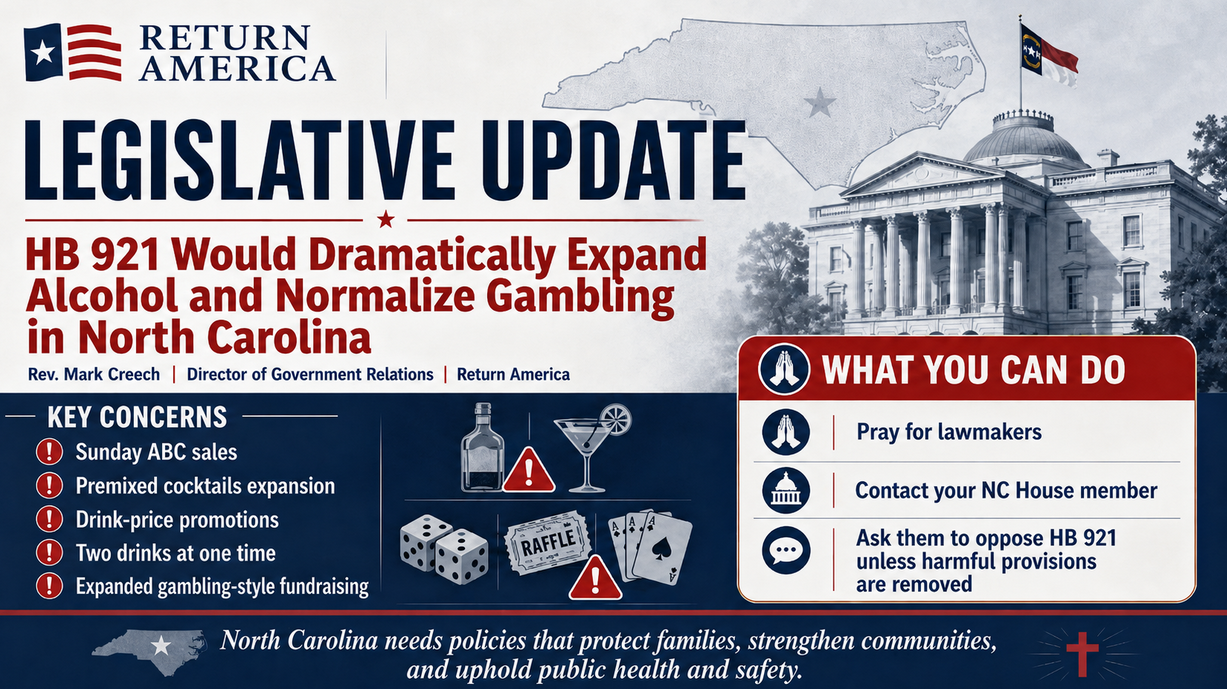
Among other provisions, the bill would allow Sunday ABC store sales, expand premixed cocktail sales beyond the traditional ABC store model, authorize temporary drink-price promotions, allow patrons to receive two drinks at a time, expand alcohol service in service businesses, permit in-stand alcohol sales at large venues, broaden social district consumption, loosen rules for mobile bars and temporary permits, place alcohol industry representation on the ABC Commission, and expand nonprofit alcohol fundraising.
Why Return America Is Concerned
Return America’s concern is that public policy should not make alcohol easier to buy, serve, advertise, or consume when excessive alcohol use is already causing serious harm to North Carolina families and communities.
When alcohol becomes more readily available, the risks are no longer theoretical. Families deal with addiction. Communities deal with impaired driving. Law enforcement deals with over-service, disorder, and underage access. Churches and ministries deal with the brokenness that follows.
HB 921 also contains gambling-related provisions that warrant serious concern. The bill would expand game-night opportunities for charities and loosen restrictions on 50/50 raffles. These provisions would normalize chance-based wagering as a routine fundraising tool in civic and charitable life. Charity and gambling are surely an unequal yoke, and the two should never be found together. This kind of gaming is already underway in the state. HB 921 would expand it exponentially.
Ten Areas of Concern in HB 921
Return America has identified ten major public health and safety concerns:
- Premixed cocktails — create a parallel commercial pathway for liquor-based products and weakens the ABC control model. Liquor products should be sold only in ABC stores, not in other venues where beer and wine are typically sold.
- Sunday ABC sales — removing a weekly public-health pause without direct voter approval. This provision not only shows disrespect for the religious community, which is often responsible for cleaning up the carnage left behind by alcohol use and abuse, but also seriously undermines local option alcohol referenda.
- Temporary drink-price promotions — encourage faster consumption, binge drinking, and alcohol-centered advertising. By tying lower prices to a narrow time window, the bill pressures consumers to purchase and consume more alcohol before the promotion ends, rewarding speed and quantity over moderation.
- Two drinks at a time — allowing multiple drinks to be served at once makes it harder for servers to observe a patron’s condition before additional alcohol is consumed, especially in crowded or fast-paced settings.
- Service business permits — This normalizes drinking in everyday service settings where staff may not be adequately trained or experienced in checking identification, recognizing intoxication, or refusing service.
- In-stand concert and sporting-event sales — when patrons can purchase alcohol without leaving their seats, consumption can become more frequent and less visible, making it harder to monitor intoxication before large crowds depart the venue.
- Social district expansion – weakens accountability because the business where a person drinks may not be the same one that checked identification, served the alcohol, or monitored the patron’s condition.
- Mobile bar and temporary permit expansion — temporary and mobile alcohol service often occurs in unfamiliar locations, where enforcement, inspections, crowd control, and accountability are more difficult to maintain.
- ABC Commission industry representation — while industry experience may be valuable, perspectives from public health, addiction prevention, law enforcement, and recovery should not be overshadowed by those with direct ties to the alcohol business.
- Nonprofit alcohol fundraising — a charitable purpose does not eliminate the risks associated with alcohol, including underage exposure, impaired driving, misuse, and the message that alcohol is an appropriate incentive for giving.
If you would like to read Dr. Creech’s full analysis of HB 921, go to this link.
A Word About the Committee Hearing
I testified against the bill before the committee. I told lawmakers that this measure moves North Carolina in the wrong direction. I also warned that the public health evidence is clear: when alcohol becomes more available, alcohol-related harms increase. WUNC reported on part of those remarks in its coverage of the hearing.
I will be candid with you. I do not believe my remarks had much influence. At times, it is painfully evident that the economic and political momentum behind measures like this is difficult to slow, let alone halt.
Still, faithfulness is not measured only by our victories. It is measured by the willingness to stand, speak, and bear witness to what is true and right, even when the outcome seems unfavorable.
What You Can Do
Please pray earnestly about this legislation.
Pray that lawmakers will look beyond the business opportunities in HB 921. It’s unfortunate, but public health and safety are rarely part of the equation at these hearings. Pray that they will consider the families, communities, churches, law enforcement officers, and recovery ministries who will undoubtedly have to deal with the consequences of expanding alcohol access and normalizing gambling.
Please also contact your state House member and ask them to oppose HB 921 unless these dangerous alcohol and gambling provisions are removed or substantially amended.
Do you need to know who represents you in the North Carolina House? If yes, go to this link. At the link, you will find the name of the person who represents you and their contact information. Call them and leave a message with their Legislative Assistant. You can email them, but emails are often not seen by the legislator. Calling is the best way.
North Carolina does not need more access to alcohol, more alcohol promotion, or more gambling normalization. We need public policy that protects families, strengthens communities, and upholds the principles of public health and public safety.
Thank you for standing with Return America.
Respectfully,
Rev. Mark Creech
Director of Government Relations
Return America