by Dr. Mark Creech
Director of Government Relations
Return America
The North Carolina General Assembly is approaching what may be one of its final periods of activity for the 2025–2026 legislative session. Several consequential matters remain unresolved, while other measures enacted in the state budget are only now receiving the public scrutiny they deserve. Some of these issues directly affect Christian schools and ministries; others raise serious questions about protecting children by banning unregulated and dangerous recreational drugs, preserving personal privacy, maintaining alcohol-control safeguards, and respecting parental authority.
This Legislative Update summarizes five matters Return America supporters should watch closely: the state’s new crisis-line mandate for private religious schools; the House’s impending decision on intoxicating hemp products; the controversy threatening the ABC Omnibus and its proposed liquor warehouse; the expansion and potential misuse of license-plate surveillance; and a possible measure governing professional attire for public-school employees.
Dr. Ron Baity, President of Return America, Issues Critical Alert Saying, “Stay in Your Lane.”
Dr. Ron Baity has issued a critical alert about a provision in the recently enacted state budget that requires private church schools and schools of religious charter to publish government-selected suicide-prevention and crisis-support information. Beginning with the 2026–2027 school year, affected schools must display contact information for the 988 Suicide and Crisis Lifeline and the North Carolina Peer Warmline in six specified locations, including school websites, registration materials, student identification cards, calendars, and school-issued electronic devices. The requirement became law as part of the 2026 Appropriations Act (Senate Bill 257).
Dr. Baity emphasizes that Return America neither minimizes the tragedy of youth suicide nor opposes helping emotionally distressed students. The deeper concern is the precedent set when the state dictates what messages a religious school must repeatedly convey on its property and in its communications. If lawmakers may compel a single government-selected message today, a future General Assembly could mandate messages on sexuality, gender, counseling, family life, or human identity that directly conflict with a school’s religious convictions.
The alert also argues that Christian schools should be free to direct troubled students first to parents, pastors, and counselors who share the school’s biblical worldview. Dr. Baity calls on the state to “stay in its lane” and on Christian educators to defend the independence and spiritual integrity of their ministries.
You will likely be hearing more on this issue in the future.
NC House Faces Decisive Vote on Prohibiting Intoxicating Hemp Products
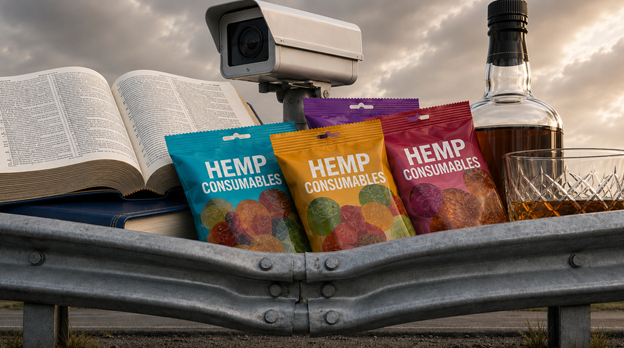
House Bill 328 – Regulate Hemp-Derived Consumables is considerably stronger than many realize. The Senate-approved conference report would effectively remove intoxicating hemp-derived products from lawful retail shelves in North Carolina. Finished products containing more than 0.4 milligrams of total THC per container would be classified as prohibited and placed in Schedule VI of the Controlled Substances Act – the same general classification North Carolina applies to marijuana. The calculation would include not only delta-9 THC but also THCA and other intoxicating forms, including delta-7, delta-8, and delta-10. Products containing synthetic or chemically converted cannabinoids would likewise be prohibited.
In practical terms, many intoxicating gummies, candies, beverages, vapes, and similar products now openly sold at gas stations, convenience stores, vape shops, and online would no longer be lawful for retail sale. Qualifying non-intoxicating hemp products could remain available to adults, but their sale, delivery, and possession would be prohibited for anyone under 21. The bill would also prohibit synthetic kratom products, including synthetic 7-OH. Natural, nonsynthetic kratom would remain lawful for adults, while its sale or delivery to anyone under 21 would be prohibited. Violating businesses could face criminal charges, substantial civil penalties, and increasingly severe consequences for repeated offenses.
The Senate approved the conference report by a vote of 37–6, but the House must still act. The choice before House members is not simply whether to regulate an adult intoxicating-hemp market. It is whether North Carolina will remove these dangerous intoxicating products from lawful commerce, restrict the remaining non-intoxicating hemp and nonsynthetic kratom products to adults, and give law enforcement meaningful authority to hold unlawful sellers accountable. The House should approve the conference report and send HB 328 to the governor.
HB 198: Sweeping Alcohol Expansion, Warehouse Controversy and an Uncertain Future
House Bill 198, the “ABC Omnibus of 2026, represents one of the most sweeping efforts in recent years to lower North Carolina’s alcohol-control guardrails and make alcohol more readily accessible. During its movement through the General Assembly, versions of the bill have included allowing spirituous-liquor-based premixed cocktails to be sold in grocery and convenience stores rather than exclusively through ABC stores; happy-hour-style temporary drink-price reductions; two mixed drinks sold to one patron at once; alcohol service in professional businesses and other nontraditional settings; expanded social-district privileges; broader mobile-bar operations; and nonprofit fundraising provisions involving alcohol. Other provisions would expand tourism ABC establishments without the customary local vote, authorize mixed-drink tastings in ABC stores and alter the membership and authority of the ABC Commission. Taken together, these are not merely technical adjustments. They would substantially weaken the deliberate controls North Carolina has historically placed upon the availability, pricing, promotion and distribution of alcoholic beverages.
The bill’s proposed $310 million loan for a new automated state liquor warehouse has also sparked controversy. ABC Commission Chairman Hank Bauer alleged that House Majority Leader Brenden Jones pressured the Commission to accept a more expensive public-private arrangement with M Group Companies, whose representatives and associates reportedly contributed about $500,000 to legislative campaigns and political organizations. M Group also has ties to individuals linked to Greater Carolina, the nonprofit under investigation for lobbyist-funded Kentucky bourbon tours for lawmakers. Four lobbyists have been indicted on misdemeanor gift-ban charges, though no criminal wrongdoing related to the warehouse proposal itself has been established.
The Senate passed its expanded version of HB 198 by a vote of 36–6, but the House refused to concur, leaving the measure in a conference committee. House leadership has since indicated that the warehouse legislation will not move this year, leaving HB 198’s future uncertain. Nevertheless, the bill still warrants close attention. Other proposals considered during the session – including Sunday sales at ABC stores and a dramatic expansion of gambling-style fundraising events for nonprofits – could be inserted into a conference report. Such a report would then receive an up-or-down vote in both chambers, with little opportunity for amendment. What has been presented as alcohol “modernization” could become a far-reaching dismantling of safeguards that have served North Carolina and its communities for generations.
Rep. Erin Paré Considers Dress Standards for Public-School Employees
Representative Erin Paré of Wake County is considering whether North Carolina should require public-school employees to wear professional attire consistent with their biological sex. The question arose after parents reportedly expressed concern about a biological male who dresses as a woman being employed as a music teacher at an elementary school. Paré said young children should not be unnecessarily exposed to mature and confusing questions about gender identity in the classroom.
At present, no bill has been drafted or introduced. Paré has said she is still examining the legal issues and has no plans to file legislation at this time. Opponents argue that a sex-based requirement would violate federal employment and education law.
The issue raises both parental concerns and a significant legal challenge. Parents have a legitimate interest in the messages and examples presented to young children, particularly regarding biological sex and human identity. Any proposed legislation, however, would need to be carefully drafted to establish neutral professional standards, respect constitutional and statutory employment protections, and withstand almost certain litigation.
Pare’ is right about this issue. Somebody needs to do something.
“Big Brother” Concerns Intensify Over License-Plate Surveillance
A provision placed in the state budget authorizes automated license-plate-reader cameras along state-maintained roads and highways, expanding technology capable of recording where vehicles travel and allowing that information to be searched by law enforcement. Supporters point to the cameras’ usefulness in recovering stolen vehicles and investigating serious crimes. Nevertheless, the creation of a far-reaching surveillance network raises substantial questions about data retention, access, oversight and the privacy of law-abiding motorists.
Those concerns became more than theory with the arrest of Charlotte-Mecklenburg Police Officer Seth Daniel Elliott, 25. According to investigators, Elliott allegedly searched an undercover officer’s license plate through the Flock Safety system and the state’s CJLEADS database, then gave the information to the target of an active drug investigation. Elliott has been charged with illegally accessing a government computer and placed on unpaid administrative leave. The allegations have not yet been proven in court.
The incident does not mean that every use of license-plate technology is improper, but it demonstrates how powerful databases can be abused by individuals entrusted with access.
Read: When Big Brother Comes to North Carolina Highways
These developments remind us that vigilance cannot end when a bill first passes – or even when a budget is signed. Important provisions are sometimes buried within large measures, disputed proposals can reappear during final negotiations, and decisions made in Raleigh can establish precedents reaching far beyond their immediate subject.
Return America will continue monitoring these matters, informing churches and Christian citizens, and speaking clearly whenever biblical principles and public welfare are at stake.