by Dr. Mark Creech
Director of Government Relations
Return America
The Lumbee people have spoken, and they have done so with remarkable clarity.
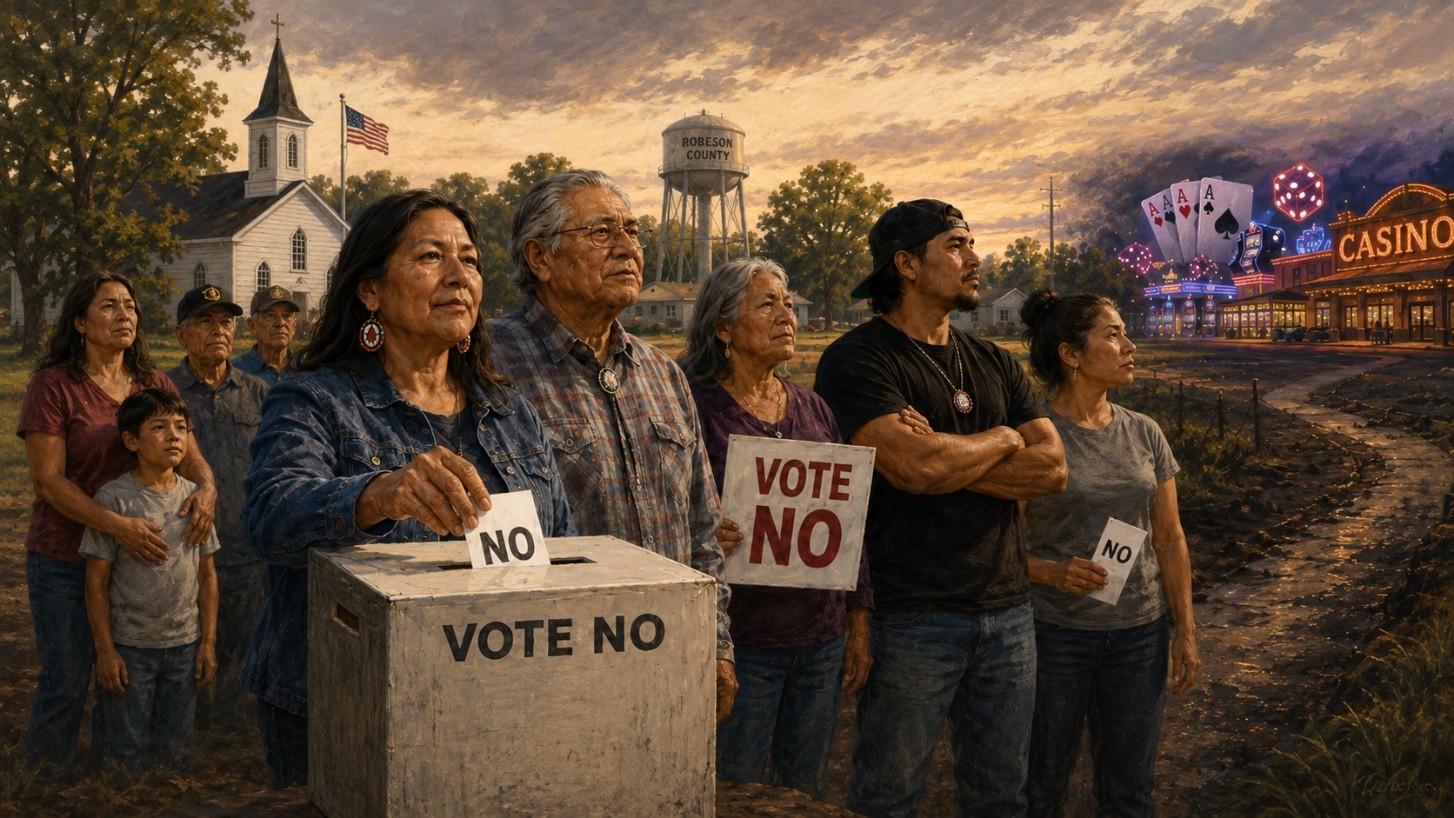
In a historic tribal vote, Lumbee voters rejected a constitutional amendment that would have allowed casino gambling and a major gaming development in Robeson County. The vote was not close. Reports indicate the amendment failed by a wide margin, with “no” votes prevailing in every precinct.
That outcome deserves respect and reflection.
This was not simply a vote on whether a casino might bring money to a struggling region. It was a vote on the future character of a people, the integrity of tribal self-government, and whether economic hardship should be addressed by an industry that profits from exploiting human weakness.
Supporters of the casino proposal made arguments that should not be dismissed lightly. Robeson County has real needs. Poverty is real. Unemployment and underemployment are real. Families need jobs, and young people need opportunities. Tribal governments need resources for education, housing, health care, elder care, public safety, and cultural preservation. No one who cares about the Lumbee people or southeastern North Carolina can easily dismiss those concerns.
But the question was never whether the Lumbee people should prosper. The question was whether casino gambling was the right path to prosperity.
Thankfully, their answer was no, and they were right.
Casino gambling is often sold as economic development, but it is a peculiar and dangerous form of development. It does not create wealth the way manufacturing, agriculture, small business, education, health care, or technology does. Casinos largely redistribute money, drawing it from the pockets of ordinary people, including many who can least afford to lose it. They promise economic renewal, but that renewal rests on the cold calculation that enough people will lose enough money often enough to keep the enterprise profitable.
That is not a morally neutral business model.
A casino does not merely offer entertainment. It manufactures temptation. It studies human behavior, preys on addictive tendencies, and turns losses into revenue. The more people gamble, the more the casino profits. The deeper people sink into debt, desperation, and compulsion, the more the system benefits. That is why gambling expansion always warrants more scrutiny than ordinary commerce.
In this case, the vote also became entangled in serious governance questions. Many Lumbee citizens were not simply asking whether gaming should exist. They were asking who would control it, how decisions would be made, whether sufficient transparency had been provided, and whether the proposed amendment would concentrate too much power in too few hands. Those concerns were well-founded.
A people who waited generations for full federal recognition and a stronger voice should not surrender that voice at the first promise of casino revenue. Self-government is not strengthened when major decisions are rushed under pressure. Constitutional changes should be carefully weighed, openly debated, and adopted only when the people are confident their rights, oversight, and future are secure.
That is one of the most encouraging aspects of this result. The Lumbee people did not seem dazzled by promises of easy money. They looked deeper. They asked whether the process was right, whether the price was too high, and whether this was the kind of future they wanted to leave to their children.
There is wisdom in that.
North Carolina has seen this pattern before. Only a few years ago, a major casino expansion effort collapsed in Raleigh after lawmakers and citizens recoiled at the attempt to tie gambling expansion to the state budget. That effort was closely associated with Senate leader Phil Berger, whose home county, Rockingham, had been eyed for a casino. It would be unfair to say that casinos alone cost Berger his seat. Elections are rarely decided by a single issue. But it would be equally naïve to pretend the controversy did not matter. His 2026 primary defeat by Sheriff Sam Page should not be reduced to a single issue. Still, the casino controversy had already revealed how deeply many citizens resented being pushed toward gambling expansion they did not want.
The Lumbee vote now adds another chapter to the same story.
Gambling interests consistently present themselves as friends of economic progress. They speak the language of jobs, revenue, tourism, and modernization. Yet behind that language lies a hard reality: gambling takes more from communities than it gives. It increases financial distress, invites addiction, burdens families, and alters a region’s moral climate. Once established, it rarely remains contained. What begins as a single carefully managed proposal soon becomes the argument for the next expansion.
The Lumbee vote should therefore be understood not as a rejection of progress but as a rejection of a counterfeit version of it.
True economic development strengthens families. Gambling destroys many of them. True development rewards labor, skill, investment, and productivity. Gambling rewards chance and normalizes the hope of gain without work. True development builds community stability. Gambling brings instability, disguised as entertainment.
Robeson County and the Lumbee people deserve better than an economy built on other people’s losses.
They deserve investment that honors their dignity, history, families, and future. They deserve roads, schools, businesses, health care, entrepreneurship, cultural tourism, agriculture, workforce training, and industries that build them up rather than take advantage of them. They deserve opportunities that do not require moral compromise.
This vote does not solve every problem. Poverty remains. Economic need remains. The desire for jobs and revenue remains. But some doors should remain closed, even in difficult places. Not every offer of wealth is a blessing. Some come dressed in promise but carry a hidden curse.
The Lumbee voters saw enough to vote no.
For that, they should be highly commended.
Their decision sends a message beyond tribal territory and Robeson County. It tells North Carolina that people are not merely economic units to be managed, marketed to, and monetized. Communities have souls. Constitutions, families, and moral limits matter.
The casino initiative failed because enough Lumbee voters refused to accept the premise that gambling was the best path forward. They demanded something better.
They were right.
May their tribe increase.
*******
Invasive License Plate Reader Provision Removed from HB 206 – DPS/Other Changes
A few weeks ago, I raised concerns about a provision in House Bill 206 – DPS/Other Changes that would have made permanent the State Bureau of Investigation’s automatic license plate reader program on North Carolina highway rights-of-way. While we strongly support law enforcement and public safety, this provision raised serious questions about privacy, data retention, government surveillance, and the risk of tracking innocent citizens’ movements.
Read: When Big Brother Comes to North Carolina Highways
Anyone who shared these concerns can take comfort in the fact that the license plate reader language has been removed from the most recent version of the bill. That is a welcome development. North Carolina can and should support law enforcement without quietly building the machinery of permanent surveillance. Safety and liberty are not enemies, and lawmakers were right not to move forward with this provision in HB 206.
HB 206 has passed both chambers, but because the Senate changed the bill, it is now back before the House for concurrence in the Senate committee substitute. It has been placed on the House calendar for June 30, 2026.
HB 198 – ABC Omnibus of 2026 Sent to Conference Amid New Warehouse Questions
Tuesday, the House voted not to concur with the Senate version of HB 198 – ABC Omnibus of 2026, so the bill now goes to a conference committee. That is significant because House and Senate conferees will meet to work out a compromise, and provisions Return America has warned about — including the more egregious and broader alcohol and gambling expansion language from the House version, HB 921 – ABC & Gaming Omnibus Bill — could be included in the final bill. Once a conference report is produced, lawmakers typically face an up-or-down vote with no room for amendment.
At the same time, recent reporting by The News & Observer has raised serious questions about the proposed ABC warehouse project and whether some lawmakers have been pushing a more expensive public-private partnership favored by a developer, rather than the $310 million loan plan advanced in HB 198. It is too early to know how these allegations will affect the bill’s final outcome, but they certainly add uncertainty to an already troubling measure. Return America will continue to watch this legislation closely and urge lawmakers not to use the conference process to revive provisions that would further weaken North Carolina’s alcohol-control system.
House Overrides Four of Governor Stein’s Vetoes
In other major news Wednesday, the North Carolina House voted to override four of Governor Josh Stein’s vetoes. Three of the bills address Diversity, Equity, and Inclusion policies: SB 227, which restricts DEI and “divisive concepts” in K-12 public schools; SB 558, which limits DEI requirements and “divisive concepts” in community colleges and public universities; and HB 171, which bars DEI initiatives in state and local government. The fourth bill, SB 153, strengthens cooperation between state law enforcement agencies and federal immigration authorities and limits sanctuary policies.
Because the Senate had already overridden the vetoes on SB 153, SB 227, and SB 558, those three bills are now law. HB 171, however, still requires a Senate override before it can become law.